
They put me in a bed with high-sided rails around it. I was offended at being put in what looked like a baby’s cot: me at nearly seven years old. I protested loudly and tearfully. If my first term at boarding-school had taught me anything, it was the importance of self-defence against ridicule from my peers. Through steel bars, I surveyed the ward, long and high like a church, with beds for pews, the night-nurse for a priest, her desk for an altar. A lamp with a green glass shade provided a pool of light for this angel-apparition whilst in the shadows thirty children snored and coughed till the morning bustle woke us and I was still caged.
My protest worked. That same day, they lifted me into a proper bed. They put an arched frame over my injured knee to keep the bedclothes from touching it. I had to learn the ropes. If you called “Nurse!” for the bedpan—I had to copy others to find out what to do—a Sister would not even look up, unless you called “Sister!”, and then she would find a nurse to perform the menial task. Sisters were nurses in a different colour of uniform. I had several painful injections each day. The kinder nurses, who were outnumbered by the fierce ones, would take care to choose a spot on my buttock which had not been stabbed before.
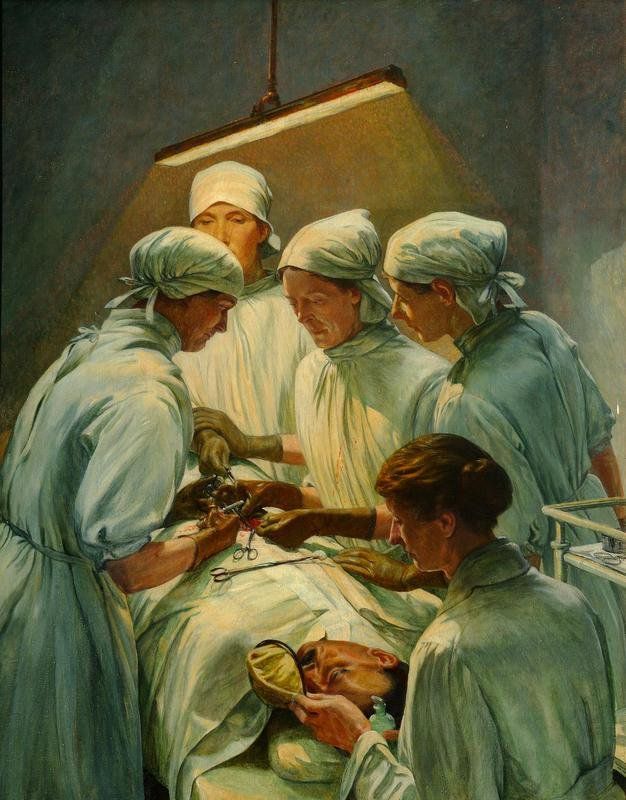
I was sent for an Operation. As the trolley was wheeled to Theatre, we passed glass cases on the walls, full of gleaming instruments. Perhaps they were museum pieces as a form of decoration, but I saw them as instruments of torture. The Theatre team had masked faces but joked like jolly clowns, or a magician at a children’s party. They drugged me with chloroform and the bright lights revolved sickeningly. Their voices squealed and splintered like breaking bottles and . . .
I woke up in the ward, with my leg in plaster of Paris, a red rubber tube snaking into a hole they’d drilled into my knee. On a pole stood a jar of yellow liquid at the other end of the tube. I’d been put on a penicillin drip, this original antibiotic being at last available in sufficient quantities for use in peacetime hospitals. This was 1949: a couple of years earlier, my infected knee would have been amputated. Still, the doctors were careful not to raise my mother’s hopes too high; and every Sunday evening Canon Griffiths asked his congregation at St Leonards Parish Church to pray for me.
Not long after, we all caught chicken-pox and the ward was quarantined, a prison within a prison. No parental visits and no presents, unless they were to be donated to the hospital afterwards. This was to keep in the contagion. Then it was May and our quarantine space extended to a shady balcony, where there was a bookshelf on wheels, full of tattered books left from a previous outbreak of chicken-pox.
Slowly I was learning to create my own freedom, with bravado as the main weapon. The food was disgusting but some of us boys (we were segregated) made a point of pretending to relish it and asking for more. In many little ways I learned to be cheeky with the nurses, to amuse but not infuriate them. I was less successful in this than my peers but you had to find your own technique and it helped pass the days.
We were still in quarantine on my seventh birthday, I assume because I suddenly found myself with two new books, mine to read until they were relegated to the quarantine collection. They were Alice in Wonderland and Wind in the Willows. I was enchanted by the first and bored by the second.
At one stage I was caught up in a measles outbreak and for this our quarantine was stricter and I was sent to an isolation hospital, St Helen’s, a ward with only five beds close together, like a boarding-school dormitory. The blinds were kept drawn and the lighting dim to prevent damage to our eyes. We had calamine lotion for our skin but my leg itched madly under its plaster. There was a heap of old comics to read and nothing else to do but argue amongst ourselves and, to the extent that our illnesses allowed, jump from bed to bed like fleas.
to be continued . . .
 a wayfarer’s notes
Nuns and nurses can be a lot of laughs all right. Ugh…
Not, of course, that I haven't met good ones. But my recent experiences with nurses have been mixed and as a kid, Catholic parochial school was kind of like boot camp without the physical fitness aspects and definitely no consultants in child psychology.
LikeLike
This is even better than the last!
LikeLike
[…] in January 1949, when penicillin saved my right leg from amputation above the knee—see “Incarcerated“. Medicine has moved a long way since then; so has our National Health […]
LikeLike