
In 1977 I won an essay competition, “Software in the Nineties” organised by Computer Weekly. The prize was presented by James Burke, a journalist and TV presenter specialising in the history of inventions. Afterwards I wrote to Stafford Beer, whose book Platform for Change I had recently read. Printed on paper of various colours, it included an account of his work for “cybernetic socialism” in Allende’s Chile. I wrote to thank him for inspiring me, and sent him cuttings of my essay and other stuff. He sent a kind hand-written reply from his cottage in a remote part of Wales. Time has washed it all away, so I only have unreliable memory as a guide. Did I predict anything like the World-Wide-Web? I certainly had the idea, in those days before mass networking of computer terminals, that we could all get linked up to exchange ideas and exercise democracy through computers, but the World-Wide-Web was far beyond my imagination: its range, its scope, its intimacy, its detail, its ubiquity . . .
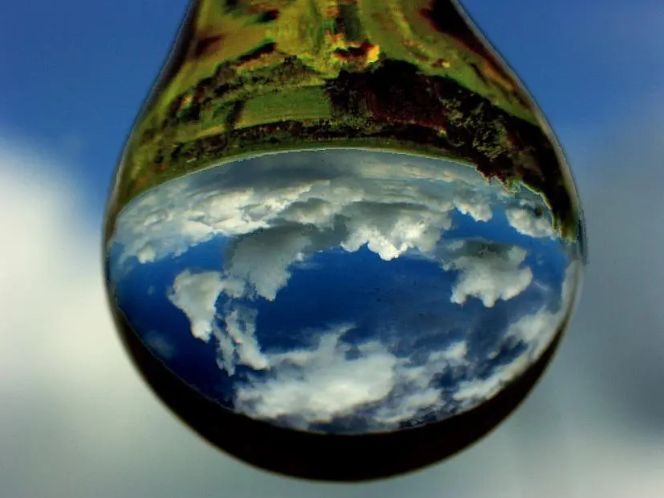
From my perspective the “blogosphere” represents the pinnacle of WWW in its capability to accelerate consciousness through sharing. I used to have a tiny walled garden at the back of my house, in which I’d spend endless hours in a hammock or on a rug, gazing at the sky. The wall provided privacy against human intruders, but sometimes I’d see an exotic bird or hedge-mouse or butterfly—a humming-bird hawk-moth was the most exciting example—which reminded me that my boundaries were totally porous to the world of nature, which could send these envoys from far away. Seeds could be wafted in by the wind, or excreted by passing birds: this is how mistletoe grows parasitically on trees. If I’d had a pond, fish would have arrived eventually, for birds such as herons sometimes unknowingly carry fish-spawn on their feet. The open sky was the most important part of my garden, being the source of sunshine, rain and the ever-changing pageant of clouds, in all their glory.
This blog is like that garden. It grows ornamental produce—words to entertain—and comestibles—words with a mission. Like flowers and cabbage leaves the produce attracts various creatures to come and browse. That’s why it’s called “As in Life”, for the virtual world resembles the real world. And it’s a great joy to visit other gardens too.
When the much-heralded catastrophe happens, and there’s no oil, & climatic chaos bites deep, and you and I have been recycled by Nature, these sturdy computers will still be linking humanity across the ether, even if their users have to hand-crank the generators, or use treadmills, to provide the necessary electricity.
 a wayfarer’s notes
maybe by then we`ll have implants that are hooked up in some clever way to the sphere so that we can communicate still…….or we have managed to upload our consciousness in such a way as the whole thing becomes mootish. i think it was issac asimov that said that any technology sufficiently advanced would be indistinguishable from magic…………….
Like
Hi Alistair, yes maybe you are right. But I prefer the idea of hand-cranking to power up carefully-preserved computers from the early 21st century. Kept in a kind of temple on a hill above risk of flood. Technicians who know how to cannibalise parts and keep them going will be revered like the shamans of their village. TFT monitors with most of their pixels still working will be offered as dowries.In my definition, it’s already magic, but nowhere near as magic as nature.
Like
and what a lovely garden you have.the age you are talking abou, do you think we need computers at all? i mean computers of this age. a chip will be transplanted to newbornes with which they might communicate with people and animals all over, may be with your hummingbird too.
Like
Well, yes, this is what Alistair is proposing and that I think is the difference between you young ones and me. At my age, I don’t want any more technology, I think we have enough. I want a cellphone without any colour screen and such features, I want a computer which stays as it is for ever more. To be honest, I regret the passing of steam trains and typewriters and carbon paper. I prefer radio to television, fountain pens to ball points etc etc. One day you’ll be just as nostalgic I expect, looking back to the Nineties, just as I remember the late Forties.
Like
about high-tech gadgets, i might disagree with you.but me too prefer radio ovr television, fountain pens to ball points and cellphone without any colour screen.you can easily gusee i am behind my age. i should have borne in the 40s.
Like
Before I read any comments, I want to say this.(besides the fact that you are one fine writer, fully expressive and very much lively)I don’t think like that, about ‘when I am gone’ and what will be then, drawn from now. I think that ‘if’ I am going to be gone, it is into then from here and it will be a vast change and different, totally different in the best ways, humanly speaking, from this place/way of being. This for me is not something new or contrived, but natural, natural above what we ‘here’ call ‘natural’. You know what I mean.And now, Yves, having read the comments, let me add, that I have been having some discussions on ‘projecting thoughts into life’, and it may well be that what you deeply think will be, will actually be, perhaps all options are open to us to ‘want’ here before we go there?
Like
Well, Jim, it’s not that I have decided that there is no after-life into which the soul may migrate. However I’m not convinced about the soul detaching itself from body & having independent life either. There clearly is some way in which thoughts project into life, as you say, but many New Age thinkers assume there are no limitations. They believe that “faith can move mountains” but no concrete example of this happening has ever been attested. Indeed, the prophet supposedly said “If the mountain will not come to Mohamet, then Mohamet will go to the mountain.”I think a lot of the new age thinking about “the law of attraction” and “creating our own reality” is a way to deny our vulnerability to all the forces of Nature—including death.It is certainly true that negative thoughts have a way of becoming self-fulfilling prophecies, but it does not follow that “affirmations” coming out of great faith can give us what we desire.Yet in my own life I seem to trust in Providence, like the old-time pilgrims, and am never let down. My beliefs are at the visceral and not the intellectual level.
Like
Well, Jim, it’s not that I have decided that there is no after-life into which the soul may migrate. However I’m not convinced about the soul detaching itself from body & having independent life either. There clearly is some way in which thoughts project into life, as you say, but many New Age thinkers assume there are no limitations. They believe that “faith can move mountains” but no concrete example of this happening has ever been attested. Indeed, the prophet supposedly said “If the mountain will not come to Mohamet, then Mohamet will go to the mountain.”I think a lot of the new age thinking about “the law of attraction” and “creating our own reality” is a way to deny our vulnerability to all the forces of Nature—including death.It is certainly true that negative thoughts have a way of becoming self-fulfilling prophecies, but it does not follow that “affirmations” coming out of great faith can give us what we desire.Yet in my own life I seem to trust in Providence, like the old-time pilgrims, and am never let down. My beliefs are at the visceral and not the intellectual level.
Like
Well, Jim, it’s not that I have decided that there is no after-life into which the soul may migrate. However I’m not convinced about the soul detaching itself from body & having independent life either. There clearly is some way in which thoughts project into life, as you say, but many New Age thinkers assume there are no limitations. They believe that “faith can move mountains” but no concrete example of this happening has ever been attested. Indeed, the prophet supposedly said “If the mountain will not come to Mohamet, then Mohamet will go to the mountain.”I think a lot of the new age thinking about “the law of attraction” and “creating our own reality” is a way to deny our vulnerability to all the forces of Nature—including death.It is certainly true that negative thoughts have a way of becoming self-fulfilling prophecies, but it does not follow that “affirmations” coming out of great faith can give us what we desire.Yet in my own life I seem to trust in Providence, like the old-time pilgrims, and am never let down. My beliefs are at the visceral and not the intellectual level.
Like
yves,Wonderfully crafted post and interesting comments. The challenge you pose to my thinking and expanding is very greatly appreciated.You say, “This blog is like that garden. It grows ornamental produce—words to entertain—and comestibles—words with a mission. Like flowers and cabbage leaves the produce attracts various creatures to come and browse. That’s why it’s called “As in Life”, for the virtual world resembles the real world. And it’s a great joy to visit other gardens too.”Poetic prose representing truth. If we get to choose the type of creature we are in your garden, can I be a ladybug or butterfly? As you can see, I also love fun and levity. Those of us who ponder and think and explore those deeper places of contemplation are also challenged to maintain balance, the balance that makes me scream the word Yay because it is a happy word, and to imagine myself as a butterfly fluttering through your blog garden, and to sing songs of the heart, and to dream dreams, look at the white fluffy clouds for the shapes they form, and to just enjoy the beauty of life for what is in this moment.Peaceful blessings of joy and balance and lightheartedness be with you.