
 In the Middle Ages (I used to study Medieval History, so I know) the religious and secular realms—Church and State—would either be at war with one another or in some kind of alliance, as in “The Holy Roman Empire”, which was neither holy nor Roman. In matters secular, foreign policy and internal laws were backed up by force of arms. In matters spiritual, excommunication inspired the fear of eternal Hell, whilst heresy could result in a painful death.
When we say the Middle Ages, it goes without saying that we’re talking of Europe. Other realms of the world—the Chinese, the Incas, the Maya and so on—had their own dynasties, while countless more lived tribally without written records. I remind myself of this, even though at school there was scant acknowledgement of the eurocentric nature of our studies. All the same, I’m grateful for the history I learned, for it helps throw into perspective the triumphs and massacres and obsessions of today. They have all happened before. Though when I say that, it makes me pause, for history doesn’t always repeat itself, and it may be going somewhere.
First there was language, then there was writing, then there was printing, now there is the internet. Without writing there would have been no Christianity. Without printing, there would have been no possibility for congregations, as opposed to priests, to read the Bible for themselves, which in any case was an offence punishable by burning at the stake.
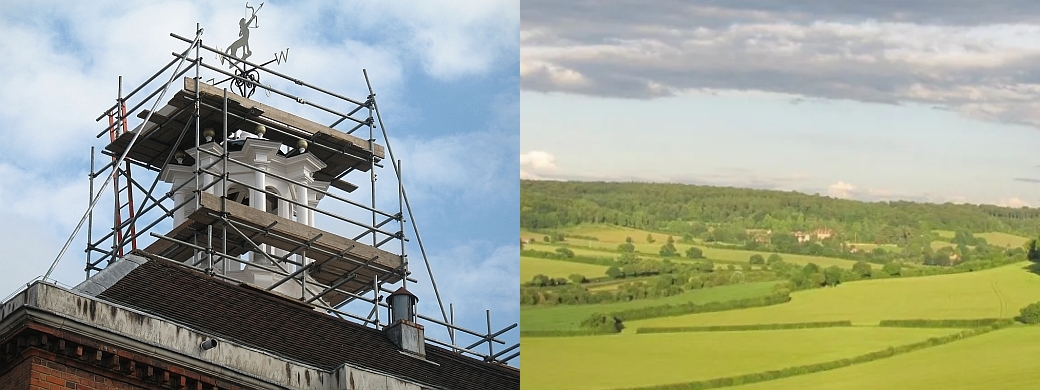
My walks often take me to the Martyrs’ Memorial in Amersham (pictured) which commemorates this practice, and if you follow the link to the full inscription, you’ll see that the burnings took place less than 500 years ago, in the time of Shakespeare’s grandparents. Meanwhile in Germany, Martin Luther nailed his 95 theses to the church door at Wittenburg, and got excommunicated. In Italy, Michelangelo was painting the ceiling of the Sistine Chapel in a commission undertaken for the Pope.
Today things are equally in ferment. I could talk of ecology and our impending doom, or politics and our impending doom, or economics and our impending doom. But in this, the ninety-fourth thesis that I’ve nailed to the door of this blog, I want to speak about spiritual things instead.
Martin Luther’s outrage was at the sale of indulgences by priests: pieces of paper which got you a place in heaven. I don’t think the practice has actually stopped yet, for I’ve seen a framed certificate, signed by Pope Paul VI*, which commends my late ex-father-in-law’s work for the church, and recommends him for a place in heaven. I could imagine the small print at the bottom: “Please bring this document with you when you arrive at the Pearly Gates, together with proof of identity.”
My own “outrage” is at something else, but space has run out. So I’ll beg your “indulgence” and hope you’ll wait for Thesis no. 95.
[…] The ground was waterlogged and the fields were desolate near Amersham Old Town, which keeps a memorial to its Protestant martyrs burned at the stake in the sixteenth century, for committing the heresy […]