
 Who was she?
Although the history of her formal canonization is complicated, regional calendars of the Catholic Church have listed her as a saint for centuries. On 10 May 2012, Pope Benedict XVI extended the liturgical cult of Hildegard to the entire Catholic Church in a process known as “equivalent canonization”.
I’ll try and read the whole book before adding more, but here’s the beginning of the Introduction:
A Time of Turmoil
Hildegard was born into a world in which everyone knew their place. There were those who ruled and fought, the kings, dukes, barons and their knights; those who prayed, the clergy, monks and nuns, and the mass of ordinary people who worked. Above all was God who had ordained this three-fold structure of society, and who had an interest in its maintenance. It would be another hundred years before the great movements for evangelical poverty swept across Western Europe and turned young noblemen into beggars. The Rule of St Benedict allowed for greater social equality, and the Cistercians, in a renewal of the primitive Benedictine Rule, engaged in manual labour, but on the whole religious communities mirrored wider social conventions. Hildegard and Jutta would have had a personal servant in their cell on the Disibodenberg, and in their Rupertsberg convent the aristocratic and high-born nuns were kept socially distinct from the low-born women who would have done much of the manual work in the community. Howev.er stable the social hierarchy may have seemed, the political world was more uncertain. Although the danger of outside attack which had threatened the German Lands for centuries, with the Vikings to the north, the Saracens to the south and the Magyars to the east, had waned by the eleventh century, internally the country was torn by strife. Since the time of the great ninth-century emperor, Charlemagne, Germany had been ruled by semi-independent dukes, mar-graves and counts, often at war with one another and with the king. The Church was closely tied into the feudal system, its prelates receiving land and titles from secular rulers to whom they owed allegiance. Bishops were soldiers as well as clerics and both bishops and popes had their own armies which they would use to defend their titles and property, sometimes taking part in the fighting themselves.
There’ll be no point in continuing with this account of an extraordinary woman in her own words, unless some of you, my subscribed readers, add comment to indicate your interest.
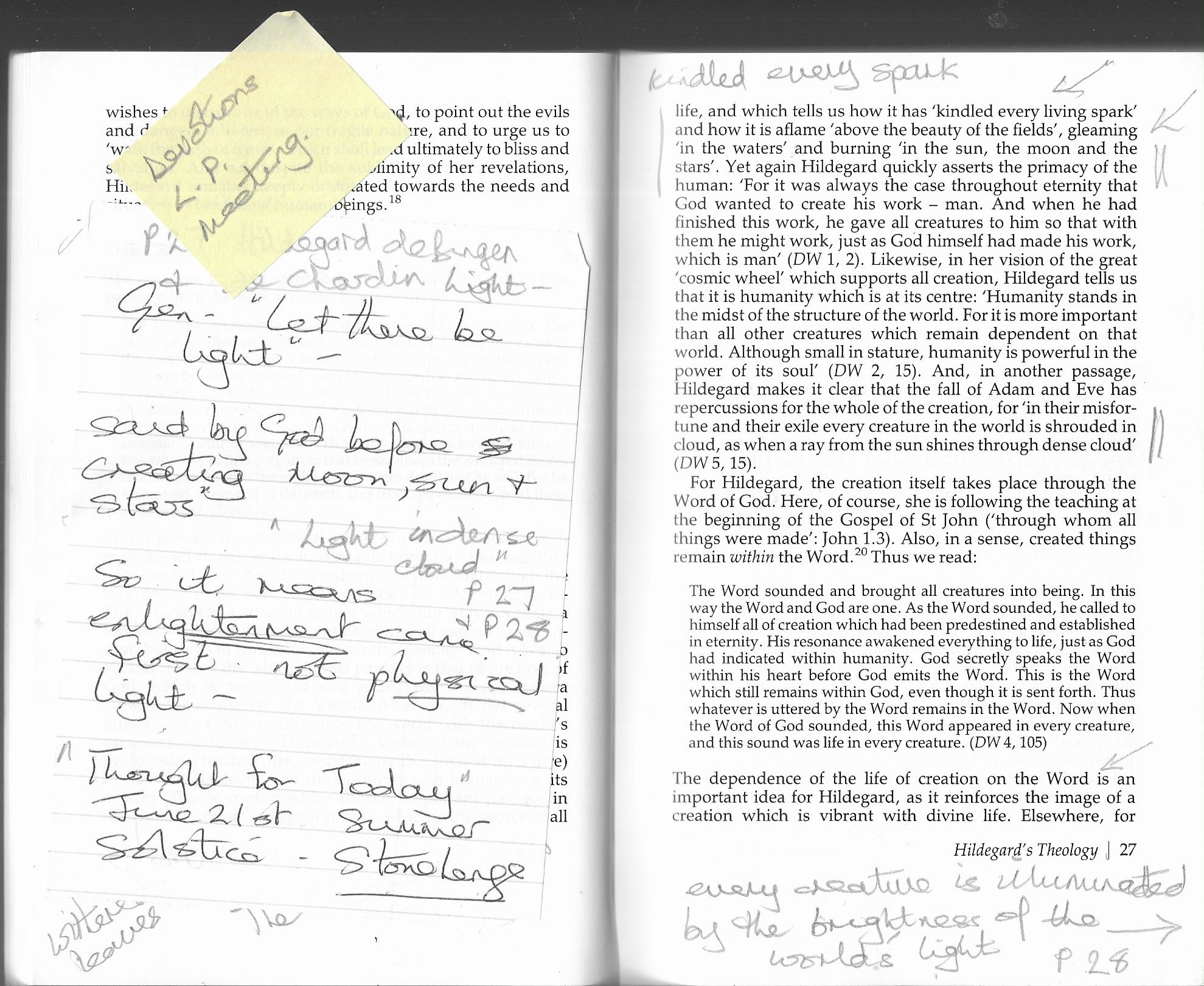
Meanwhile, here’s a scan of some comments by previous readers:
PS, on the topic of Popes, see also this post: The Pope and the Koran
 a wayfarer’s notes
Set me down as interested! Hearing her music on Radio3 is always a joy and a thrill… so much you can do with a single melody line. This must be the most ancient music I ever hear. But I gather there’s a lot more to Hildegard than music. Best wishes and Happy Advent, Michael
LikeLike
So glad you’re a potential fan. It gets better, can’t wait to add the next instalment. I wish I could listen to Radio 3 sometimes. The bedroom is tuned to Radio 2 for the 7 o’clock news, which I try to ignore. Downstairs is Karleen’s domain with Greatest Hits Radio on Alexa for Ken Bruce & Popmaster, or you can ask for any music you like. I’ve got a CD of Feather on the Breath of God, which is very pure musically as you say but I just looked up the wonderful lyrics in English here https://genius.com/Patricia-leigh-feather-on-the-breath-of-god-lyrics Over to you, Michael, and thanks
LikeLike