
This post was rescued from perpetual-lab.blogspot.com as made available on the Internet Archive, 13 years after it was written

What is this life, if full of care,
We have no time to stand and stare? (W. H Davies, “Leisure”.)
Go to the ant, thou sluggard. Consider her ways and be wise. (Proverbs 6:6)
I’ve gone to the ant, considered her ways for the last fifty years, and no longer think her a worthy role model. Sluggardry suits me better now. I’d be the first to admit that I’ve become unfitted for gainful employment. Others might simply call me an idler. So when have I denied that? Check my profile. “Occupation: idler”, it shamelessly admits. “Many a true word is spoken in jest”: that’s eight true words for a start.
Out of the strong came forth sweetness. (Judges 14:14)
Who am I to judge, but I say “Out of the fool came forth wisdom.”
A worthy fool! Motley’s the only wear. (Jacques in As You Like It)
The fool in Shakespeare seems to be someone who says the first thing that comes into his head, and yet he’s a holy fool. That’s my role model! He’s treasonously irreverent to the King, but safe from beheading, for he’s the only one who speaks true. The others are fawning flatterers, whose advice is worthless.
Gainful employment does come knocking on my door occasionally, unbidden: an hour here, a day there. It astonishes me that I can still do it. Unacknowledged brain cells seem to be waiting there for something to do, like gut flora. I call myself an idler but it’s aspirational. I cannot see myself like the proverbial Mexican squatting under a sombrero. I don’t play the guitar or even the lute, more’s the pity. Now that I have the chance I wanted for most of my life, I’ll do anything to avoid sitting down to write. Oh, the displacement activities!—fixing catches on doors so that they close properly; making nice labels for CD cases; growing pot plants from seed for which there’s no room in the house. Is this idling? The other day, when I started to think seriously about this idling concept, I nearly worked my fingers to the bone, as my mother used to say when playing the harassed housewife. I realised that if I was going to spend my day lolling, any untidiness within my line of sight would disturb the perfect tranquillity I had in mind, so I performed a veritable spring-cleaning in several rooms, by which time my window of lolling-opportunity had run out.
Superficially, the concept of “saving the planet” seems to demand more ants and fewer sluggards for its proper implementation. Won’t everyone have to work harder for less pay and so on, so that together we can solve the debt crisis? Forgive me for oversimplifying but this site is not a place for incisive political and economic commentary. Let it rather be a haven of foolery, a simulacrum of honest toil, an excavation for fool’s gold: not the real thing but a catalyst to make someone see differently without knowing it. That is my kind of truth, not the rational-scientific kind, for which I defer to Bryan M. White and Steve Law (see below for links to their sites).
So, I propose, idleness is the only way to evade the frenzy of production and consumption which have brought this world to its current state. They say we’ve seen nothing yet. So, if I learn the graceful art of idleness, and embrace foolery while I’m at it, I’ll benefit the planet more surely than any action could possibly achieve. Proudly declaring my manifesto, I scotch the guilty feeling that I should do something. Then I start throwing all my energies into the most challenging pastime known to man: what the Italians call dolce far niente. Or if not sweet nothing, as little as possible, consistent with my temperament, which constantly seeks to prove and improve. As I said, my profession of idler is aspirational. It cannot be achieved in a day. That would be too much trouble.

My fool’s truth is to think no thought, till one arises unbidden from I know not where: a still small voice.
And after the earthquake a fire; but the LORD was not in the fire: and after the fire a still small voice. (I Kings, 19:12)
I have no religion, but I aspire to be the servant of that still small voice, and to listen to the truth in every jest. To justify my cowardice, for instance.
The better part of valour is discretion: in the which better part I have saved my life. (Falstaff, in Henry IV Part I, V:iv.)
The quotation has been so wrested from its context that we forget the jest. Falstaff’s “discretion” was a euphemism for cowardice. Instead of fighting loyally for his friend Prince Hal, he played dead on the battlefield the moment danger arose.
Me, I’m a shameless coward. Instance (1): I hate to see dog-owners let their animals foul the children’s playground. Sometimes I see them from my study window. I did challenge one once, but he was hobbling as if his leg was injured. Even so, I made sure to be out of his immediate reach, in case he took my reproach badly. Instance (2): I hate it when cyclists miss pedestrians by inches on the sidewalk—a place where technically they are not allowed to ride. The only one I scolded was about ten, with a timid face. He apologized politely, but said the police had visited the school and advised children to ride on the sidewalk for their own safety. I was left wondering if pedestrian safety had been mentioned at all.
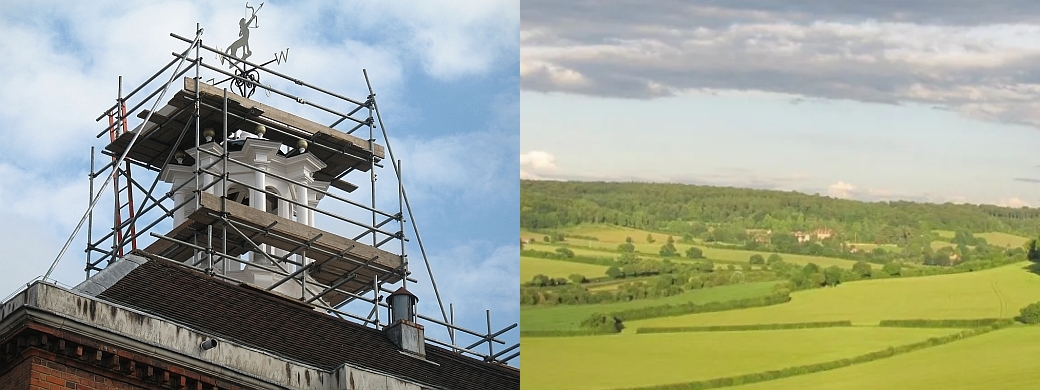
What reminded me of cowardice was an incident in the street, the other side of the playground, which my study window overlooks (see snapshot alongside). I saw three police there the other day, scanning the ground for clues, but I didn’t know why. Now they’ve sent a leaflet through the letter-box appealing for witnesses. A boy aged 16 had challenged a woman with an out-of-control pit-bull terrier. By way of response, her male companion broke the boy’s jaw with a metal bar. I’m sorry he had to learn such a harsh lesson. If he’s more careful, he’ll outlive me by many years, and tell his children that discretion is the better part of valour. It’s the better part of cowardice too.
Darev2005: My mind, in it’s infinitely juvenile and childlike way, immediately grasped on the phrase “growing pot plants from seed” and ran around the room with it clutched joyfully in my jaws. The adult portion of my psyche informed me that you were probably referring to “potted plants” as we would say over here and not marijuana. But then again, that might explain your propensity for random idleness and those sparks of creativity that seem so profound.
Vincent: I have already conceded to the American language by saying “sidewalk” when a British reader would understand what I meant by “pavement”. So I shall leave the original text as “pot plants” and let the reader draw his or her conclusions ad libitum. As for psychedelia, herbal and laboratory-prepared, I have been clean since 1972. But who knows how long it might take before the flashbacks stop?
Gina: Delightful reading, including the two comments!
John Myste: When I first read about pre-historic hunters and gatherers it was with delight I learned they ‘worked’ for only an hour or two a day. Since I’m far too lazy to write much or spend a lot of time considering the downside of eating only what can be easily obtained (or could once have been), I’ll just say that the original agricultural revolution started all this trouble in the first place. How nice would it be that if you found your home to be getting messier than you liked you could just plan on moving somewhere else tomorrow? In the meanwhile there’d be time to make a daisy chain or compose a new tune on the flute you’d just finished carving. I’m also imagining pot plants would have been among the legion of flora fit for picking.I too feel very sorry for that young boy. I tend to think that in that long ago age people were kinder to one another because they were so few and the predators ferocious.
I feel I’ve been typecast as “scientist” in the cast of characters who populate your world. I hardly feel qualified for the role. What I don’t know about science could fill a book, several volumes even, I’m sure. I defer to Mr. Law, who I believe is actually a professional in these matters. As for me, I’m probably a more expert idler that you are. Not that I like to brag about that 😉
Ah, the flashbacks. Wonderful little creatures, aren’t they? I wouldn’t be at all surprised if a study were taken of all of the worlds greatest writers and thinkers and discover that at least 99% of them “indulged” at one time or another. Somewhat helpful in allowing you to step outside mundane thinking and explore the cosmos freely.
Bryan, I never meant to categorize you as a scientist. And I know that I don’t like to be categorized in certain ways, so I must be careful here. I see you, from our written wrangles, as one who is prepared to accept definitions of reality and truth which come from scientists (which, as you may infer, I’m not).This is a bigger topic than there is space for here, however. I just want to ask you if you have by any chance read Straw Dogs by John Gray. It will (God willing!) be the subject of my next.Your casually tossed-out challenge–that you are a more expert idler than I–sounds like an invitation to some kind of contest, which I must gracefully decline. First, because I believe you. I’m not at all good at idling. That’s why it attracts me so much.Second, because your boast is a cunning trick. If I take you up and propose a contest in idling skills, to be judged by a poll of our mutual readers, I’ll instantly lose. A true idler ignores the boasts and challenges of other men. He merely shrugs and murmurs, “Sure you are, Bryan. I believe you.”
John, thanks for your eloquent tribute.
Rev, I was thinking that in truth, those wonderful little creatures have deserted me. But they’re alive and wriggling. You just have to know where to look. With me it’s in hypnagogia and, to a lesser extent, hypnopompia.
Susan, the information you convey in your comment leads me to suspect you’ve read John Gray’s Straw Dogs, or at least have encountered some of the same sources. His book will fuel the inspiration for my next, assuming the inspiration solidifies as hoped.
I’m glad you enjoyed, Gina! Yes, it’s comments which make blogging so superior to other genres of writing, yes?
There are two concepts here – survival, or “Glory”. Long discussion, i guess.
Yes, Davoh, it could be a long discussion. Me, I prefer glory. But there’s a difference here. To get badly beaten and possibly killed by some local crazy would be ignominy, not glory. If I am to fight to the death and achieve immortal fame in the process, it will have to be with weapons I know how to use, making a worthy stand against a worthy opponent. Alternatively I’ll use my bare hands against an oafish thug to protect someone special against injustice.So thanks Davoh for reminding me of the lion within this pathetically-bleating lamb’s clothing—one I hope will never have to reveal itself in anger.
Life or ignominy. Quite. To die conquering Persia is one thing. To get rough up trying to stop two drunks fighting is another entirely. No one gives you medals for getting thumped by the local hardcase. We don’t even give them to ourselves.I’m 6’2, still youngish and 20 years in the classroom have given me the ability to look very nasty at will, but I haven’t been put in that position for a long time. I don’t know what I would do and I hope I never have to find out. Put me provisionally with the cowarsd pending further research.
Ah, great. Just as soon as I go look those words up, I’ll be back!And you best not have made those up!
Your multi-coloured pegs are inspirational and aspirational. It’s surprising how colourful a drab street scene can become with a little tomfoolery and idleness. We all need to experience a bit of both before the next spring clean.
Ah ZACL, yes, the rituals in the backyard with clothes-pegs, on my own little patch of this spinning Earth, in the solar system, part of the Milky Way, hanging out the multi-coloured clothes with multi-coloured pegs is a sacrament, a holy mass, to elevate the soul. For the whole Universe is a communion wafer for us to devour. You and I are part of it. We are part of the beauty. The great secret is ours to grasp and possess: that separation is an illusion.To be a human animal is to feel most of the time like Robinson Crusoe on his desert island, locked in a kind of semi-paranoia about the world. Yet when we can contemplate – it happens naturally with those clothes on the line, hanging them out, taking them down again – the separation dissolves like morning mist, just for a while. And eternity is visible.
-
Rev, I have a confession to make. Those words were semi-made up. The words hypnopompic and hypnagogic are both recorded in the Oxford English Dictionary, but not the noun forms hypnopompia or hypnagogia.
-
CIngram, I’m glad for your support in this matter. However, we don’t know how we would actually behave in these situations that we imagine. Sometimes our anger might just take over.I read something very interesting and counter-intuitive. A survey found that in general, men are more likely to intervene (to help or defend someone) when there is no one else around to watch, even though this means putting themselves more at risk, if it turns nasty.Which shows that embarrassment is a major inhibitor. I think this factoid came up when it was reported that someone who fell in the street in Tokyo was merely stepped over by thousands of people before anyone checked what was the matter.
-
No, indeed, we don’t know how we will react when faced with the need to act. In fact I’ve more or less stopped worrying about it as observation suggests to me that when called upon in such a situation, you act without much conscious thought. You may save the child from the fire, the pretty girl from the thug, or you might turn and run, but I don’t think you will do much agonizing on the spot. Afterwards, perhaps, but at the time I hope that instinct will take over, for good or bad.
I always appreciate it when writers take time to explain not just the “how,” but the “why” behind ideas. You did both beautifully here. Visit us Teknik Informatika