
Restored from a lost post published 10th September 2011
The story so far:
On 29th July—seven weeks ago—I posted a piece about a sense of mission.
It finished with these words:
Disputatious as ever, I question the reasonableness of reasonableness.
We make ourselves blind to the fact that our lives are not actually ruled by reason. They are ruled by pursuing whatever makes us feel all right. We then apply reason to tell ourselves that what makes us feel all right is “the truth”.
Within the comments to that post, a mission or project was mentioned, which I said would take me away from blogging to some extent, in order to write something bigger: a book. Putting it in context, I’ve probably been talking this way for the last fifty years. The first hints of a possible collaboration emerged. I asked John Myste if he wanted to be more intimately involved but he “wasn’t sure about the intimacy”. None of us is. It’s the human condition. (He might also have recalled I was educated in a British boys’ boarding school. This might have given him some erroneous ideas about the implications.)
In a comment to the following post, Life-Illusion, Bryan M. White took the risk of intimacy and made an offer which I did not refuse:
If you’re ever interested in making this project of yours a joint endeavour, you know like a point/counter-point type of thing, I’d be more than happy to provide the counter-point.
To facilitate our collaboration, we started a private blog, initially called I’m a Stranger in Paradox with the following subtitle, taken from the lyrics to a well-known song:
Won’t you answer the fervent prayer / Of a stranger in paradise / Don’t send me in dark despair / From all that I hunger for / But open your angel’s arms / To the stranger in paradise / And tell him / That he need be / A stranger no more
This lasted for three weeks in August, with each of us writing short essays as blog posts, then discussing them in comments. It was a stimulating rivalry, but our mutual misunderstanding was often frustrating. Bryan had the additional frustration of not knowing where I wanted to go and what I expected of him. Additional? I didn’t know how to answer those questions either, but it didn’t cause me frustration, merely guilt. So we fell out and abandoned the thing. Then, as one does with a failing retail enterprise, I reopened the site under a new name: The Possible Phoenix, subtitled “The ashes are not yet cold. Perhaps we shall rise again”. So it rose again on the third day, to demonstrate continued life. Since then, for the last week, it has been quiet.
Our discussions on the private blog have been mainly on two topics: Reason, and Reality. Our views weren’t quite unbridgeable, but most of our effort was focused on our differences, just like the wider world, where differences lead to a vast expense of conflict, both diplomatic and blood-shedding.
Now read on:
The other day I had an idea so simple that I didn’t even consider it worth an essay on its own. I had nibbled around its edges in our private blog, but never seen the simplicity. That place was wonderful all the same: a kind of laboratory in which Bryan and I had identified the ingredients and even mixed them, somewhat dangerously. All we lacked was a simple detonator to ignite the ideas with a suitably big explosion.
(Note to monitoring Security Services: whilst this sounds like a secret bomb factory, it’s purely metaphorical. And I deny any incitement to acts of violence. I’ll explain in full detail when you arrest me.)
In fact a fuse had been laid, in a blog post I wrote five years ago, The nature of Spirit. I had put a link to an interview with David Abram titled “The Ecology of Magic”. Abram, who was once the house magician at Alice’s Restaurant, became interested in traditional forms of magic as practised by shamans for all kinds of healing purposes. So I re-read the interview the other day and was struck by something:
Everyone is hungry for magic!
I remember the shouts of joy and lit-up faces when David Blaine performed astonishing tricks in the streets of US cities. I know the TV programmes were edited to the point where you could call them rigged, but I’m talking about the faces of his audience, not the tricks. I did a Balducci levitation once in a bookshop, prompted by a David Blaine book they had on display. The shop-owner was awed. Then he wanted to talk about it; but I bid him a swift farewell, leaving him to spend the rest of his life wondering.
But now, the fuse has been lit, thanks to David Abram providing the flame. It has fizzed all the way to the explosive mixture that Bryan and I synthesized, a mixture sitting stolid and lumpy, sulking in a corner of Blogger where no one else goes. I realized that:
All religion is magic!
Just four words. No need to write a book about it. Not just religion, but all the irrational things we are so influenced by, or even addicted to. They are all impure forms of magic. Not that there is any pure magic, that I know of.
Belief is magic. Look at the placebo effect, self-belief and its role in achievement, alternative therapies, rituals, prayers. The thing about belief of course is that you have to believe in it. It’s not so effective if you say, “I know it can’t be true but I want to believe it.”
But magic isn’t just belief. (Or shall I say belief is not just belief?) Magic is a transformation that happens within you.
I must have heard a thousand times someone saying, “If it was good enough for my forefathers, and their forefathers before them, it must be good enough for me”—though I suspect that “someone” was mostly me! So what happened? Why is so much of the magic that sustained our forefathers under attack? I have a theory for this. To simplify the argument let us talk about the predominant form of magic in our culture: religion, though the argument does apply equally to other forms of magic.
In past centuries, religion and reason were not separate in the common perception. Religion and kingship (the main form of government) were inextricably linked. The king was divinely ordained to rule. Even to this day the British sovereign is crowned in a special church service. Religion and philosophy even were closely bound together. Ever since St Paul there had been a Platonic element in Christianity, and then in the Middle Ages St Thomas Aquinas reconciled Roman Catholic doctrine with Aristotle.
But scientific knowledge, as formulated by a series of astronomers, then Isaac Newton and finally Darwin, widened a crack that had always been there. Nevertheless, despite millennia of scepticism:
Religion has always striven to show itself reasonable.
It has been most reluctant to relinquish that prestigious territory, even though congregations are educated now. They can think for themselves.
If you simply admit that religion is magic and that it’s part of human nature to hunger for magic, there is no problem any more. Magic is an illusion that works (unless you see through it). To call it illusion obviously spoils the illusion. If you stop trying to claim that it’s reasonable and consistent; or stop attacking it for not being so; then we can live with one another peaceably.
Apart from the attacking and defending, nothing is wrong.
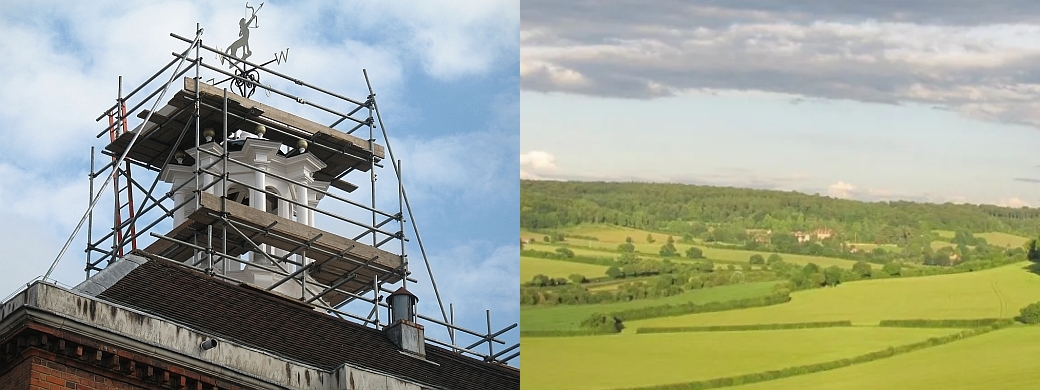
My photo shows the Centaur weathervane, atop our Guildhall, undergoing I know not what repairs. I took the photo the other day, for comparison with this site’s emblem, which is based on a photo taken on January 12th, 2007. I like it best when they put the scaffolding up (notice that it’s still the same ladder). It symbolizes work in progress. The Centaur reminds us that we are animals. The N E S W of the weathervane represents Wayfaring. The whole thing represents my spot on the earth’s surface, this town in Buckinghamshire, England, which I call Wye Vale, to confound the probing electronics of search engines.
I’ll try and restore the broken links