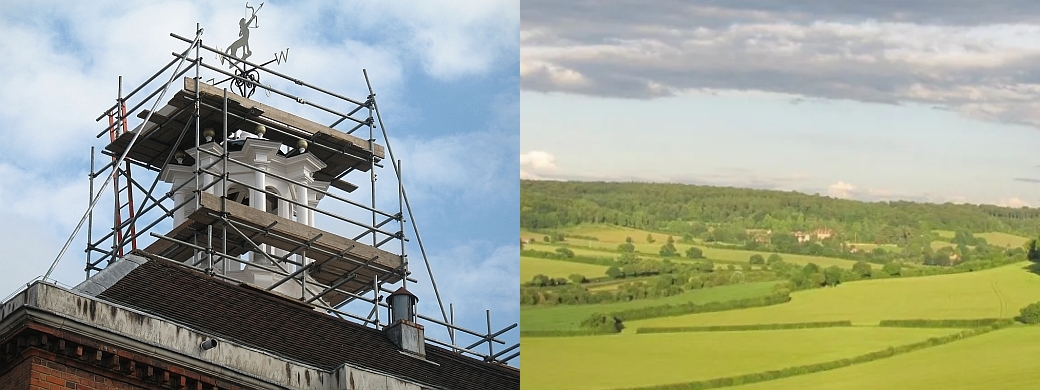


previously published on 1st December ’22 after a lunch in the ancient Cookham pub Bel and the Dragon, see pics below
After I graduated in 1963, I supported myself with various jobs, including selling ice cream in Butlins in Clacton that summer.
When I got married, (to Gail as mentioned in the above post) I needed a proper job. We were living in Birmingham, where we’d both been students at the University.
I was taken on as as teacher for a small “remedial” class at Winson Green primary school, my only qualification being an Honours degree in French and Italian. They were desperate because their proper teacher couldn’t stand it any more, It was a tiny room for 12 kids and the teacher. Remedial if the teacher could manage it but basically a dump for the children who disrupted other classes. I managed 2½ terms then resigned without sticking it out long enough to get my summer holiday’s pay. Everyone said computers are the up-and-coming thing. Tried IBM but they said you need A-level maths, which I’d failed. But there was ICT, British rival to IBM. I applied, told to report to see John F.G. Percival at their office in Putney Bridge House. He was an ex-Brigadier, totally charming and a man of instant decision. Took me on straight off as a Technical Advisor. My career developed in similar fashion to that of Brendan Supple, who tells his story here:
I qualified with a degree in electrical engineering in 1963. Engineers were in short supply that year, so I was offered a wide array of jobs from a sound engineer with the BBC Third Programme — which fitted with my interest in music — to selling Trident aircraft. I was seduced by an offer from ICT to introduce me to computers in four years time — if I behaved myself and ‘if computers happened’.
Although I had specialised in electronics as an engineering student, I had not yet seen a computer at that time; a slide rule was the nearest to one I had ever got. I arrived at ICT’s training school in Cookham, Berkshire to discover that computers had happened. I was one of a select batch of 13 graduates for spearheading the delivery of a batch of 100 computers that ICT had just sourced from Ferranti. The system would be known as the ICT 1500. We spent 15 weeks in Moor Hall on Course SS107 in what felt like a continuation of university, but with pay.
We learned the basics of systems analysis, systems design and accounting. We scratched the surface of programming, where our instructor* never quite managed to keep the requisite one day ahead of us. It must have been appalling trying to cope with such a group of smart-assed know-it-alls. At the end of the course I was allocated to ICT’s ‘electricity region’ with clients such as the London Electricity Board and the Electricity Council. The company ran 13 ‘regions’ in Britain and each of them received a newcomer from SS107.


I worked with systems analysts who had been doing their job for many years and who found it hard to be upstaged by this whipper-snapper. I learned much from such people and learned to appreciate their experience and wisdom. Computers brought flexibility and speed to methods which had been constrained by the punch card. Programs were written in machine code and we were excited by the power of assembler. Languages like Cobol were still in the future.
The first 8 weeks of my introdcutory course in Summer 1963 was on tabulators, collators, sorters and card readers. The last 4 were on computers (“Although I don’t know why we’re teaching you this” our instructor said; “Our experts have worked out that 8 computers will look after all the needs of the UK”) We trained on the home-grown 1300, that had sterling currency functions (multiply £23/14/6 by 23) as well as decimal functions. You could send the machine into a hardware loop by multiplying sterling by sterling!.
This is most interesting, thank you. It’s a sign of how fast the computer industry was moving in the earlier 60s.
We too started on tabulators, collators, sorters and card readers. The 1300 had dropped out because the new 1900 series was being strongly pushed against the older IBM 360. Instead of the 1300, we were trained in the use of the 1004. https://rochereau.wordpress.com/2010/01/26/night-and-day/ gives an account of this machine but also how I was persuaded to join ICT.
My job in the field was Technical Adviser, meaning support to the salesman. I was good at this job, and was lucky to use it in the Seventies and Eighties, but what they needed me for was programming in PLAN, for which I was sent to a 2-week course at Bradenham Manor, a stately home acquired like Moor Hall for training courses.
If you are interested to chat by email, just click on the “Drop me a line …” link at the top of the post.
Best wishes, Vincent