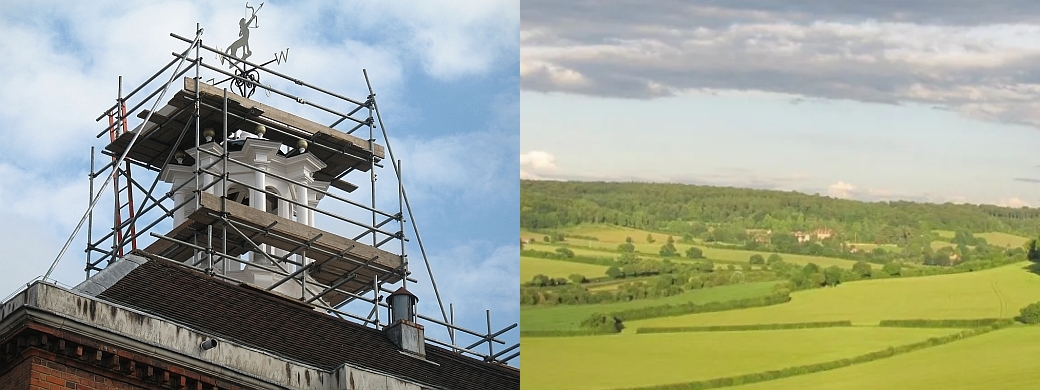

By day, my bedroom window is transformed into a viewing platform to watch the renascence of my Sun-dial Factory across the road. On April 29th 2013, I wrote a piece beginning:
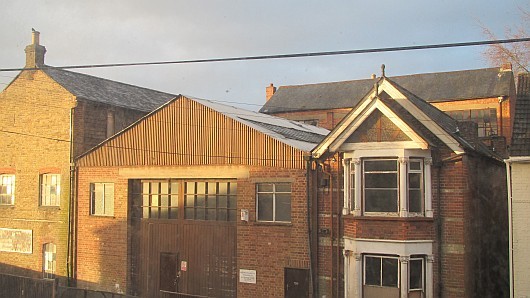
I see things as imbued with meaning, like fragments written in a foreign language. Sometimes I can decipher them; sometimes even put them in English. For instance, from my bedroom window I can see the Victorian factory opposite. I wake as the early sun catches its gable ends. As on a sun-dial, it moves rapidly down the walls . . .
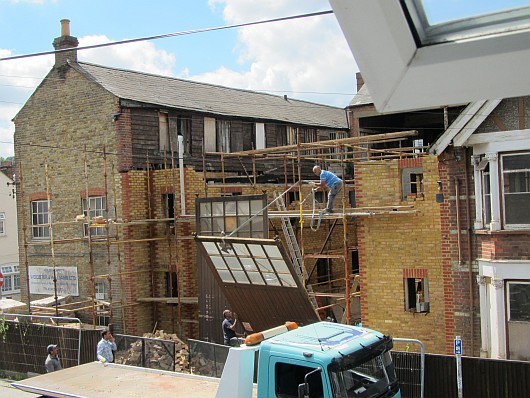
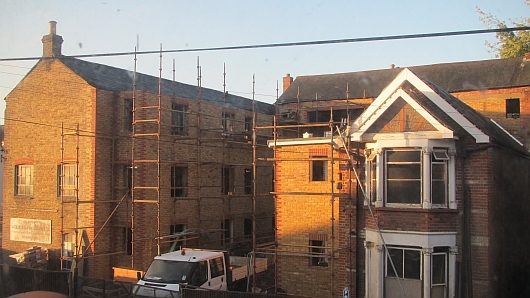
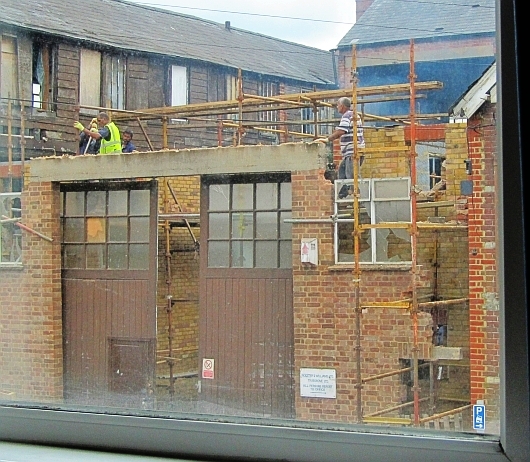
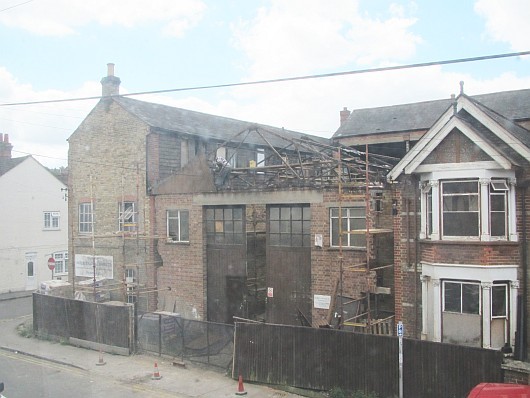
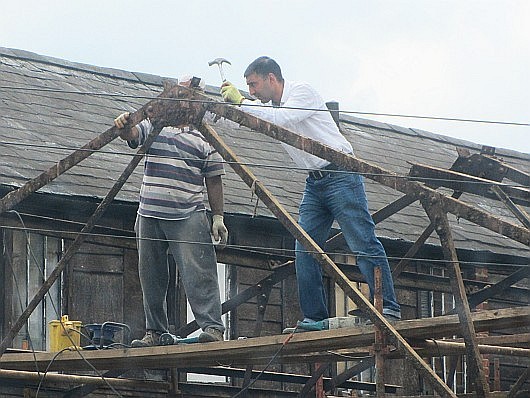
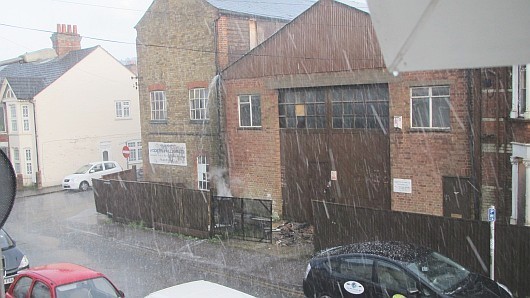
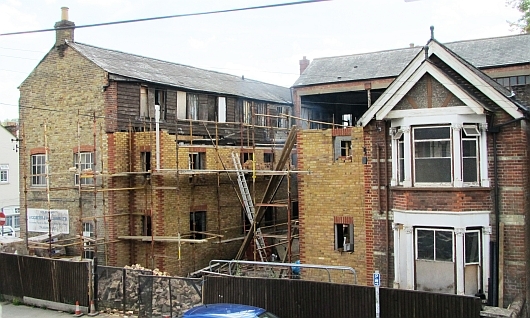
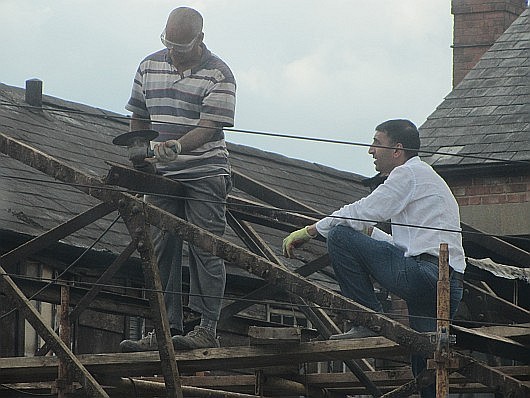
There wasn’t much to see at first, just bricks being delivered, debris and subsoil being taken away, whilst they dug new foundations and a drainage system, all behind the sliding doors of the central shed.
Mostly he provides guidance, inspiration—and wages. I understand he bought the property himself and will be landlord when it is finished. These pictures may convey the impression of a building site in some Asian country. Your surmise is not far out. The buildings survive from Victorian England, but the prevailing culture survives from Pakistan, some time in the 20th century. In our multiverse, worlds intersect. And on this site, as far as I can see, they carry the bricks and mortar in buckets, up ladders and rickety scaffolding. Elsewhere in the UK, they’d use hydraulic cherry-pickers—boom lifts in American English—to save their leg-muscles.
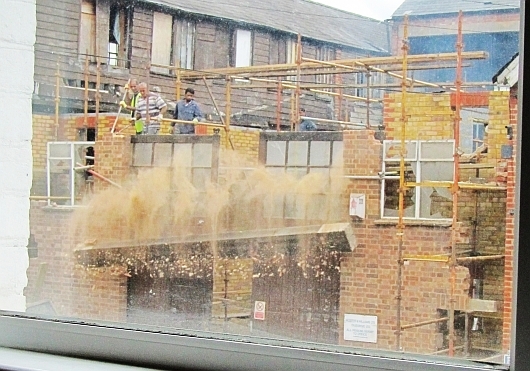
One day through the dirty window of my observation platform my inquisitive eyes perceived that the team were preparing to remove the heavy concrete lintel from above the shed’s sliding doors.
It just required a concerted push. My patience was rewarded by capturing a shot of the the thing in full flight, something I never manage with birds or butterflies.
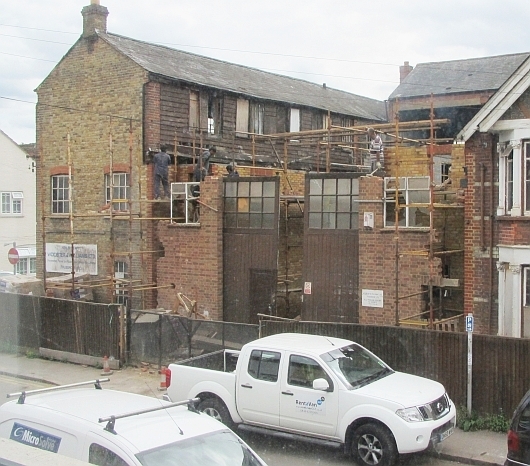
The boss had prudently moved his dazzling white pickup round the corner for this operation, and worn a yellow vest, the more officially to hold up traffic in case of bouncing debris. Then it was safe to bring back the pickup.
After this it was an easy job to use a sledge-hammer on the front shed wall and reduce it to two piles of bricks. Then the boss brought round a flat-bed truck to carry away the doors. You can see one being lowered inch-by-inch.
So now we see, once the façade of the old shed is removed, how the new version of the old building is taking shape, with bricks to match, once their brightness has weathered. You can begin to see the little courtyard, due to be surrounded by students’ rooms on three sides. The architect’s vision becomes manifest, brick by brick. I’ll keep you posted periodically.
Life enacts itself before my eyes as a real-life allegory of the soul’s progress.
 For weeks I’ve been waiting for a book to arrive from the States. I once had a book of Eckhart’s writings. I think I bought it in 1971. It had an orange and yellow cover. I couldn’t remember the title or publisher, and couldn’t see it illustrated anywhere on the Web, so in the end I settled for a volume on sale at a penny, plus standard Amazon postage. When the parcel came yesterday, I discovered it was the same book, the one I’d owned and loved but neglected and lost; the same book whose distinctive cover I’d retained in memory. It can’t surely be the actual copy I once possessed, but it’s as good as. As I revisit its pages, the content seems to reach me without effort, as if I’m finally ready to absorb it, just as plants serenely take in sunlight via photosynthesis. Reunion with an old friend; rebuilding from within—happy coincidence. Or a call answered.
 a wayfarer’s notes
Vincent, You couldn't have snapped that photo of the concrete slab coming down at a more perfect moment! It's fascinating to watch buildings being restored and also created from the bottom up. And how wonderful to be reconnected with your book.
LikeLike
Milton, Plate 6, (E 99)
“From Golgonooza the spiritual Four-fold London eternal
In immense labours & sorrows, ever building, ever falling,
Thro Albions four Forests which overspread all the Earth,”
http://www.english.uga.edu/~nhilton/Blake/blaketxt1/home.html
LikeLike
Welcome back, dear Rebb! Somehow I lost your details a while ago. But now you are on my reading list again.
And yes, there are plenty of blessings to count.
LikeLike
Nice post —you are fortunate that they seem to be preserving the integrity of the buildings—looks like they're doing a decent job. As opposed to what's going on in NYC: the continuous wholesale destruction of classic old buildings—which are replaced by architectural abortions and stunts. One of my favorite sites: http://kunstler.com/featured-eyesore-of-the-month/
LikeLike
Yes, I do think it is a decent job, so far. And I like the way they are building. On one of the first days, I complained to the men. They were burning some tarry timber and it was blowing in through our windows. The Irish labourer I spoke to was defensive but the boss and I have been friendly ever since and they take care with their neighbours, who, it has to be said, have been implacably opposed to the project, all of them giving the same reasons, as if they had agreed amongst themselves like a political party.
Here it is difficult to get rid of an old ruin, such is the power of conservationism. One way is to remove roof tiles and leave it a few years. Avaricious developers like to do that. But this is the “historic factory distrinct”!
I checked your linked site and was mightily amused by July's offering, noting that it is only a maquette at this stage. I think the only answer when you love the old buildings, and of course have no power to save them, is to embrace the new anyhow, on the principle that when you can't be with the one you love, then love the one you're with. But you knew I would say something like that.
I shall check out the site and see what else there is to enjoy!
LikeLike
I've been following “Eyesore of the Month” for many years.
Several years ago THIS went up directly across the street from my old apt:
https://twitter.com/BrianSpaethNYC/status/491705364178427904/photo/1
It almost looks like they are trying to re-create the 911 attack with this one…
LikeLike
Wow. That hits where it hurts. The name of Cooper Union is dear to me for literary reasons, as the place where the young Henry Miller first heard the older John Cowper Powys on one of his lecture tours through the States, and perhaps thereby acquired an enthusiasm to be a writer. Here's an account of Cooper Union: http://www.powys-lannion.net/Powys/America/Cooper.htm together with an old photo. That website, run by Jacqueline Peltier, has a few articles I've written on Powys, I believe.
LikeLike
Speaking of Miller, I recently picked up “The Air-Conditioned Nightmare” from a used book salesman near Washington Square Park…
LikeLike
Another building project.
http://b03.deliver.odai.yale.edu/74/76/7476cc5b-d051-4342-8db1-be06a67e9235/ba-obj-3612-0001-pub-large.jpg
Yale Center for British Art
Blake's Illustrations to Thomas Gray
I want to learn to copy Blake's little figures, which are so descriptive.
LikeLike
I remember your original post on the building. I physically drew back as I saw the basic building activities that were enacted. They were almost worthy of a neighbourhood evacuation. How on earth did the boss man get away with such cavalier demolition, deconstruction and reconstruction? I really hope that the new accommodation is not as haphazard as its birth. The founds presumably, will be sound, considering their solidity at the time of original build.
The rising and setting of light over the road will look different from now on. I am not sure if it will be a reunion.
LikeLike