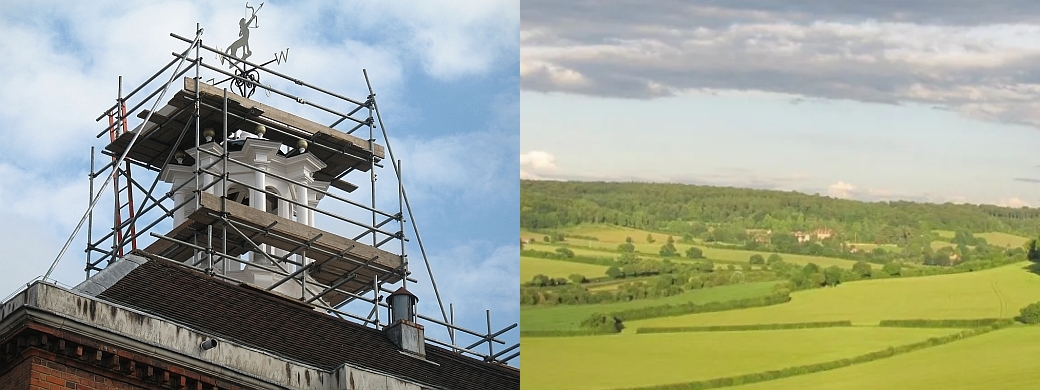

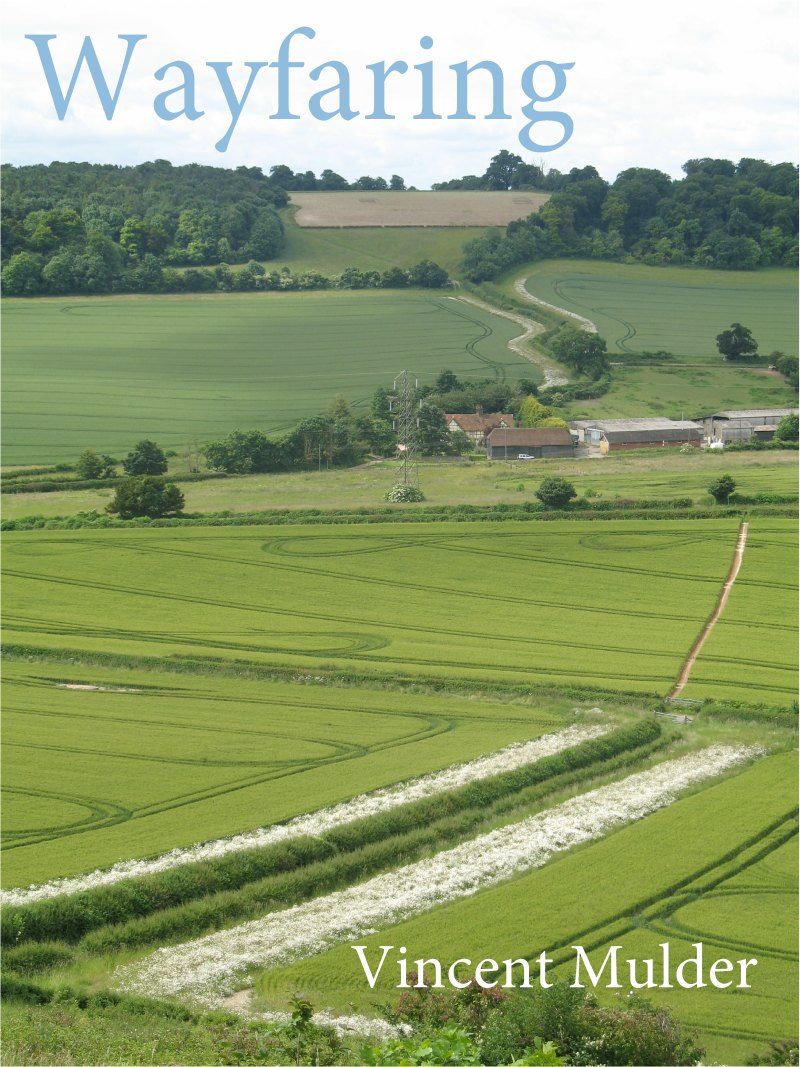
 Brian Spaeth’s been helping me design a front cover for Wayfaring. His style tends to be low-res—or even ultra low-res. I respect that, but I wanted a picture you could enter, so as to walk the paths it depicts, and see every detail. Up till June 2005, I could only gaze at enticing landscapes, and imagine wayfaring amongst them. Then, at a stroke I was cured from a decades-long illness: “with one mighty bound, Dick was free” (parody of the radio series Dick Barton, Special Agent, that I recall hearing in 1947). And so, if you click on the picture above, and then again to enlarge it, you can enter that scene, in thought. But I can do it in real life now, and the picture gave me a yearning to go there again.
With this in mind K & I returned to the scene on Easter Monday, following the route I’d taken eight years before, as recorded here in two posts: “Country Walk” and “Dwelling in one’s tribe”. I meant to take photos but had forgotten to charge the camera’s batteries. It didn’t matter; in fact the tourist who’s constantly thinking of good shots holds his excursion at arm’s length, missing the opportunity for total immersion, that ineffable re-baptism into life on earth that’s constantly there for us, if we know how to plunge. So I looked for a break in the clouds to go back on my own, while K was at work a couple of days later, to take the shots anyway. This is the story of that visit.
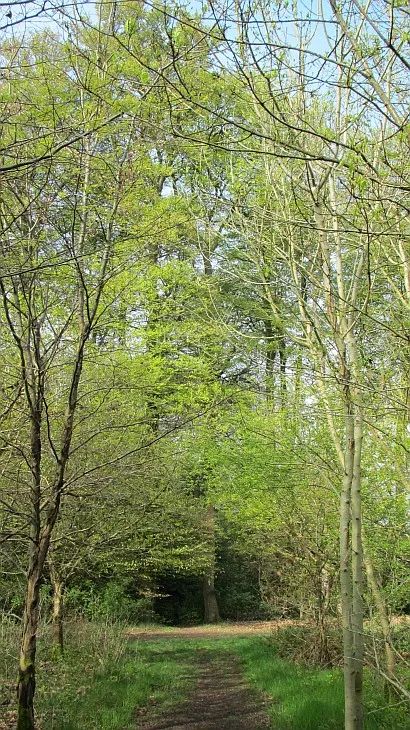
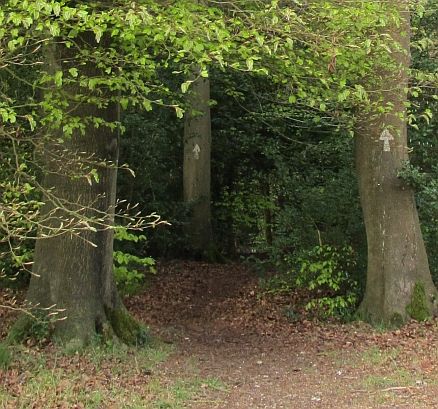
I’d brought along my pocket recorder as usual. I’d been capturing birdsong and other ambient sounds as I walked. Halfway through Hearton Wood, you take a path to the left, which after a while disappears beneath the trees. When this mysterious entrance came in view, I felt inspired to record these words: “Fabulous (mythical) places can also be real. The real can also be fabulous (wondrous).” It was the best I could do to capture the moment’s feeling.

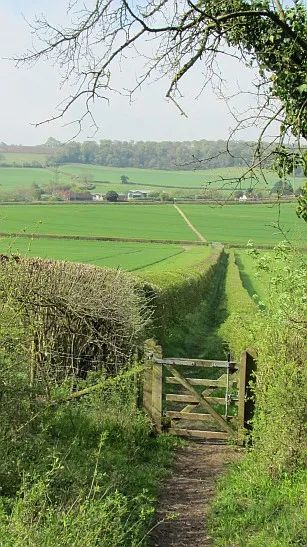
Then you go down some steps to a little gate which opens on to the narrow green valley shown in my cover picture.
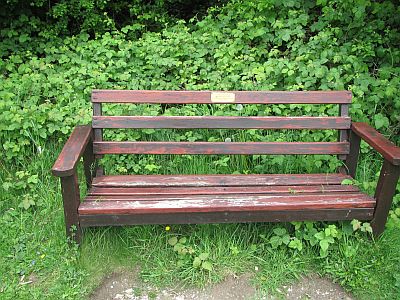
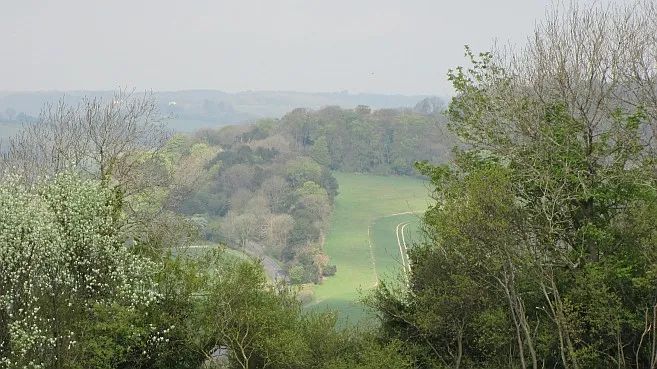
Then you come to an inscribed bench which marks the spot more or less where my cover photo was taken, in 2008
You walk down a bit. When you look to the left you can see the church tower again, up on the hill.
. . .
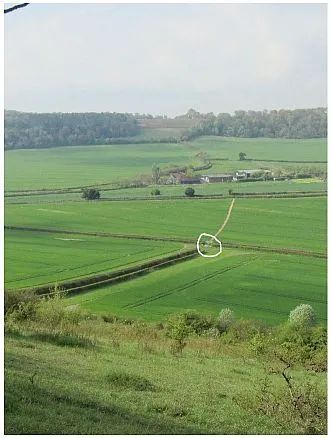
. . . which, allowing for the difference in season, looks the same as eight years ago.
That’s where I met a man, and we got talking, about how it was a good day to walk, and so on. He expressed a wish to send me his writings. Neither of us had a pencil to write the other’s address, so he invited me to his house—a short walk away— and got his wife to make coffee whilst he went rummaging upstairs to gather some typed photocopies, perhaps thirty pages in all. He gave me permission to show them to others. I’d like to share one of his pieces with you. It’s headed “To Walk”. I haven’t changed or omitted a word of his manuscript. It describes more beautifully, and in more precise detail than I would, the walk along the very paths for which I’d returned to retrace my steps after eight years.
To walk is to know a freedom when you can choose your own pace, stop and view whatever interests you.
For medicinal and pleasure purposes, I take this walk three times a week. The footpath sign for it is eight minutes from my home. As you pass the sign, the muddy footpath goes alongside and behind Arch-Sheil Farm. Already the traffic is being left behind.
An eerie, weird, almost human whistle-like sound is heard, changing sometimes to a wavering different note.
The flying feathered forms are climbing, swooping, diving, almost hovering. The Red Kites forever circling, hunting for their carrion, while the sun casts their intriguing shadows onto the earth. Their presence, colour and activity make quite an addition to the rural scene.
Continuing upward on the path, I have a hedge either side of me. I hear faint noises and rustling sounds and through holes in the hedge seven pheasants appear. They hesitate for a moment and then scurry away in a flurry of feathered and honking panic.
I walk on until I am on the level top of the hill, either side of the path are large fields with the green of the corn showing three to four inches. In this higher position you are aware of more air movement.
The footpath has another user; the Drag Hunt, the horses and members were on it three days ago, but left it after forty yards.
The path goes slightly downhill for twenty yards where it becomes stony and my boots slide noisily on them. At the wood entrance I step up eight strides onto a bank. In the wood there is a sudden feeling of quietness, perhaps its being combined with the towering trees. Between the carpet of brown leaves, the bluebells’ three or four inches of green growth are appearing.
Recent strong winds have brought down some boughs; three lie at intervals across the path. Another tree has two half-fallen split boughs at a dangerous suspended angle. Fourteen yards away a pheasant makes me glance at it. Instantly above me, clatter, clatter, bang, bang, wings flapping, some pigeons, squawking angrily, noisily, fly off at my intrusion under their tree. Stronger sun is now filtered by the trees, giving a hide and seek to my eyes.
I walk the last thirty yards of the path and then I come out of the wood. My first glance is to the left, where I see the church on the hill opposite me and we seem to be on the same level. The church rather dominates the whole area.
Walking downwards and on a straight path now, the house and park grounds give a spaciously comfortable picture. The cricket ground, traditional and so in keeping, the busy garden centre and village school, the tall trees on the corner hide the village. I have thirty yards left to walk before the footpath ends at the road, which is busy now.
I feel most fortunate that I live in this area and can appreciate all Nature’s gifts that she most generously shares with us all.
JOHN WENTWORTH
MARCH 2007

At the stile on Wednesday we met as strangers. But he mentioned one thing: that he had worked for seven years as a cleaner at a local railway station, and it was the best job of his career.
That’s the moment I realized he was the man I’d met before, on the same path, eight years earlier.
And I’d written about the encounter, here, and referred to an uncanny sense of kinship, for which I had no explanation, so I’d concocted one, that it was some kind of tribal recognition.
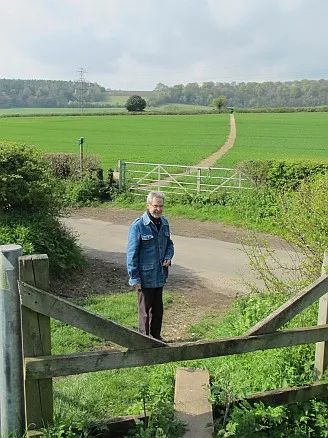
How to account for the coincidence of this second meeting? It’s as if we were . . . I’ll let you complete the sentence, in the light of your own beliefs about occurrences such as these. It’s by no means the first that I’ve reported on this blog, with circumstantial and photographic evidence. Were the angels acting for me, or for John? He has entrusted his writings to me, to pass around as I see fit. He has no access to the Internet. His works are signed and dated.
Fabulous places can be real. The real can also be fabulous.
 See 14th comment below.
 a wayfarer’s notes
You're fortunate to have such a beautiful countryside to explore, and you're fortunate to have the capacity to appreciate it.
I like the piece you shared. I was probably predisposed to find fault with it after you introduced it by saying that it described the area better than you could, just because … well, just because that's the kind of intractable SOB I am. But I ended up liking it very much. It drew me into the sights and the sounds and maybe even the smells. I doubt I'd agree it was “better”, but it was good. Definitely.
LikeLike
I think of it as “better” in the sense that it systematically describes the natural scene, in ways I never can, because I get distracted into other stuff. I don't write in that level of simplicity.
The intractable SOB in me says that meeting him again is not such a huge coincidence if indeed he takes that route three times a week. I've done it probably four times in eight years & bumped into him twice. He could write such a piece by cobbling together multiple incidents and memories. But this is the nature of art. I find myself slightly shocked when I look more closely into live albums, as I have with Grateful Dead, Dire Straits and Paul Simon, to find they are cobbled together from multiple performances on a single tour, with a little tampering on some of the tracks to bring them to album standard. This is art. Selection and massaging is involved, sometimes intuitively, sometimes by hard slog, trial & error.
Much can be said. It is indeed a beautiful countryside, & John has it on his doorstep. On my doorstep, 2½ miles away, there's a good deal of ugliness and squalor, which artistically & spiritually makes me try harder.
there's an English adjective “chocolate-boxy” which the OED defines as “like the (usu. stereotyped romantic) pictures on chocolate-boxes”. The area near St Lawrence's Church is like that, preserved for the nation and the world by the National Trust.
What strikes me most about John's writing, from which I selected this relevant example, is a sense of what inner vision moves him to make the considerable effort. Writing as we both know is hard work, something we struggle with forever. At least in my case, though such conversation as this flows easily enough.
I felt a kinship of inner vision, despite the gulf separating us in other respects. That came across in the first meeting eight years ago, when the topic of writing was never brought up.
LikeLike
Well that's just the thing. If I WAS going to lodge a complaint, it would be that it was a bit TOO systematic (although it never fell to the point of being tedious, so I readily forgive it for this, and even find a sort of quirky charm in it.) But imagination can be a funny thing. Too much precision can sometimes get in the way.
LikeLike
Yes, it was my fault in the first place to introduce the notion of comparison and thus the sense of a beauty contest. There can be a quirky charm in the writings of someone who is better versed in precision engineering than literature. I would like to edit my original words more judiciously, but shall let them stand so that this discussion makes sense to others.
LikeLike
I absolutely adore the picture of 'the gate'. There, I am walking in the picture, feeling the picture, almost sensing the moments of meandering on the path with the bushes either side. Arriving at the gate, do I choose to climb over, or, open it and walk through the gate, in so doing, merging it into my meanderings? Who can say.
Coincidences are probably more common that people will admit to. As this man walked that way three times a week, there was a good chance you might cross paths again; and you did. Your incidental/accidental timing was all important.
I love this suite of pictures.
LikeLike
To me, ZACL, the special value of this experience was to be dreamlike yet happening in real-life and fully attested.
It is universally acknowledged that dreams lend themselves to speculative interpretation. Some people believe they really do “have a meaning”, others don't. But either way, it's a game everyone can play.
Some see prophecies or warnings of future events, but the modern view is mostly that dreams come from the unconscious mind, presenting a commentary on current events in the dreamer's life.
When the thing happens in real life, as in this instance, one can ask who is the dreamer; for whose benefit are these events presented.
In imagination, I see John Wentworth as an distorted mirror of myself, his mystical and literary inclinations hid under a bushel, a lone vice in the wilderness. He keeps to his routine. What else can he do? It nourishes him day to day. What to do with the writings that he keeps upstairs under the bed? In the course of his regular routine, he meets another writer whose reach is a little wider, who offers to publish his work, in a limited way.
What John thinks of it I don't know. As dreamer Vincent, I could take it as a little drama presenting the mirror to my own aspirations, like a Shakespearean play-within-a-play. Similar things have happened before, in real life, which, as I have interpreted them, have proved prophetic. I would like to share them but they are too personal.
LikeLike
A propos the above, dear ZACL, we’ve trodden this path before, you and I. In August of last year, I wrote an open letter “To my literary agent”, and you replied,
“Vincent, don’t try so hard. Relax and enjoy following your pathways, mental and physical, for the pleasure of doing so. You may be surprised what flows and sometimes you will not. C'est la vie.”
To which I replied,
“Not for the first time, ZACL, you unwittingly act as the mouthpiece of my guardian angel. Thank you so much for this timely message!”
LikeLike
You have written about synchronicity although you haven't used the word. When you answered ZACL with a statement about dreams I felt I had to jump in. My post yesterday was on Blake's poem A Dream. I was led away from the literal content of the poem to Biblical incidents which may have influenced Blake's imagery.
Along the paths we follow there are frequents nodes where we may admit content which our logical, rational egos would prohibit. Wouldn't life be dull without these interventions from outside the patterns of the predictable?
https://www.youtube.com/watch?v=BX_nMwYa-nw
LikeLike
Thanks, Ellie, I see that you are right, especially after confirming the meaning of this word “synchronicity” via the YouTube video. I also went back to your post on Blake's poem & gave more attention to it, & was able to see the allusiveness linking the various sources (St Luke, I Samuel etc). Many are they who habitually dwell in this allusiveness & interconnection, I think, especially those given to much reading of the Bible.
I think such reading & searching for synchronicity can put the person in a waking state similar to dream, in that the corrective influences of objective daytime rationality lose their hold.
One can also see the dangers here, to those whose hold on sanity is weakened, or whose moral foundations are faulty.
LikeLike
If sanity is conventionality, and morality is conformity then synchronicity may be dangerous. I prefer to associate it with spontaneity and the liberty to escape from linear thinking.
Marriage of Heaven & Hell, Plate 5, (E 35)
“As I was walking among the fires of hell, delighted with the
enjoyments of Genius; which to Angels look like torment and
insanity.”
Laocoon, (E 272)
“There are States in which all Visionary Men are accounted Mad”
LikeLike
I take your point, but I think that for most people, sanity is conventionality, and morality is conformity. Therefore, the concept of synchronicity can be debased, as in commercial New Age therapies, often enough.
There are rare souls who delight in the enjoyments of Genius, spontaneity and the liberty to escape from linear thinking. But if I had the choice of neighbours, I’d find it easier to live alongside those who were conventional in their moral behaviour, and conformed to commonly accepted standards of sanity.
All the same, I get what Lao Tzu means when he says
When the great Tao is forgotten,
goodness and piety appear.
When the body’s intelligence declines
cleverness and knowledge step forth.
(Tao te Ching, tr. Stephen Mitchell)
In fact I live by it and try to express similar things here.
LikeLike
It is pretty obvious that you wouldn't want to walk the same path three times a week, no matter how lovely it is. It may make you more pious and clever, but who needs it?
LikeLike
With this, Ellie, you may have inspired another post, going off in a tangent you may not have anticipated.
LikeLike
Alas! the above mentioned “another post” has gone off into one of those tangents beyond hope of rescue.
You are right. I wouldn’t personally walk a pretty path three times a week, as you accurately surmise. On the other hand I salute the efficacy of repeated rituals in connecting other people with a taste of eternity.
I was going to go on and say that in my own neighbourhood I walk the same routes hundreds and thousands of times, in the course of “The trivial round, the common task” which, as the hymnodist continues to say, “Will furnish all we need to ask, Room to deny ourselves; a road To bring us daily nearer God.”.
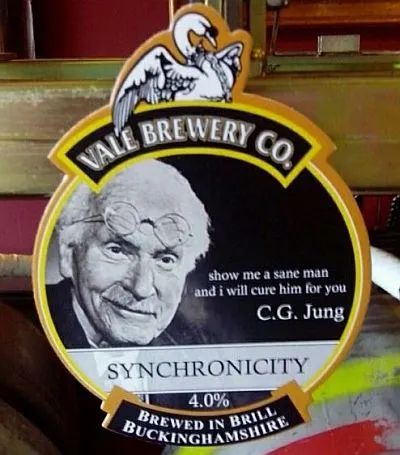
As for synchronicity, I’ve an example to show you in a further illustration appended to the piece above. K & I went to the pub in town today and I had a pint of “Synchronicity” ale, from the local Vale Brewery. I reproduce the label on the pump which has a photo of CG Jung and a quote: “Show me a sane man and I will cure him for you.”
However I will readily admit that my discovery of this brew was less an instance of the eponymous phenomenon, more an instance of that flippancy beloved of the English, whereby we try to deflate any pretensions to intellectualism with jokes.
Tasting notes: it was characteristic of ales from the Vale Brewery, but bitterer than usual.
PS: I have never ceased regretting the mention of “ugliness and squalor” in a comment above responding to Bryan. Like beauty, these things reside in the eye of the beholder.
In a recent post on her blog Ellie writes of Lambeth (a part of London on the south side of the Thames) as Blake’s neighbourhood in a particularly creative ten years of his life. Its dual nature he represents as two female symbols of beauty, Jerusalem and Vala. Jerusalem is the spiritual aspect, Vala the physical. Applying the same to my own neighbourhood, it’s not a lovely vale in every sense, but look upon it with eyes of love, as a microcosm of the world. When I see Jerusalem here, I see Vala by her side.
Goethe in a journal quotes Neapolitans as never wanting to leave their city, and having a saying, “Vedi Napoli e poi muori! — See Naples and die!” That’s how I feel about this place, but not because it’s pretty like that book cover.
LikeLike
I once described a drive Larry and I took on the west side of Tampa Bay to our son. We expected views of the water, luxuriant vegetation and pleasant neighborhood scenes. When I told Paul of our disappointment at seeing only industry, shipping and derelict warehouses, his reply was that kind of area was more to his taste than what we had been looking for.
Our children often make a habit of presenting the contrary sides to us. They are better able to see the distortions in our personalities than anyone else. Paul's remark made me more conscious of my need to see the beauty in the unlovely.
When you state that you may 'look upon it with eyes of love', you are indicating that you already have made a mental transition, that you are looking not 'with' the physical eye but 'through' the spiritual eye. The fallen Vala could not do that for she sees everything as external, as a veil or covering through which the eternal is invisible. The unfallen Vala 'loves' Jerusalem and does not wish to hide her with a veil.
William Blake
The Everlasting Gospel, (E 520)
“This Lifes dim Windows of the Soul
Distorts the Heavens from Pole to Pole
And leads you to Believe a Lie
When you see with not thro the Eye
That was born in a night to perish in a night
When the Soul slept in the beams of Light.”
LikeLike