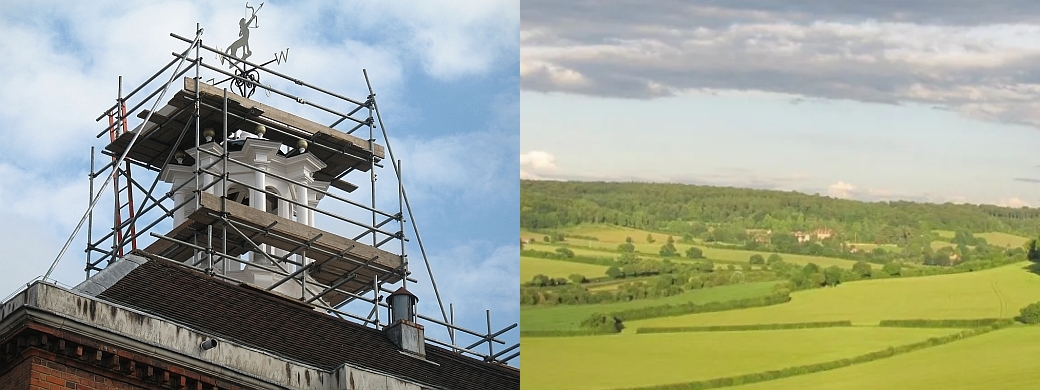


Stepping out the door into sunshine or cloud, nothing on my mind, I marvel at what it is to be human. It’s like being in a strange land with no map. Here am I, familiar to myself. Slowly I change, but not as fast as the world around me. I’m more comfortable with things as they were some time ago, whether five years or fifty. Distance lends perspective; often adding enchantment to the view. The person I am now would flourish in the world then—I can easily convince myself it’s so. Part of me likes to dwell in those times, those places beyond reach except on wings of fancy. There’s nothing on my mind yet I carry my entire history with me, and greet my neighbourhood affectionately, in a mutual embrace.
They say that in moments before death, you see life as panorama. Stepping out, I retrace fragments of my life, prompted by scent or sound, spring buds or fallen leaves. Everything is vivid, everything is now, as in Greek drama with its unities of time, place and action. I’m alive on the stage, carrying my protagonist role lightly, like summer clothes.
It’s not easy to be human, waking up each day to a persona bequeathed from yesterday. Did I sign up to this? Never mind. It’s what I have. It’s best to accept, to give it my loyalty, energy, hours; all the days which remain. I shall honour the contract I can’t remember taking on, perhaps before birth. I accept the genes I was born with. Perhaps I’ve forged them into something else, in a bone marrow transplant of the soul that hasn’t yet been proved possible.
If we learn to seize our freedom, can we not each learn some fancy steps, partnered in this dance with destiny? I rise to the challenge, take wisdom from every source I find, inward or exterior. Like everyone else on earth, I’m partnered with the inevitable.
The other day [19th March 2014] I thought I must have broken a bone in my foot. It was agony to put weight on it. I knew I should see the doctor but couldn’t make it to the surgery, though it’s a short walk. Driving wouldn’t help, my car was parked half a mile in the other direction. Then the pain lessened. The broken bone must have healed itself, as in Marlo Morgan’s novel, Mutant Message from Down Under:
I was told that the movement of the hands up and down, over the area of involvement, without touching, was a way of reconnecting the former pattern of the healthy leg. It would eliminate any swelling during the healing phase. Medicine Man was jogging the memory of the bone into acknowledging the true nature of its healthy state. This removed the shock created when it snapped in half, ripping away from the position developed over thirty years. They “talked” to the bone.
Psychologist Roddy Cowie says “There are lots of obvious connections [between symptoms and emotions] and the frustrating thing is that people don’t have the background to see how obvious the connections are. People seem to find it puzzling that emotion can affect your health. . . .”
Reviewing her words in Divine Economy, Ellie remarked that they sounded too positive—”as if I were avoiding the darker, troubling side of life.” I find this something to ponder endlessly, as with all the words of her book. Its substantive text amounts to 552 words. This suffices to encompass her topic. Their composition may have taken seven years.
Why did those words need to be said? Why do they strike a chord deep within us? Why is there a Divine Economy, in addition to this mundane economics which gives us so much trouble in this world—that like pain and death helps pile on “the darker, troubling side of life”? Why is it puzzling to accept that emotion can affect our health? Why is the human animal so plagued with emotion anyhow? Why do we have symptoms? What does the dark, troubling side of life tell us? My questions are all answered in the embrace.
 a wayfarer’s notes
When light rays converge at a particular pace they create an image. The location of the image is determined by the direction of the rays. If the light is received at a point other than the convergence point the image is fuzzy. If the rays are traveling disparate parallel courses there would be no convergence before infinity. Rays traveling in divergent courses would never produce an image.
I'm glad that a focal point was reached in the production of DIVINE ECONOMY.
Thank you Ian that you recognized the point of convergence.
LikeLike
If it is astonishingly difficult to be human, does that not imply that one has prior knowledge of what it means to be human? If so, what is it precisely that we just get on and do? It seems to me that most of the time we simply 'get on' with life, saddled with the duties, responsibilities, modes of behaviour and all the rest, that society imposes on us for society's comfort and well-being, or at least fearful control. Allowing the nearest influences to beat us and mould us into shape seems to me to be the complete opposite behaviour for one who is completely human – if I knew what it was to be human.
LikeLike
Tom, I think you answer your own very good question. Yes, I do think that somehow we have prior knowledge of what it is to be human. For you suggest that allowing the nearest influences to beat and mould us to shape is the very antithesis of being human. Yet this is precisely and literally what education has mostly been, and bringing up one's own children has mostly been.
You appear to have an idea of what it is to be “completely” human, whilst at the same time denying it.
In short, therefore, it is astonishingly difficult to be human. For I agree with all your paradoxes.
LikeLike
Editor’s (vincent’s) notes on the comments: The original version of this post ended up with a quote from a song by Bob Dylan, which inspired most of the 23 comments appended at the time. I’ve therefore deleted them but have retained others which may be of interest to some
yes, they are just sounds or marks. But some long time after the invention of writing, there was the invention of silent reading.“It is important to realize that the now common experience of “silent” reading is a late development in the story of the alphabet, emerging only in the Middle Ages, when spaces were first inserted between the words in a written manuscript (along with various forms of punctuation), enabling readers to distinguish the words of a written sentence without necessarily sounding them out audibly. Before this innovation, to read was necessarily to read aloud, or at the very least to mumble quietly; after the twelfth century it became increasingly possible to internalize the sounds, to listen inwardly to phantom words (or the inward echo of words once uttered.”David Abram, The Spell of the Sensuous, chapter on “Animism & the Alphabet”, section headed “Synaesthesia and the Encounter with the Other”.
LikeLike
I wrote a comment which vanished. The last bit of it referred to part of Ellie's quote from Dylan, above:
“Someone would come along eventually who would have it again – someone who see into things, the truth of things – not metaphorically, either, but really see . . .”
The inspiring Muse visits for a while, & it's our privilege to play host, but we don’t possess her & she never dies.
LikeLike
First, thank you Brian for the beautiful cover for Divine Economy. You added the surrounding clouds in such a way that the central image is always approaching or receding. It is great metaphor for the dynamic aspect of our ability to see our environs from multiple perspectives.
Chronicles has been on our bookshelf for a good while but only recently have I given it attention. My fondness for Dylan come through the influence he had on our sons. Because we heard his songs through them, Larry looked for some indication that Dylan read and valued Blake. He saw the similarities but found little evidence.
Here are some quotes from Chronicles which show something of the journey Dylan was on:
Page 115
“All I'd ever done was sing songs that were dead straight and expressed powerful new realities…I had very little in common with and knew even less about a generation I was supposed to be the voice of…Being true to yourself, that was the thing. I was more a cowpuncher than a Pied Piper.”
Page 236
“Folk music was a reality of a more brilliant dimension. It exceeded all human understanding, and it called out to you, you could disappear and be sucked into it. I felt right at home in this mystical realm made up not with individuals so much as archetypes, vividly drawn archetypes of humanity, metaphysical in shape, each rugged and filled with natural knowing and inner wisdom. Each demanding a degree of respect. I could believe in the full spectrum of it and sing about it. It was so real, so more true to life than life itself. It was life magnified. Folk music was all I needed to exist.”
Page 292
“The folk music scene had been a paradise I had to leave, like Adam had to leave the garden…The road out there would be treacherous, and I didn't know where it would lead but I followed it anyway. It was a strange world ahead that would unfold, a thunderhead of a world with jagged lightning edges. Many got it wrong and never did get it right. It was wide open. I went straight into it. One thing for sure, not only was it not run by God, but it wasn't run by the devil either.”
LikeLike