
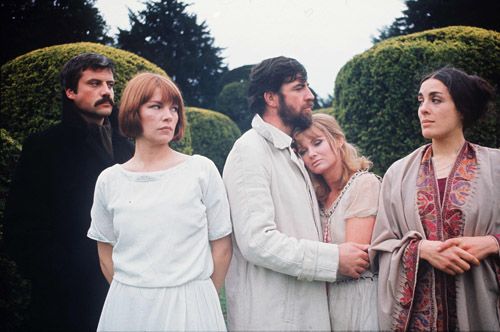
 From D. H Lawrence’s Women in Love. Scene: in the garden at Breadalby, where Hermione entertains her house-guests. Her brother Alexander Roddice is a member of Parliament.
There had been a split in the Cabinet; the minister for Education had resigned owing to adverse criticism. This started a conversation on education.
“Of course,” said Hermione, lifting her face like a rhapsodist, “there can be no reason, no excuse for education, except the joy and beauty of knowledge in itself.” She seemed to rumble and ruminate with subterranean thoughts for a minute, then she proceeded: “Vocational education isn’t education, it is the close of education.”
Gerald, on the brink of a discussion, sniffed the air with delight and prepared for action.
“Not necessarily,” he said. “But isn’t education really like gymnastics, isn’t the end of education the production of a well-trained, vigorous, energetic mind?”
“Just as athletics produce a healthy body, ready for anything,” cried Miss Bradley, in hearty accord.
Gudrun looked at her in silent loathing.
“Well—” rumbled Hermione, “I don’t know. To me the pleasure of knowing is so great, so wonderful—nothing has meant so much to me in all life, as certain knowledge—no, I am sure—nothing.”
“What knowledge, for example, Hermione?” asked Alexander.
Hermione lifted her face and rumbled—
“m- m- m- I don’t know.——But one thing was the stars, when I really understood something about the stars. One feels so uplifted, so unbounded——”
Birkin looked at her in a white fury.
“What do you want to feel unbounded for?” he said sarcastically. “You don’t want to be unbounded.”
Hermione recoiled in offence.
“Yes, but one does have that limitless feeling,” said Gerald. “It’s like getting on top of the mountain and seeing the Pacific.”
“Silent upon a peak in Dariayn,” murmured the Italian, lifting her face for a moment from her book.
“Not necessarily in Darien,” said Gerald, while Ursula began to laugh.
Hermione waited for the dust to settle, and then she said, untouched:
“Yes, it is the greatest thing in life—to know. It is really to be happy, to be free.”
“Knowledge is, of course, liberty,” said Malleson.
“In compressed tabloids,” said Birkin, looking at the dry, stiff little body of the Baronet. Immediately Gudrun saw the famous sociologist as a flat bottle, containing tabloids of compressed liberty. That pleased her. Sir Joshua was labelled and placed forever in her mind.
“What does that mean, Rupert?” sang Hermione, in a calm snub. “You can only have knowledge, strictly,” he replied, “of things concluded, in the past. It’s like bottling the liberty of last summer in the bottled gooseberries.”
“Can one have knowledge only of the past?” asked the baronet, pointedly. “Could we call our knowledge of the laws of gravitation, for instance, knowledge of the past?”
“Yes,” said Birkin.
“There is a most beautiful thing in my book,” suddenly piped the little Italian woman. “It says the man came to the door and threw his eyes down the street.”
The Contessa’s remark puts an end to serious discussion, and soon a maid brings out tea.
The photo is a still from Ken Russell’s film of Women in Love. Left to right: Oliver Reed as Gerald, Glenda Jackson as Gudrun Brangwen, Alan Bates as Rupert Birkin, Jennie Linden as Ursula Brangwen (Gudrun’s sister), Eleanor Bron as Hermione Roddice.
The sisters are teachers. Birkin is a school inspector. Gerald is an ex-army officer who runs a coal-mine belonging to his family. Hermione I think has inherited wealth and no profession.
———————–
Postscript
After posting the excerpt above, I realized that there was something that Rupert Birkin said in it that resonated with my own thoughts.
Rupert says,
“You can only have knowledge, strictly, of things concluded, in the past. It’s like bottling the liberty of last summer in the bottled gooseberries.”
…
“Could we call our knowledge of the laws of gravitation, for instance, knowledge of the past?”
“Yes,” said Birkin.
Tantalizingly, Lawrence interrupts the debate at this point. I never read his book before, but I mentioned something similar in one of my earliest posts:
Euclid’s theorems, Harvey’s discovery that the heart pumps blood, Shakespeare’s plays, the changing uses of a given word over time, where to place apostrophes, the Ten Commandments: all these are history. You might say they are knowledge, but they are inventions and discoveries made in the past, wonderful and exciting at the time. *
Arash says
My take on teaching is that our message as teachers needs to vibrate within the soul of our students. Something must click within them or at least partially open their eyes to the world and themselves. They must learn to ask questions instead of following authority blindly … †
I spoke of
personal knowledge, the kind that changes you permanently. It is something you cannot get by any shortcuts. A teacher could not convey it without possessing it. ‡
The post wasn’t in fact about teaching, or history. It was about personal knowledge: something you cannot be taught, but can only discover for yourself. You can be assisted by a teacher, but only one possessing personal knowledge. Any teacher who tries to impart knowledge (other than the historical kind), that he or she does not personally possess, can do nothing but deliver “dry lectures”. Only if you have personal knowledge of immortality can you speak about it. You might say that is impossible, but in the post I claimed a revelation.
* This part of the original post was edited out in a partial rewrite
† “Teaching and the Difference between Being Educated and Having an Education”
‡From “Intimations of Immortality”, June 16th, 2006
 a wayfarer’s notes
Arash wrote a post here on the topic of teaching. Coincidentally I’m reading Women in Love and came across the above passage, which I felt adds to the discussion, especially as it allows D.H. Lawrence to speak up from the grave and add his various opinions, expressed through different characters. It’s said that Rupert Birkin is modelled on the author, but Women in Love is full of philosophical discussion, and I'm sure that the other characters are modelled on aspects of himself too.
LikeLike
I haven't read the book or seen the film—but it's great to see you back, Vincent!
LikeLike
Thanks so much for the dedication, Vincent! Incidentally, D. H. Lawrence has lately passed through my mind and since I have never read him, I was thinking to start with The Rainbow. However, now I would have to check out this book first. My hunch is that D. H. would agree with me, but I will get back to you after reading him.
I am also very glad to be responsible for inspiring you to post again! Please keep up with it, as I will try to write on controversial issues so that you are moved to write more yourself.
LikeLike
Would it be anti-climatic at this point to say that I haven't read D.H. Lawrence either? (except for the excerpt above, of course.) And to say welcome back, as well?
LikeLike
That was fun to read again, after so many years. Thanks, Vincent, and Happy Yuletide!
LikeLike
Thanks all for the welcome. I’m delighted to be back.
Well, for present purposes, it is not necessary to have read Lawrence or seen his work translated into film. I’d become a little proud of having broken the blogging habit. But now you make it seem like an episode of pointless self-mortification (like other episodes in my life), and a worse habit than its predecessor.
I started to write a long comment, but have decided to append it above as a Postscript.
LikeLike
By further coincidence, I listened this morning to “Start The Week” on Radio 4. The topic is “Teaching History”, with contributions from Michael Gove, UK Education Secretary and other distinguished guests. Here’s a link to listen http://www.bbc.co.uk/programmes/b03mcmwx
LikeLike
I'll jump into the discussion without doing my homework because Vincent always reads and replies .
Thomas Cahill, Sailing the Wine Dark Sea
“I tell you these things because my methods of approaching the past have scarcely changed since childhood and adolescence. I assemble what pieces there are, contrast and compare, and try to remain in their presence till I can begin to see and hear what living men and women once saw and heard and loved, till from these scraps and fragments living men and women begin to emerge and live and move again – and then I try to communicate these sensations to my reader…For me the historians principle task should be to raise the dead to life.”
http://ramhornd.blogspot.com/2010/07/big-picture.html
Keep on truckin'
LikeLike
As narrative I find the scene rather clunky, but it's quite possible that was Lawrence's intention, to show up the superficiality of his characters. I haven't looked at it in context yet. (I think I read the book many years ago, but if I did I remember nothing about it.)
Education, as he suggests here, means a number of different things. Learning for the sake of knowledge, which I think is a wonderful thing; and a part of that is allowing people to discover how wonderful it is; preparing English gentlemen and ladies to play that role in the world; preparing the rest of us to make a living so we don’t starve; generally improving the skills and competence of the population so that the country as a whole can live more comfortably. The first two are traditionally paid for directly by the family of the educatee, the latter two are more practical and have usually been paid for by the taxpayer. They frequently overlap, especially in the last few decades, and the state education system is particularly bad at explaining its own purpose to those it trains, which adds to the confusion, but the point is that education means different things to different people.
Lawrence’s characters, who you say are mostly involved in education, see it as an aesthetic experience, with no practical value. At least, they pretend to in the dialogue. I wonder why. Perhaps because Lawrence himself knew nothing of teaching. It would be a wonderful world indeed where anyone who wanted to learn for the sheer pleasure of it could choose to do so, but it isn’t practicable. Philosophers eat because most people are not philosophers. Which is why we need education in the broader sense.
We can, however, thanks to the wonders of the modern world, engage in those part-time symposia we call blogposts and comment threads, while also earning a living. Like the above commenters, I’m glad to see you back beside the inkwell.
LikeLike
Ellie, I like the sound of Thomas Cahill, had not heard of him before but will look into his broad-ranging oeuvre when there is time. In the entire excerpt you append above, he conveys a sense of continuity; his methods have scarcely changed since childhood; scraps and fragments in his awareness are like seeds still living from dead plants; and so on.
Education above all else is to convey this sense of a living heritage, I think.
LikeLike
CIngram, thanks for your comments. I like your trenchant approach, & of course your inside knowledge of teaching.
I think the aesthetic preoccupation of the Lawrence excerpt may emanate from the dominating character of Hermione in her role as host.
Of course state-funded education has to yield an economic dividend, and surely this has always been the case. There is constant debate about how best to do it, how for example to prevent devaluation of the product by dumbing-down and easier pass-grades in exams. If you have anything to add to that debate, welcome!
Some things never change, but others are new. With ready availability of the Internet—with chatter, Wikipedia, so many persuaders, so much opinion or unvalidated rumour, everything in instant snippets, we need to ask afresh what education is really for.
It’s not so long since encyclopaedia salesmen persuaded parents that knowledge at your fingertips was the way for a child to achieve its best education. Now we have a world of information, good and bad mixed. Never has the responsibility lain more directly on the teachers themselves: not as sources of knowledge, not for the subjects they teach, the syllabus, methods & examination targets, but for their character, integrity and for being living examples of what good education is, in every sphere.
A good teacher is one who can be relied upon to resist the ignorance, falsity, unbalance, changing fashion, ideologies both prevailing and rebel; to stay firm in a continuity of truth, faithful to historical fact. He or she must be personally worthy of trust and respect, faithful to his pupils. She must be self-effacing to let the subject come through vividly; not to stand in the way of learning and self-development; but harsh on anyone else who stands in the way of learning.
I was a teacher for nine months after graduation. Long enough to know I was no good at it.
LikeLike
What is education really for? Well, I am reminded every day that for many people it appears to have no purpose at all, and for many others it is simlpy a tedious process through which they hope to be able to make some kind of living in the world.
But for those of us lucky enough to understand it as having a greater purpose, and able to indulge the desire for education, I think it's purpose is to understand the world better. By the world I mean the physical world, the mind of man, the concept of beauty, a global comprehension of what can be done and has been done, and what we all are, and what at least some of it means, and the wisdom to enjoy it and apply it to our own life.
Knowledge is not education, as you suggest, but it is necessary for learning and understanding. Accumulated for the sake of it, it serves little purpose (except to annoy the people you share it with) but without it it is hard to reach any kind of understanding.
The purpose, then, I tentatively advance, is to acquire the tools with which to think and to comprehend. And to have fun doing it.
LikeLike
I composed a response, Cingram, to yours above “What is education for?” but it got swallowed into Blogger oblivion.Now, several days later, I’ll try to reproduce the gist of that response. First I said thanks for expressing it so fairly and comprehensively. I wouldn’t want to challenge it or add anything to it, except to say something about the interaction between teacher and student.
If I were a teacher today, I would not ask my pupils to accept or agree with anything I had said, or give it any particular value; but to remember something, so as to be able to agree or disagree later in life. Or perhaps to remember my classes, and how they were transacted, the way we treated one another, whether it was fun, whether it was worthwhile. This may sound strange to anyone who sees the teacher as merely a facilitator delivering a package of knowledge and skills. But what I see now, fifty years after my own brief stint of teaching, and sixty years after my main schooldays, is that the best use of schooling, for a pupil aged between 10 and 16, say, is to soak up experience and absorb it as a foundation for later life. On this basis, inattention would be the worst thing. Being encouraged to do your own creative thing in class, whether individually or in groups, could be a form of inattention. It seems to me correct that the teacher should be the focus of classes, and his/her primary task to ensure that pupils are as present as possible.
LikeLike
PS: without in any way looking for it, I stumbled upon a page which may add to the discussion, and lend weight to Arash's original argument as expressed in his post here.
I find it hard to evaluate its content, though. It seems to fight cliché with cliché, but that's probably how people talk in places I never visit. In discussing education, it uses a different jargon from the one I'm used to. In particular it conflates what I'm used to call “school” and “university” into a single word “school”. Where it's necessary to distinguish the two, it refers to “college”, a word which has various meanings in English. Eton is a college, so is Balliol, but one is a whole school and the other is part of a university: both are collegiate. But we also have such things as colleges of further education, which are not collegiate.
In general, it refers to a system of education, or an attitude to it, which seems peculiarly American. As I know nothing about that except from movies, I can only point out that in the UK, you cannot lump school and university together as if they are integrated parts of one system, at least they weren’t in my day. School was regimented: classes were compulsory. At university, no one monitored whether you turned up to lectures, and I soon found out that I could miss most of them. I developed a personal policy of boycotting nine o’clock lectures on principle and often tutorials (where your absence would be noted) as well. “Too early” was the principle, and my policy was designed to persuade lecturers to start at a sensible hour. My behaviour was of course regrettable, not to mention ungentlemanly.
LikeLike
Teaching is partly, mainly, an exercise in communication. The art is to recognise that almost all the work of creating and maintaining the communication falls on the teacher. Many of the problems poor or inexperienced teachers have, stem from not understanding how little of that work will be done by the students. They expect us to do the work, not only to offer them communication, but to make it worth their while to be part of it. We know what the Devil does with idle hands. The work of making them 'present' is entirely the teacher's.
LikeLike
Sorry for this delayed response to your important point, CIngram. I'm sure you're right in this. The teacher must always provide the focus, Maintaining the communication and making it worth the students' while to be part of it is inseparable from “keeping order in the classroom”, a state of affairs which may be hard to achieve these days but once was taken for granted as a prerequisite; and achieved where necessary by threats of punishments forbidden today.
LikeLike