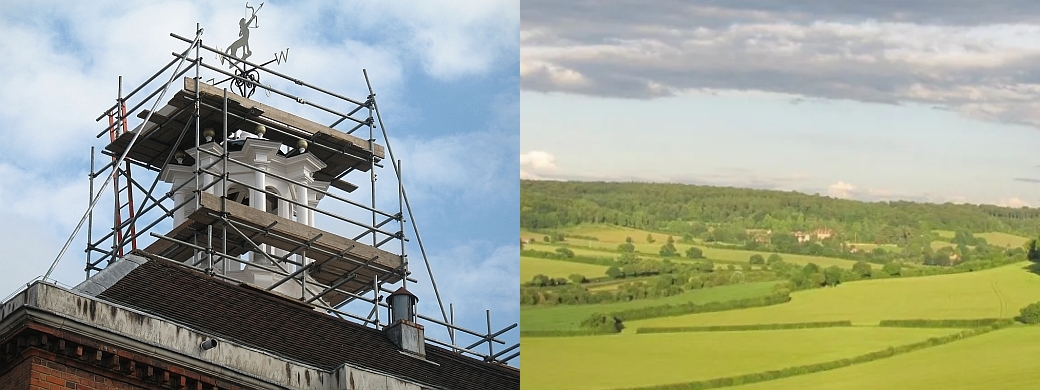


I dreamt I was dead. There was no afterlife. This “I” became a past-tense “he”, a past-tense entity, no longer part of the scene, soon to be forgotten. The dream was about that which remained: the world continuing as before, other people still there, gladness still existing. All was well, better than before, even, because “his” restlessness was stilled.
Awake later, I recalled a moment in 1979. I was a project leader for Zeus-Hermes Ltd, designing and delivering a computer system for Douglas International, freight forwarders, which had offices at the Cargo Terminal on Heathrow. I’d just emerged from a session with the client. There’s a lot I could tell about that project, and my life at the time. There were complications in the middle of life’s path, I was lost in them, like Dante when he found himself in a dark wood.
In shirtsleeves and tie, carrying my jacket and briefcase, I walked across to my car. Where to now? Should I go back to the office, or straight home? It was that time in the afternoon when you’d have to weigh the decision. Both destinations would swallow me whole, drown me in responsibilities. As long as I didn’t decide, but stood under the blue sky with keys in hand, I was free.

Suddenly, the world was mine. I was caught in its embrace, serenaded in its cool breeze. Never mind that the air carried a scent of jet fuel, the hum and roar of the busiest airport in the world. I thought of standing there indefinitely on this grey patch of tarmac, surrounded by low buildings, where no trees grew, no birds sang. It was just a moment; like a flirtatious glance from a known face in a strange city, seen from the window of a receding tram. Never forgotten, still fresh.
How come I suddenly remembered that single moment, out of millions? I guess it was stored away until I could find words with which to re-enter that wordless zone, distant but somehow reachable, like those glittering silver birds overhead. Are they planes or are they shuttles, tirelessly pulling white threads of weft across the warp of clouds, in a great curved loom, under the azure vault of heaven?
When I consider the millions of moments between then and now, I wonder why that one sticks. There have been others. I guess they were stored away till I could find words. Only with words can I fly back to that wordless zone, distant but somehow reachable, like those glittering silver birds in the blue sky above. I know they are planes but they seem like shuttles, tirelessly weaving white threads across the clouds’ warp in a great loom, under the azure vault of heaven.
To convey the wordless, we must resort to some alchemy where pure Experience passes from soul to soul and ends up as wordless as it began, using words in between, just as music can be translated into numbers via digital recording, then back again to music. In this case, I’m not sure if it makes sense to try and convey in words that moment on the grey tarmac. In these extremes, one can only appeal to a common resonance in the reader’s mind.
When I analyse the context of that moment 34 years ago, I see myself beset on all sides with intractable problems that I was hardly conscious enough even to recognize, let alone tackle. All the same they percolated through me like a constant background noise that you forget to notice; till suddenly it stops. Then, in a tingling metaphoric silence, there is nothing but pure possibility.
And that is what happened in those seconds of indecision, pondering whether I should go home, or back to the office.
That was a moment when I “realized my true nature”. I saw the “I” as a pathetic heap of discarded clothes. The being that stood alongside in naked glory was Infinite Possibility.
Ellie wrote, “Words are what makes it so difficult to think and write”, and I responded, “Words are what makes it possible to think and write”.
I wish I had been on hand for this exchange. While I completely sympathize with Ellie’s feelings, I also totally agree with you. It can be so hard to put things into words sometimes, but this speaks not to a fault in words, but to the need and the drive to “put things into words” in the first place, to express, to understand, to even try to hold and caress them with our minds. We can certainly hope that we might evolve and develop some higher form of communication some day, but until then we certainly shouldn’t think of words as something that holds us back. Quite the contrary, to date words are the best tools we have at our disposal to reach the highest shelves of thoughts and ideas.
It is far better to resonate than to respond.
Indeed, Ellie, it is preferable to resonate. But response is a voluntary action. Resonance simply occurs, or fails to occur.
The rational mind is always ready to jump in with a response and drown out the faint sound which requires listening in the silence.
But my rational mind is demanding that I link to this post:
http://ramhornd.blogspot.com/2010/12/weeping-babe.html
Ellie, I am not contradicting you, and I don't see responding and resonating as mutually exclusive. My response was to show the other side of the coin, and I brought it up in the above post to agree with you and explore further. I think it's easy to resonate, in the sense of feeling the thing intuitively, if one has the inner equipment to do so. What's hard is to communicate in words so that one's wordless experience can be understood and shared, which is what I was trying to say in the post; and if I am not mistaken, is close towhat you meant.
But as to hearing faint sounds—meanings which can't be comprehended rationally—surely we are all different in this. Listening in silence to the message of Hui-Neng, I begin to understand what he says, and why he says it in a particular way.
But when you point to your explanation of Blake's use of the terms “weeping infant”, or “weeping babe”, I am willing to take that explanation on trust, and understand its relevance to my post. For as you say, “The following passages scattered through Blake's writing give the impression that the 'weeping babe' or 'weeping infant' is man in his potential form holding all possibilities.” And the topic of my post was a sudden moment of feeling possibility, with an accompanying sense of liberation. But it was extremely hard to write in a way that communicated that feeling, that sense; and I may have completely failed.
But no matter how I listen to any faint sound, I don't get why Blake has chosen this particular image of a “weeping babe”. To me, the resonance is missing. But that's just an example.
I know it's a bewitching idea, this notion that enlightenment can be gained through surrender rather than effort, by ditching your mind instead of using it, but unfortunately it's a huge fraud. It's a performance. It's all smoke and mirrors, a lot of soft words and slow gestures with nothing behind it. Letting go of reason won't put you on a fast track to understanding any more than letting go of language would put you on a fast track to expressing yourself. (Mind you, I'm not saying that's what you're advocating here. I'm not even talking strictly about you personally. I'm just saying that this is where this conversation seems to be leading.)
However, if I were to address you personally, I would speculate that perhaps you still think of reason as you did back when you worked with computers. You still picture it in that capacity, numbers and code and so forth. You don't think of it as something equipped to deal with the “big questions” of existence. For that you need Hop Ling Sing and his 7 Folded Pieces of Paper or whatever. You think of reason as a stapler you've brought home from the office and now you're staring out at lush moist fields of brown earth that need to cultivated and seeded. Naturally, the stapler seems wholly inadequate to the task, but this thing it, reason isn't a stapler; it's the whole CONCEPT of tools. It's what makes the tools possible. You don't need a stapler; you need a tractor! But if you forsake the concept of tools altogether, you're going out there with nothing but your bare hands to dig around aimlessly in the soil. There might be a certain animalistic comfort in that, and there will certainly be plenty of “silence” to enjoy, but you will never, ever, get more than a few square feet of that field cultivated. There's no “enlightenment” down that road, just resignation.
Bryan, this is brilliant. Earns my respect and gratitude in equal measure. You have well characterized many difficulties and makeshifts in your examples.
Your example of the stapler, when a tractor is needed, is genius, for it well expresses the kind of frustration I've been experiencing. For yes, a tractor is needed, but I don't yet know a word for it, and I cannot visualise it because I have never seen one, nor heard one described. Yet I cannot believe that I am alone in “staring out at lush green fields of brown earth that need to be cultivated and seeded”. If I knew what it was I was looking for, I could type “tractor” into Google and find out how to get one, or make one, if necessary.
It's a strenuous quest and needs lots of reading and reflection.
Well I'm glad that went well then ;D
And I'm glad you liked the “moist brown earth.” I wanted to be clear that I understood that we're talking about something that feels vital and organic here.
As for the tractor, I have to think about that. I suppose that I have my own tractor that I used. I revved it up a few times to write these comments and in all our conversations, and really, in pretty much everything I write (expect for maybe the Sunny Blog which is more like joyriding on an angry little lawnmower that goes bzzzzz bzzzzz.)
The point, of course, is versatility, not making the mistake of thinking that reason can give the tools to do this but not the tools to do that. Reason is your toolbox. And by THAT, I suppose I mean approaching things with an active mind, a thinking mind, not being led to believe that you're dealing with a special situation where you'll get the answers by NOT THINKING.
I believe that I mentioned before that I did some computer programming when I was younger. I started when I was about 10 or 11. I designed and programmed my own (rather rudimentary) games. I spent days writing long lines of code. I was doing complex algebra even before I knew what that even was. My family thought it was great. They thought my future was set. But I grew dis-satisfied with it. I knew there was only so much I could do with, only so far I could go.
So, I turned to writing because I knew I could accomplish so much more, I could express so much more, explore so much more, FEEL so much more. But writing uses tools every bit as much as programming does. It just uses a wider array of tools and employs them for more various and interesting effects, but they are tools just the same.
That's all I'm sayin'
Bryan,
So your toolbox is named reason, but I think of reason as only one tool in my box. My (and Blake's) complaint is that reason wants to be the only tool in the box. The tool which Blake proposes as essential and missing from many toolboxes is 'Imagination.' Now if you let reason define imagination you will immediately find it deficient. But he meant more than reason's definition: he meant the ability to create images; he meant the link that connects the disparate functions together to act as one; he meant a mind attuned to information which the five senses do not discern; he meant the perfect liberty of living in the spirit; and he meant far more which words may or may not contain.
Perhaps you mean by mind all that Blake meant by imagination. I don't pretend to have all the answers. I try to follow the path that opens to me.
As a fiction writer, I most certainly hold imagination in high esteem. The toolbox metaphor itself was, of course, a product of the imagination – albeit a fairly dry and abstract one. However, I don't think that reason and imagination needs to be at odds with each other, or that one needs to trump the other. I think that incredible things can be accomplished and created when they are both used in tandem.
In pursuing my toolbox metaphor, I didn't mean to suggest that analytical logic was the only tool at our disposal. Rather, I was trying to make the point that I don't think that anything is ever gained by discarding reason. I don't think that reason should ever be treated as an obstacle. I was making the point that reason is more versatile than we typical give it credit for, that it can serve the both the poet and the engineer in different capacities.
Which isn't to say that the poet works strictly through reason – naturally they rely on imagination and intuition as well – but again, that doesn't mean they should treat reason like that “Silly Rabbit” that's just going to get in the way. It too is an important part of the work. A poem could no more be written without using reason AT ALL than it could be written without using words.
[…] “. . . as soon as I got out the door, open air enveloped me. Its sensual immediacy was unimaginable from indoors: this unspoilt sharp […]
[…] The realm of infinite possibility […]
[…] Apr 4th , ’13Vincent11 Comments […]