

The fridge has been in a coma for three weeks. We’ve discovered there’s no hope of a cure. The freezer works normally, but the mechanism which controls the refrigerator compartment has failed. There’s only one moving part: the little door which lets cold air flow to the refrigeration compartment when the thermistor tells it to. Part of the main circuit board is brain-dead, so the moving part does not move. As I speak, it’s below freezing in the back yard, and I don’t like opening the kitchen door to get milk and & fresh things I’ve had to keep in the outside sink. We’ve run down our perishable supplies and this means daily shopping for food, or else eating out.
The “sharpness of the fresh air”, that I mentioned near the end of my last as one of my keys to the Numinous realm, now feels more like a hostile nuisance. I spoke then of The Presence, but I’d prefer not to. I’m cautious about giving a name to the holy. It’s not for me to drive a wedge between holy and profane, knowers and ignorant, believers and lost souls. I’m caught between growing awareness of my own “religious practices” and wanting to resist religion’s gravitational force. I want to observe what goes on in my life, without tying it down into concepts; to talk about what happens, without naming. So I go on reading books, and look at the authors’ naming—which is a way to see through their eyes for a while, without giving up the fresh vision from my own. Let me tell you how Karen Armstrong, in The Case for God: what religion really means, distinguishes between logos and mythos:
Logos (reason) was the pragmatic mode of thought that enabled people to function effectively in the world. It has, therefore, to correspond accurately to external reality. People have always needed logos to make an efficient weapon, organize their societies or plan an expedition. Logos was forward-looking, continually on the lookout for new ways of controlling the environment, improving old insights of inventing something fresh. Logos was essential to the survival of our species. But it had its limitations: it could not assuage human grief or find ultimate meaning in life’s struggles. For that people turned to mythos or myth..
Nice, but even the application of logos couldn’t fix my fridge. Losing physical comforts that I’d taken for granted was just one frustration. Having to call in an engineer was another. As an experienced handyman I’m always reluctant to endure someone else’s wrong diagnoses; particularly when, trying to be helpful, I may inadvertently lead them in the wrong direction. For I want to understand things for myself, instead of keeping out of the “experts’ˮ way.
I’m the kind of man who prefers to discover for myself what was discovered long ago; to be original, rather than a normal person. ‘Prefers’ implies I once had a choice in the matter, and I’m not sure that’s the case. It’s not a smooth road that I take. More like the path of a fool, the kind Blake writes about, who persists in his folly till he becomes wise. My attitude to home improvement is similar to my do-it-yourself theology. I can’t just hand over and let someone else do it for me, because I don’t just think I’m right, I know. In the words of the late JB Lenoir, [YouTube https://www.youtube.com/watch?v=hjl7FnN6iR0?si=YnPgwsxSm1rHQ7zg%5D
What Grandma told me was-a good advice
She said “you keep on going if you’re sure you’re right”
It’s a very important advice because progress is slow and you make so many wrong turns. I want to make great leaps forward and when I examine my frustrations closely I find my peculiar methods forgivable, because there’s no other way. Being original involves hacking a path through thickets, not knowing if it will lead anywhere. You need to establish feasibility, but how can you do that without hacking first? Obviously you look at what others have done and learn from them as much as you can. But then, you may have to build a quick prototype before investing the full detailed effort. The prototype probably won’t work, precisely because it is a prototype. So you realize that you’re not making a new thing so much as conducting a series of experiments, whose outcome may lead to the production of a new thing. I was tempted just then to say “may lead, if successful”, but stopped myself in time. An experiment is successful regardless of whether it yields a desired outcome; because you are supposed to conduct it with an open mind. Prototypes, on the other hand, are meant to fail. The most efficient prototype fails in several ways, so that you can learn several things.
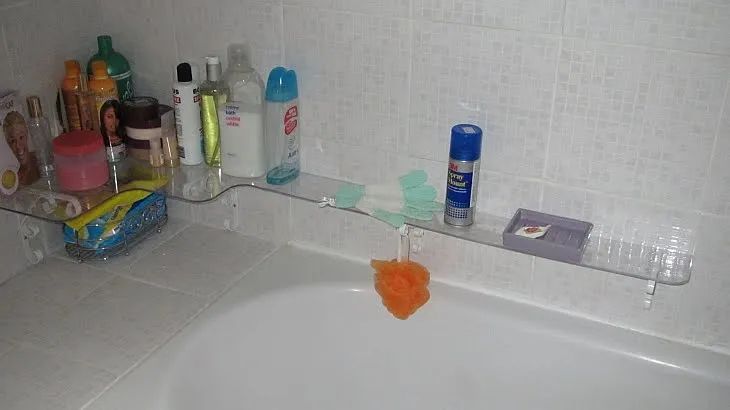
What I’m saying has applications in theology, home improvements—and life in general. For the last few days I’ve been designing something for the bathroom. A space measuring 6’10″x4’4″ in feet and inches (209x133cm) has to hold bath, shower washbasin & WC. The project was to improve the storage of all those bottles and jars that women in particular tend to accumulate. K looked up the Web and found various shelves, hooks and caddies but unless you bought stainless steel they’d soon go rusty in our bathroom. I thought of clear acrylic, known also as Perspex. You can cut it and drill it into all kinds of shapes. But all I could get locally in 4mm thickness was clear polystyrene, which appeared to be the same thing, both in the manner of working and the final appearance. To cut a long story short (and cut a full-size sheet into the shapes I wanted) I managed it. What I learned along the way was that polystyrene melts in the friction generated by power tools. You can cut, drill and sandpaper it, but you need to do it slowly by hand. An electric jigsaw will cut through the plastic very quickly, but the cut heals and the two pieces remain welded together. Even with hand tools the sheet is liable to cracking and surface damage. To protect it from this, I glued paper to both sides. This way I could mark the cutting lines and drilling holes from designs I’d printed using a graphics package. I stuck the paper on with 3M’s SprayMount, specially designed to peel off and reposition, like the adhesive on Post-It notes. Then I discovered that SprayMount eats into polystyrene. The whole process was too wearisome to consider throwing away the prototypes. I opted for sanding off the pitted surface with wet-and-dry, then rubbing finally with T-Cut, to restore the polished surface. Life’s like that too. It doesn’t provide the option to throw away your prototype and start again. The future starts from where you are now. This idea is imprinted in the origins of this blog, which was first called “An Ongoing Experiment”, then “As in Life”, before settling on “A Wayfarer’s Notes”. The URL “perpetual-lab” survives to this day.
So much for the logos, as defined above by Karen Armstrong. It helps clarify the design-and-build process. What about her mythos? I propose that in every human thought or activity, there’s a place for mythos alongside logos. For I discover within myself a prompter or angel, to aid my reason and keep me clear of despair, when my fridge goes into a coma and the quick shelf-job takes several days to complete. You may object that despair is too strong a word, but with cold weather like this, it’s easy to imagine the central heating breaking down, instead of the fridge. Or any kind of calamity beyond the scope of my meagre handyman’s resources. In anyone with a vivid imagination, one kind of chaos is easily associated with another. Fortunately I don’t live in Syria, or anywhere else suffering from civil war. Scratch the veneer of an ordered life and you find chaos, and nothing to fight it with but helplessness. So the negative mythos spawned by imagination corrodes our self-assurance, as factually as SprayMount on clear polystyrene sheet, and equally wearisome to fix.
This is by way of introduction to a particular mythos which I find in myself, despite all the housekeeping I perform to clear my head of beliefs. (I like this word mythos: it sounds much more respectable than “religious superstition.) I have an inbuilt belief that “nothing happens by accident”, or “these things are sent to try us”. When things go my way, I give thanks for the gift, with nary an image of the Giver. I find it easy enough to conceive of an anonymous Benefactor, without personifying the abstraction by the addition of any attributes. It’s a bit more effort to give thanks for things which go counter to my strivings. When I say that whatever happens is meant to be, it’s not so much a belief, more a declaration of intent: that I’ll embrace the circumstance, convert the raw nectar into honey, however noxious-seeming the weed-blossom from which it’s extracted. For this particular centre-of-the-known-world I call “me” is fashioned from nothing but circumstance. First there was the circumstance of my begetters, and their DNA, and then, from the moment of conception, a series of interactions between the embryonic “me” and “The Other”—that is, the rest of the Universe. Change any of those interactions, and the resultant “I” is different. Every moment is another brick: not a Brick in the Wall, à la Pink Floyd, but a brick in the ongoing edifice of me. One possible mythos says that I’m flawed, doomed, ruined, beyond redemption. Another says no, it’s all meant to be, everything is just right. And from that premiss, there are those who build a notion of God. I cannot blame them, but I prefer to think we really know nothing. We just seize on the mythos we find most helpful. O Karen, thanks for this handy word!
Oddly enough, this post in its original form was entitled “The Blessed Virgin Compared to the Air that we Breathe”, after the title of a poem by Gerard Manley Hopkins which I quoted therein. Re-editing that draft, I got stuck on the ending, & realized I’d tried to say more than could be squeezed into 1500 words. No wonder I couldn’t tie all the ends together.
This version may be no better. The ends still resist tying: perhaps they have a life of their own. So I’ll end as that draft did, with an excerpt from the Tao te Ching, as rendered into English by Stephen Mitchell:
See the world as yourself.
Have faith in the way things are.
Love the world as yourself;
Then you can care for all things.
– – – – –
 a wayfarer’s notes
One time when I was a kid we had just moved into a place and we had to keep stuff out on the patio in the snow like that. I thought it was the neatest thing, but I'm sure it was a big headache to me parents.
It's funny how the adventures of childhood become the inconveniences of adulthood.
Anyway, reading on….
LikeLike
(P.S: We didn't have a refrigerator yet. Forgot to mention that.)
LikeLike
Aaaaand… done.
Nice. I can see hints of the other piece embedded in this one, sticking out here and there.
“Scratch the veneer of an ordered life and you find chaos, and nothing to fight it with but helplessness.”
I hear you there. I feel like I always have at least three different calamities simmering the back of my mind at all times. Things that I can't quite do anything about, and I am just close enough to almost being able to do something about them that I can still feel guilty that I'm doing nothing. (Does that make any sense?)
For instance, the waterline to the ice maker sprung a tiny leak a few weeks back. We didn't notice it until one of the wood floor tiles near the fridge became a little warped. We shut off the water, of course, and I got the stuff to replace the line, but the damage to the tile is already done. It makes just a little bit of a pop when I step on it now. It's not a big enough issue to pull up the tile (which interlocks like a jigsaw puzzle), but it's still enough to be an aggravation, still enough to cause anxiety and make me sense that scratch in the veneer of an ordered life.
Which brings me back to my comment about the fridge above. As an adult you have a NEED, a responsibility, to fix the fridge, and you feel a twinge of guilt until you do. Even if there's still that lingering little sense of adventure where you enjoy “roughing” it a little and changing things up a bit, you still feel it weighing on you and you know that just can't go on like that, living like some kind of pioneer or caveman, slipping off the edge of civillization, and so you can't completely indulge in it the way you would as a child.
It's like a few years back my furnace went on the fritz. For a few day we had to confine ourselves to one room with the portable heater. In a way it was fun, but it was also inevitable that I had to get someone out to fix the furnace, and sand back over that scratch in the veneer.
LikeLike
[1] In the beginning was the Word, and the Word was with God, and the Word was God.
[2] The same was in the beginning with God.
[3] All things were made by him; and without him was not any thing made that was made.
[14] And the Word was made flesh, and dwelt among us
The prologue to John's gospel has more to say about logos and mythos than does Karen Anderson's quote. The logos is the abstract idea which has not been implemented. Its existence is not in the material world but in the world of thought. Logos is the idea of how to fix your refrigerator or build your shelf. The actual fixing or building involves you in mythos. Through mythos the ideas assume substantial form. The logos is conceptualised; the mythos is experienced.
In the prologue John is speaking from logos explaining the incarnation; in what follows he presents mythos. Throughout his book he tends to insert logos into his mythos by supplying explanations for his narrative.
The point I am trying to make is that when you experience the Presence, the Word is made flesh to you. When you read Karen Armstrong's book you deal with abstractions. Mythos and logos complement each other but we have a tendency to become absorbed in the logos to the exclusion of the mythos.
Blake quote:
“it is but lost time
to converse with you whose works are only Analytics.”
Marriage of Heaven & Hell, Plate 20, (E 42)
LikeLike
Thanks, Ellie. Yes, I was aware when reading Armstrong that she was using logos and mythos for her own purposes, without acknowledging a need to align her usage with the beginning of John's gospel. I can only say in defence that her usage has more to say than St John's for me, at this time. For she uses the two words to identify two strands in traditional religion, and their uses, as in the passage of her book I quoted above.
I've a feeling we are coming to this from different angles, Ellie, though I'd never think it is but lost time to converse with one another.
LikeLike
Bryan, I see myself as further from the adventures of childhood than you. In calendar years, obviously; but I find myself deeply invested in the idea of things staying the same; with an emotional attachment to the ways of the nineteen-fifties, despite knowing things are better now. I remember aged 13 & 14 having the job of lighting the coal fire in the hearth before leaving for school on days like this; and my frustration when it didn't light properly.
Whilst today there will be children playing excitedly as their suburb gets bombed, they realize they can play truant from school, and everything is different, such as a whole wall missing in their apartment …
Yes, as to the previous draft post you saw, I started from its unfinished ruins, and decided not to be constrained by the original plan, but let things flow more spontaneously. And there, indulging the moment, pops up that adventurous child who thrives on anarchic whims; the child who in matters of real-life comfort inhabits ageing bones & responds more to the glowing hearth than the call of the wild.
LikeLike
Your mal-functioning fridge reminds me of my childhood when refrigerators were rare. We lived in Nainital- a town in the Hiamalayas (bitterly cold in winter) and our cook – Hira Lal used to go for shopping supplies and meat every evening. In winter he hung a few things out of the window in a a basket to keep them fresh.
Your reading reminds me of a statement in n ancient sanskrit scripture, “A man who has discovered the source of knowledge has no use for volumes and volumes of books”
LikeLike
Did you get your experiment to work (logos)? Mythos appeals, I like originality of thought, even if it doesn't result in exactly what you had hoped for.
Adaption of something in existence might be a retreat back into logos.
LikeLike
Well, ZACL, I installed three clear plastic shelves in the bathroom, and they look good. One has been written off as a failed prototype. And the new fridge will be delivered on Monday.
I find that the distinction between logos and mythos, using Armstrong's definition, rather than John the Evangelist's, is mainly useful in understanding the various historical roles of religion, rather than DIY. So for example the Church in medieval times had a vast array of essential functions in society: fostering literacy and scholarship, providing moral authority, giving legitimacy to kings, strengthening hierarchies of power, etc. they would have been the logos functions, again using Armstrong's definition.
But on the other side, that she calls mythos, the Church provided hope, comfort, meaning, & a language to express the soul.
What has this got to do with hard-to-work plastic sheet, and malfunctioning fridges, you ask. Well, I ask, anyhow.
I can't yet grasp the thought behind your second para, though. And shamefacedly I have to admit that I didn't develop the notion of being original rather than 'normal' in the direction I intended.
I meant to point out a parallel: that the same impulse which makes me design my own piece of furniture, and go through so much painful trial & error in the process, shows itself in not fitting in to any set of ready-made beliefs; and not quite being able to express what I feel is the most important thing to say.
LikeLike
Yes, Ashok, of course there was a time when there were no fridges, but in Britain the very rich would build an icehouse, where snow and ice could be gathered in winter and wouldn't melt till the end of summer.
Yes I like the ancient sanskrit scripture saying that, particularly as it was part of volumes and volumes of books.
Or as Stephen Mitchell says, in a footnote to his translation of the Tao te Ching:
Hence Po Chu-I, poet and stand-up comedian, wrote:
“He who talks doesn't know,
te who knows doesn't talk”:
that is what Lao-Tzu told us,
in a book of five thousand words.
If he was the one who knew,
how could he be such a blabbermouth?
LikeLike
Well said Vincent 🙂
LikeLike
Have any of you guys read THE KING AND THE CORPSE by Heinrich Zimmer.
http://books.google.com/books?id=cRYJDuzjd44C&dq=king+and+corpse&printsec=frontcover&source=bn&hl=en&ei=QSFbSrjzNYWntgfDydSaCQ&sa=X&oi=book_result&ct=result&resnum=4
It opened my mind to the dimension of myth.
LikeLike
Vincent,
I looked at this blog several times. At first, I thought it was all about fridge. I gave up, but I looked at the beautiful white basin with a clear shelf with a line of jars. I love the photo. So, I read it all. I especially love the part you wrote every detail about how to build it from a sheet and so on. When something goes wrong in my household, I become helpless. So I admire people like you who can do such things.
Please let K know that you are the highest in the rank of ideal husbands according to the article I had read in the past. Older women get, handyman type men comes to the top.
Merry Christmas and Happy New Year!
Keiko
LikeLike
Keiko thanks for your good wishes, and the same seasonal greetings to you! I seldom know whether you are presently in US or Japan, but at any rate, it's winter in both places, and I expect both celebrate New Year in a similar way, if not Christmas?
I'm glad you noticed that shelf project. I read out your comment to K. She laughed, probably agrees. It takes more than being good with hands to be a top husband, of course …
LikeLike
Vincent you have been included with a special message in my latest blog post
LikeLike
Vincent,
I'm in the U.S. I always stay away from extreme cold and hot weathers of Japan. I stay in Japan during spring (march to June) and autumn (Sept. or Oct. to before Xmas). Besides, I don't own air conditioned or heavy heating units in Japan.
LikeLike
[…] I want to observe what goes on in my life, without tying it down into concepts; to talk about what happens, without naming. […]
LikeLike