

Numen n. the spirit or divine power presiding over a thing or place. Numinous, adj. having a strong religious or spiritual quality, indicating or suggesting the presence of a divinity. (Oxford Dictionary of English, 2010)
I suggested in my last that one might find a starting point for the meaning of “God” in the everyday experience of illiterate peasants, monks and nuns. I guess I used them as examples of people sequestered from that wider modern world in which it’s important to explain, defend or evangelize. Their external life is tightly defined by the hours and seasons, leaving their inner self free to experience without being obliged to analyze. I want to write this post in a similar manner, for if I looked at God as a vast public topic, on which there are polarised views, I’d want to tread warily, as through a minefield, at worst; or at best, the scene of endless historical battles.
I prefer to accompany you through a more secluded space, in which an Ariadne thread may be traced: the thread of my declared intention, as in various hints set out in my last. Or, to continue a metaphor I used there, let us follow a trail of crumbs already laid down. Let us be Hansel and Gretel trying to find our way out of the forest.
I had spoken of two books by atheists trying to explain God. Quoting from Chuang Tzu, I suggested they were like frogs in a well, without any practical idea of the ocean. Chuang Tzu is further credited with a fable on the same theme, which starts like this:
A frog lived down a well which contained everything he needed to live. One day, a soft-shelled turtle came by and told him about the sea. The frog replied: ‘The sea? Hah! It’s paradise in here. Nothing can be better than this well. Why don’t you come down and share my joy?’
I’m not sure how an atheist can usefully talk about God at all, let alone write a book about the origins of something which he’s certain doesn’t exist. So how does he know what to deny the existence of? Like the frog, he can only guess what others mean when they say “God”. And what about me? Do I know what others mean when they say “God”? I think of God as like a pronoun. In conversation we can use “he” or “she” when we have a common understanding as to who is being referred to. Suppose I’m talking with Claude, who commented on my last. I don’t think she’ll mind my quoting her. She says “. . . I cried to the Spirit of God, ‘If you’re there, if you’re there, I beg you, answer me. . .’ And He did. He always does.” Though we’ve never met, I feel that Claude and I know each other through fragments of correspondence (via the medium of this blog) to the extent that I can understand what she means, for I’ve had parallel experiences.
But let us suppose I’m listening to Jesse Bering, atheist and professional psychologist. He starts The God Instinct with a personal anecdote of his childhood. Playing alone, he broke someone’s precious object. When suspicion fell on him, he lied: “I swear to God it wasn’t me!” After this, bad things started to happen to him, and belief, so to speak, rose spontaneously in his heart:
. . . I thought it was God’s wrath. I nearly offered up an unbidden confession to my parents. I was like a loathsome dog whimpering at God’s feet. Do with me as you will, I thought to myself; I’ve done wrong. Such an overwhelming fear of a vindictive, disappointed God certainly wasn’t something my parents had ever taught me.
So now I know what, to Jesse Bering, God signifies—a non-existent watcher and punisher whose psychological explanation requires a book-length thesis. Many people would have been satisfied with looking back and calling it “the voice of conscience”; and if they grew up to be non-believers would be tolerant with how others related to God. Not so Bering, whose style I find flippant and coarse in referring to what some find sacred. I was put in mind of the banter of medical students dissecting a cadaver: but even they would have respected the feelings of the deceased’s loved ones. It’s not just that he pours out the baby with the bathwater. He doesn’t even look for a baby, sees nothing but dirty water and gives it no respect.
It’s not Bering’s atheism I object to. Scepticism can cleanse, like a scrub with carbolic soap. Optimistically I like to see it as what passes these days for a reform movement. Martin Luther in his day didn’t just excoriate the corruption of Catholic clergy. His whole point was to preserve something precious, to rescue the baby from the bathtub. What I cannot forgive is a haughty disregard of all religious phenomena besides those that might be deduced from a hell-fire sermon at a church down the road. It never occurs to Bering to look further afield. For him, it’s enough to look at his own provincial America in an instant survey skewed by bias and selective evidence.
To knock religion requires no special skill. Even I can do it and somehow managed this feat in my last when as an unreliable narrator (as confessed in my blogger profile) I misrepresented the origin of a quest which began on 15th September. I’ve realized since that I was sidetracked by the content of Robert Wright’s book The Evolution of God. The real origin of my quest was asking myself how religions have retained their followers over the centuries, considering how much effort one has to invest in being a worshipper. So many atheists—or shall I call them “enemies of religion”?—focus on the craftiness and corrupt motives of the leaders (whose pastorage may run on a business model) and pay scant regard to the hearts of individual Christians through the ages.
In this discussion I must confess to being a lifelong onlooker, never a participant, so let me briefly explain that. I attended boarding schools where church attendance was not optional and Scripture was a mainstream subject on the syllabus like history and geography. I was steeped in those things, like a stone in the bed of a river which dries in minutes when you fish it out and leave it in the sun. To most of us, boys and masters, Christianity was little more than a tradition, our tribal culture if you will, the ornament of our seasonal rituals. The game of cricket aroused more passionate devotion. One would have particular relatives or teachers who hoped one would attain “conversion”; but by and large, one survived the intensive religious immersion through lip-service and vague respect. You could call that common decency, or if you wanted to be earnest, hypocrisy. Being over-earnest was generally considered bad form.

So when as a solitary reader, aged 12 or 13, I discovered at various times Foxe’s Book of Martyrs, The Pilgrim’s Progress and The Imitation of Christ, I read them in secret, as if the thrill I obtained was something forbidden. Later it would be heavier stuff, such as the Upanishads, Zen Buddhism, Mysticism Sacred and Profane, by R. C. Zaehner. Something in me responded as in younger days I had responded to tales of adventure and derring-do. For these were spiritual adventures of the most strenuous kind. The price was self-sacrifice, surrender, martyrdom; the prize an almost unattainable, quasi-mythical joy, with the glory of sainthood. But it was just reading and fantasy, until like Dante midway through life,I found myself in a dark wood, not knowing which way to turn, so I prayed till I was pointed to a supposedly Heaven-sent guide. I shudder to think how I entrusted thirty years of my life to the confused ramblings of that so-called guru; but I take grim consolation in 10,000 hours of meditation: my own free decision and steadfast perseverance. It was dry stuff offering scant reward till, ten years ago, I gave up. Only then could I discover that what I was looking for lay immediately to hand, in ordinary life with no pretensions.
“That which you are looking for is within inside of you,” the guru had said ungrammatically—and unhelpfully to boot. For when I escaped his influence and claimed back my own life, I saw that what I’d been looking for did not lie within me. It subsists in the touch that bridges self and other. I see it in clouds, sun on chimneypots, the holy act of hanging out washing in the backyard, the drumming of rain on my umbrella, the sharpness of fresh air.
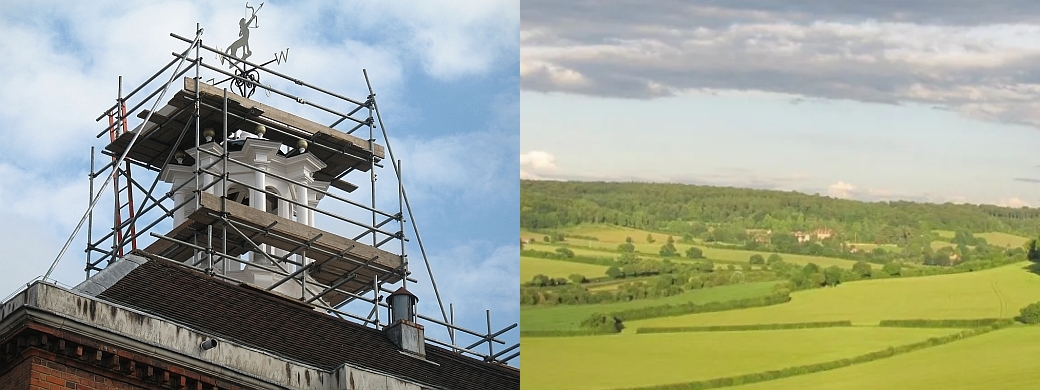
It wasn’t till very recently—the morning of 6th November—that I gave a name to the feeling which has dictated the themes of this blog for the last six years. Mind you, I don’t think it needs to be named, being as varied and omnipresent as the whole world. But since the pilgrimage of this linked series of posts is focused on God, a word I never use on my own account, perhaps I shall choose my own word for whatever it is I hold most precious. I’d spent a few minutes in a wilderness early on that damp morning, a nature reserve on a hillside behind some factories, and noticed how it instantly swept my head clean. I could not call it beauty, for it was beyond that. I call it the Presence, because it can only happen in the present, when you are present to the experience. And I could imagine shepherds in a pastoral age giving a name to that numen: which the OED defines as “a local or presiding power or spirit”. That’s a description of what it was like, not a belief.
And while we are at it, let’s make clear that a Wayfarer, at least on this site, is one who journeys or loiters in hopes of catching the Presence.
There’s a great deal more to say, so this remains . . . to be continued.
You raise a good point. People often talk of believing or not believing in God without really first clarifying exactly what they mean by “God.” I suppose for many of them, they're saying that they don't believe in the Judeo-Christian mythos. They don't believe in the God of the burning bush or the God who penned the ten commandments of Mt. Sinai. But that's not believing in the BIBLE and the specific things it claims to have happened. That's not the same as not believing in God.
And of course I'm not talking about your professional atheists (if there is a profession to be had in such a thing) but more people that I've known personally. A lot of them grew up, rejected Christianity, and went straight for Atheism without considering that maybe there should have been an intermediate stage, maybe there should have been some soul-searching, some moment of wondering, maybe there was still a story behind it all, one larger than the Bible, more incredible. I think, something like that, there should at least be a point where it's considered, if not embraced.
Beautifully written as always Vincent and this exciting Journey to the presence, perhaps a feeling of unity or tuning in to the universal consciousness that surrounds us all and some call God consciousness but to give it an existing name would take from your personal and unique experience. Will wait to hear from you more about it as mentioned in this post.
It is a good thing that you have decided to break up the post, so that is in easily digestible bytes.
Since reading your comment, Bryan, I've been wondering whether there is a profession to be had in atheism. Indeed there's money to be made in the form of royalties and general celebrity. The late Bertrand Russell & Christopher Hitchens stand witness to that, along with the still-with-us Richard Dawkins, but they all had day-jobs with somewhat wider scope.
But there are certainly leading atheists, who do the thinking for their followers. And if these atheists have a blind spot, their followers won't notice or will forgive. For there is blind faith in atheism as much as in their enemies. Just as there are possibly Marxists and Freudians still alive who can see no flaw in the philosophy of their idol.
Thanks Ashok. It is not so much breaking up the post but conducting a kind of research as it goes along. The natural rhythm of my writing is to produce an output of not more than 1800 words at a time, but I think the series on this topic has involved more work than ever before. For example I've written 82 pages of handwritten notes so far, covering the two most recently published posts and some of the ground for the next one. That's counting from an entry on 6th November first referring to “the Presence”.
And for the next one, I'm reading Rudolf Otto's The Idea of the Holy, first published in 1917. I think you might be interested in Otto. He was much travelled and knowledgeable about Indian religion too. Here's a brief quote:
“Durga, the 'great Mother' of Bengal, whose worship can appear steeped in an atmosphere of profound devotional awe, is represented in the orthdox tradition with the visage of a fiend. And this same blend of appalling frightfulness and most exalted holiness can perhaps be even more clearly studied in the eleventh chapter of the Bhagavad Gita, in which Vishnu – who is yet to his votaries the very principle of goodness – displays himself to Arjuna in the true height of his divinity.” (p.77, Pelican edition.)
There is bliss not only in the Presence, but in the Path that leads to it, and in the Receptiveness through which it is perceived.
Thanks Vincent.I have made a mental note of Rudolf Otto as a worthwhile read Vincent. My blog on the gods and goddesses of Nainital discusses many of the said avatars of Durga, sweet and fearful ones both, the mother goddess in India and elsewhere
( http://nainitalgoddess.blogspot.com). Incidentally Queen Victoria is one of them and the blog has a pretty depiction of her too as do my novel (nude besides the lake) and another small booklet on the mother goddess Naini Mata ( both available at amazon).
I confess to being baffled at the idea of Queen Victoria as an Indian Goddess. A year or two ago i went on a tour of Osborne House, the residence designed for her by Prince Albert, and the guide told us many anecdotes of the Queen, none of which supported a view of her as a goddess. But the guide told us about the high-born Indian who attended her in her last years, enabling her to experience India at second hand, so to speak.
Ellie, this is fascinating, but I don't understand what you mean by the Path, and the Receptiveness. I assume you are speaking of your own experience. Have you written about it in any detail?
An individual's spiritual journey is what I referred to as Path. Because it is one's own, because it involves one's spirit, and because one travels it voluntarily, there is joy in claiming it, whatever sorrows it involves.
As for Receptiveness I speak of the internal ability of the human to receive the Divine Voice. There is a built-in receiver within man, his Soul, which he can tune to what you called the numinous. The God within is the receptive experience of God through which man connects with the eternal, infinite, unifying force which seeks to manifest itself in both the whirlwind and the still small voice.
Beautifully expressed Ellie,
“As for Receptiveness I speak of the internal ability of the human to receive the Divine Voice. There is a built-in receiver within man, his Soul, which he can tune to what you called the numinous. The God within is the receptive experience of God through which man connects with the eternal, infinite, unifying force which seeks to manifest itself in both the whirlwind and the still small voice.”
This is something I fully harmonize with. The built in receiver is the inner eye connected to the source of our feelings perhaps but different from our other senses connected to the mind.
Beautifully said, Ellie, in words which help put shape on my own thoughts for next time.
I must apologize to anyone who has subscribed by email for the spam comments you may receive following my recent decision to allow anonymous comments again, for the benefit of a few readers who don't have a “profile”. Fortunately these comments are given the treatment they merit and deleted automatically from the blog page. Let me know if the spam offends your inbox & I'll reassess accordingly.
Profoundly interesting and deeply moving.
For me, it has always been difficult to describe my spiritual awakening and the instantly, conscious awareness of the Presence of God.
I believe we're walking towards the Omega Point as expressed by Teilhard de Chardin. Or it could be differently worded elsewhere.
Using the name of God, I think: “God always was. God is. God ever shall be.” What a Gift to feel, to know His Presence. I could say more. I'll wait for your next chapter.
Claude, I hope you will say more, and thanks for these words of encouragement.
I first visited Paris in 1959, staying with an English relative who worked at the British Embassy. Had I heard of Père Teilhard, he asked, mildly surprised that I hadn't, though I was a schoolboy of 17 who knew little of the world. I thought Paris must have been a-buzz with Teilhard's name in that year, till I checked him up just now and discovered that in 1959 Le Phénomène Humain was first translated into English, which explains things.
I've just pulled down from my shelves a copy of Hymn of the Universe, my favourite amongst his books & one which harmonises very closely with my own view of the relation between matter and spirit. But I don't have a view about his Omega Point; don't personally see the need for such a belief or hope. I also have a biography of Teilhard by Vernon Sproxton (SCM Press, 1971) – well worth reading for getting to know the man behind the books.
You sound like a voracious reader of worthy and philosophical works Vincent. I on the other hand mostly read the trees and flowers of the forest 🙂
Now I'm envious of you Ashok. The weather here has been too cold lately to go into the forest to read trees and flowers. I've had to wear two pairs of gloves, one inside the other.
Worthy, yes I suppose. I haven't mentioned the unworthy books that have recently come my way by accident, such as Nicholson Baker's The Fermata, & Helen de Witt's Lightning Rods, which share a rather similar theme …
Over here we end up with a summer that is too hot instead. That is the time I guess the direction of envy shall reverse unless I get an opportunity to visit the Himalayas again.
Right now, yes, the weather is delightful here when just a pullover or a light jacket will do and the sun is deliciously warming. Beginning in the last week of this month though it will be colder for a few weeks.
The two pairs of gloves reminds me of the times when I was in colder places, up north in India or Canada. Over here there has never been the need for even one pair, although I do feel more comfortable with socks on, a sign of aging most likely.
For sure you are a prolific reader and they say it is one of the finest indoor hobby there is, especially when one has to stay indoors.
somehow, during the first sixty-something years, i had failed to engage with this lovely word, “numinous”
so thanx for that !
You're welcome. It took me all of seventy years to engage with the word “numinous”, not that I'm trying to be competitive.
Is Tristan really your name? I ask because I burdened my eldest son with it, to his chagrin, so he changed it to Elwood in defiance (after one of The Blues Brothers) & changed his surname for good measure, to match my father's, after I discovered my own paternity, late in life. Whereas I keep my given surname of Mulder, which one of the X-Files characters thought so cool he copied it.
Ashok, I went out in walking boots this morning determined to go a-wayfaring in the hills and dales without any gloves because it's mild; but the rain changed my mind, and home feels delightful after that, books or no books.
[…] Presence: the numinous in everyday life […]
[…] https://strangeparadox.blogspot.com/ https://rochereau.uk/2012/11/19/the-evolution-of-god/ https://rochereau.uk/2012/12/02/presence-the-numinous-in-everyday-life/ https://rochereau.uk/2014/10/09/a-ramble-through-landscape-hypermedia/ […]