
 One of the most stylish and effective films I’ve recently seen is The Man Who Wasn’t There, starring Billy Bob Thornton. Set in 1949, it tells the story of Ed Crane, a small-town barber, who faces life with an eerie impassivity, whilst not enjoying his job, becoming a cuckold…
He cuts the hair of a travelling salesman, whose dodgy toupee, sales pitch & general demeanour would raise the suspicions of the average person, but Crane is not average. He is convinced by the salesman’s proposition, that it would be good to buy into this new-fangled technology and open a dry-cleaning franchise for the measly sum of $10,000. But how can he get his hands on that kind of money? He thinks of a way. Things start to go inexorably, inextricably and ineffugibly downhill after this, in the manner of a Greek tragedy . . . except that the genre is called Film Noir. Instead of the unities of time, place and action, the classic form involves a lot of cigarette-smoking; a major police investigation with various false trails and little real progress; a rugged hero who usually shows little emotion, but whose facial bone-structure shows up well in studio lighting;—and black & white photography. Amongst the bonus features on the DVD’s was an interview with the English cinematographer, Roger Deakins, who waxed lyrical about black-&-white. He listed a number of films which had influenced him, including In a Lonely Place (1950), starring Humphrey Bogart as a much sought-after screenwriter, whose artistic temperament sometimes flares up in violence. Lots of smoking, studio lighting that shows Bogart at his most seductive and sometimes at his most ugly, a police investigation whose verdict comes too late . . . A tragedy marches towards its ineffugible conclusion.
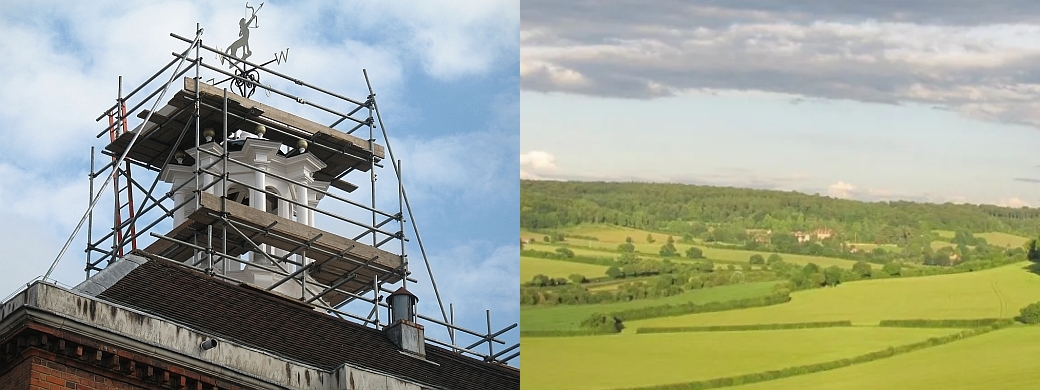
On several Spring days, I’ve been out walking amid April showers & with my birthday camera. Everything I saw had a marvellous depth. Every picture I snapped was gorgeous with fresh greens, but turned out flat and disappointing. So I tried black and white.
Why does black-and-white, “grayscale” to be precise, give a better sense of depth? What makes it more exciting, crisper? Is it merely my imagination? Well, as for the latter, without imagination there is no seeing at all. “I Am a Camera”, said Christopher Isherwood, but he lied for poetic effect. We are better than the camera. We must not surrender to its offer of colourful cornucopias. The more realistic the artificial representation appears, the more we let imagination doze, and pretend we are seeing the real thing. Paradoxically, the stylized artificiality of Film Noir frees the imagination and touches our soul; whereas the realism of colour movies, especially in 3D as in the recent conversion of James Cameron’s Titanic (1997), keeps the imagination shackled and earthbound, in mechanical fear and primitive wonder.
You may disagree, and if you do, Variety Magazine is on your side; but to me, less is more. I think I prefer Film Noir.


Comments:
Bryan: I absolutely love that movie! The plot, the characters, the dialogue, and of course, as you said, the indispensable use of black & white. Color would have completely ruined that movie. The black & white brings out such a rich texture of everything, perhaps because the eye can focus on it in a purer form. There’s something always a bit more “abstract” about black & white too. I’m convinced that one of the reasons they’ve never been able to successfully bring back The Twilight Zone series is because somehow the show just doesn’t work in color. The black & white and the cheap sets somehow give it a more conceptual feel that works well with the idea of the show. The remakes come off like cheesy soap operas with low budgets and bad acting. Of course, it probably doesn’t help that Rod Serling is dead either. With Black & White it’s all about how it’s done too, though. The Coen Brother’s have always been good with cinematography to begin with. Darren Aronofky’s Pi (another recent b&w film), on the other hand, looks like crap by comparison. Instead of The Man Who Wasn’t There’s rich texture, the contrast is up so high that it looks like you’re staring at ink blots at some points. It comes off seeming like he used black & white just to be “artsy” without really understanding it’s advantages. As for Titanic in 3-D, I really can’t think of anything more pointless than that, although I haven’t seen it in 3-D and don’t plan to. The movie itself was also a beautiful-looking film and I’ve always liked it, but this re-release comes off like a director obsessed with his latest toy and also looking for any old cash cows he might be able to dust off and squeeze a few last drops out of their dried up udders.
Darev2005: In my humble opinion, black and white makes you use your imagination to conceptualize the color of the scene. It gives you something to think about, even subconsciously, and engages your brain in a way that color films and pictures do not.
Claude: I grew up in an only-black-and-white period (photos and films). I never really took to colour. But we had to accept it when non-colour became hard to get (and more expensive for cameras). My favourite Titanic film is A Night To Remember, based on Walter Lord’s book. Only true facts, and a black-and-white masterpiece.I’ve seen and enjoyed many of the “Film Noir” genre without knowing they were classified as such. An addition of colour to them often diminishes their cinematographic beauty and intensity.Your photos are superb!
darev2005: And for the record, I loved your pics. I bookmarked the page and plan on looking again. Are you going to add more?
Charles Bergeman: The Artist was mostly black and white, and silent.While it did eventually incorporate color and sound, it was separated from other recent films by its lack of color and sound. I have found that younger audiences are put off by B&W. I am proud of the fact that I brought my daughter up to appreciate old films, even silent ones. She has tried to get her friends interested, often to no avail. I love it, and appreciate when it is used, although it is used less and less today.
Claude: Thank you for bringing back, in my mind and heart, the memory of Abel Gance’s 1927 silent, black and white masterpiece, Napoléon. I saw it in Toronto, January 4, 1983. Carmine Coppola, who had composed the background music, (with “La Marseillaise” repeated many times), directed himself the Milan Philharmonic Orchestra, on that evening. What a tremendous experience! Afterwards, I bought the LP, with the book illustrating many scenes of the magnificent film.And now, with a bottle of Châteauneuf-du-Pape, I will listen to the music again and review the pages of Napoleon’s life, lifting my glass many times to your good health.Merci de tout coeur. À votre santé, Vincent!
John Myste: I guess I have to watch the movie now.
The above post uses the words ineffugible and ineffugibly, which are not recognized by this computer, It took a while to track down the meaning The OED acknowledges ineffugible but I’d have to pay £10 for a month’s subscription to this monumental work. Further digging gave me the Latin word ineffugibilis, meaning unavoidable, inevitable. No idea how I discovered it.