
He who binds to himself a joy
Doth the wingèd life destroy;
But he who kisses the joy as it flies
Lives in eternity’s sunrise.
This verse of William Blake is never far from me, internalised, imprinted upon my unconscious, and a work in progress. There is joy in being alive; breathing fresh air; having an intact functioning body; being usually not oppressed by worry and misfortune; being in community with my own species and with all of Nature, I mean the rest of Nature, for I am of a piece with it, a fully-working part of a continuum, a functioning whole. My nature is to touch joy and cherish it, take it to my bosom. Still, it’s not enough. There is the urge to capture and preserve this joy, to share it, to find words to preserve its form and colour for posterity. As if it wasn’t going to last, as if I should store up the surplus grain in case of lean years to come; in case somehow there is a shortage of this joy. Well, everyone thinks there is a shortage. The evidence is everywhere, like a drought; interspersed with the odd flash flood.
I’m pretty sure that when Blake wrote the words, he too was struggling with the meaning of what he said. As a poet, he wanted to take that joy, both its presence and its absence, and fix it, bottle it, like essential oils fixed within a perfume. That’s what poets do. And if ever a poet glimpsed eternity’s sunrise, and said which way to look for it, and felt the pain of what stands in the way, in the heart of men, in society, in the cheapening of humanity brought by the industrial revolution—William B was in that number.
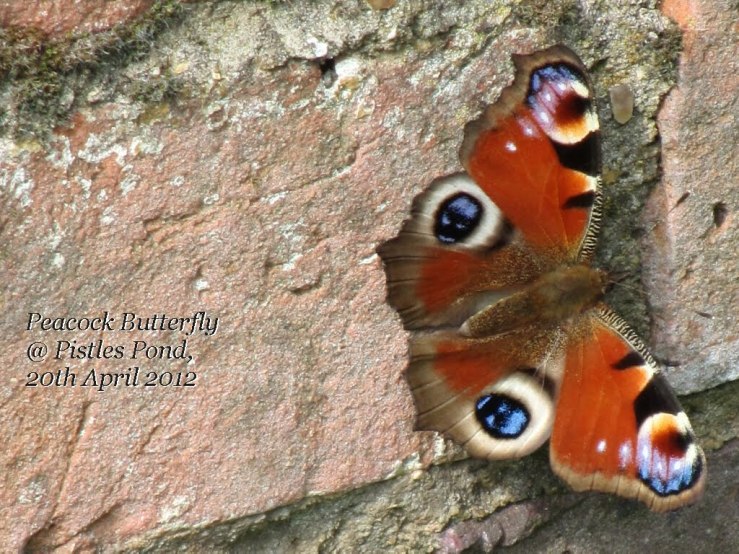
How do you bind to yourself a joy? We all know the materialistic ways: the sweat of your brow, the cunning of your brain accumulated into money and property. We give thanks for these, for human life is fragile. We know the traps. But I like to give those lines the most literal reading possible. When I try to capture the image of a butterfly or bird, the moment I expose my camera lens in its direction, it flies off. The photo above was an exception. Insects are sluggish in cool weather. This one wanted to rest its wings on the brick wall, was very reluctant to move. But why would I want to photograph these winged creatures anyway? I can get any number of such pictures on the Net. Maybe it’s a displacement of the hunting instinct. Is this “binding to yourself a joy”?
I do normally take a camera when I go on a walking trip, but most important is a voice recorder, so I can capture as best I can any sensation, feeling or thought. It’s so difficult, though. The sum total of all the inputs, the complete specification of my sense of now, comes all jumbled together in a second; and it cannot be held static and coded into words, because the next second something else happens. Why do I want to codify it into words anyhow? Well, words are more versatile, quicker and easier to learn than painting in water-colours for example. The camera never even captures what I see with these two eyes. All it does is jog the memory, like one’s soliloquy into a voice recorder. That little device is useful for birdsong, too. They’re all souvenirs, little reminders of the atmosphere to take away, and write about, and leave as illegible scrawls in my notebook, abandoned.
I guess what I’m talking about is an important part of the poet’s skill-set. Wordsworth wrote about it in quite a technical fashion: “the spontaneous overflow of powerful emotions recollected in tranquillity”. Perhaps he returned from his outings in the Lake District with little mementoes, such as a freshly picked wildflower: “A violet by a mossy stone, Half hidden from the eye, Fair as a star, when only one Is shining in the sky”. Or he would take along a notebook and pen: not easy, for the fountain-pen had not been invented, and even the steel nib was scarcely known. Perhaps he used a pencil. Graphite was first discovered in the Lake District. I found a link here to a poem he scratched with a slate pencil on a stone:
STRANGER! this hillock of mis-shapen stones
Is not a Ruin spared or made by time,
Nor, as perchance thou rashly deem’st,
etc etc; but I’m pretty sure that wasn’t his normal modus operandi.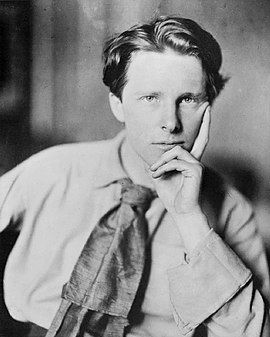
What really blew my mind in the poetic business of binding to oneself a joy, or possibly kissing it as it flies, but at any rate capturing it in words forever, was a prose piece by the English poet Rupert Brooke, whose name is instantly linked with his sonnet “The Soldier”, which begins
If I should die, think only this of me:
That there’s some corner of a foreign field
That is for ever England.
He did in fact die in a foreign field, aged 27, of an infected mosquito bite, and was buried in an olive grove on his way to fight in Gallipoli, in 1915.
Two years earlier, he took a trip to Canada and saw the Niagara Falls, writing about them in letters sent to the Westminster Gazette, from which I wrest the following excerpt:
Sit close down by it, and you see a fragment of the torrent against the sky, mottled, steely, and foaming, leaping onward in far-flung criss-cross strands of water. Perpetually the eye is on the point of descrying a pattern in this weaving, and perpetually it is cheated by change. In one place part of the flood plunges over a ledge a few feet high and a quarter of a mile or so long, in a uniform and stable curve. It gives an impression of almost military concerted movement, grown suddenly out of confusion. But it is swiftly lost again in the multitudinous tossing merriment. Here and there a rock close to the surface is marked by a white wave that faces backwards and seems to be rushing madly up-stream, but is really stationary in the headlong charge. But for these signs of reluctance, the waters seem to fling themselves on with some foreknowledge of their fate, in an ever wilder frenzy. But it is no Maeterlinckian prescience. They prove, rather, that Greek belief that the great crashes are preceded by a louder merriment and a wilder gaiety. Leaping in the sunlight, careless, entwining, clamorously joyful, the waves riot on towards the verge.
But there they change. As they turn to the sheer descent, the white and blue and slate color, in the heart of the Canadian Falls at least, blend and deepen to a rich, wonderful, luminous green. On the edge of disaster the river seems to gather herself, to pause, to lift a head noble in ruin, and then, with a slow grandeur, to plunge into the eternal thunder and white chaos below. Where the stream runs shallower it is a kind of violet color, but both violet and green fray and frill to white as they fall. The mass of water, striking some ever-hidden base of rock, leaps up the whole two hundred feet again in pinnacles and domes of spray. The spray falls back into the lower river once more; all but a little that fines to foam and white mist, which drifts in layers along the air, graining it, and wanders out on the wind over the trees and gardens and houses, and so vanishes.
When I read the piece, it first made me desire to see the Falls for myself. But then, such was the excellence of his description, just under 2000 words, that it had precisely the opposite effect. I didn’t want to see them at all! For if I did, I’m sure I’d come away with less than he witnessed, feel less than the way his words moved me from beyond the grave.
And that’s the kind of writing that I envy, that’s what puts me in awe. How he managed to reconstruct the experience. And Fernando Pessoa—coming back to him at last after the botched attempt of my previous post—says that it’s a tricky business to make his reader feel what he felt. If you try to say straight what you feel, if you try to achieve a “close fit” between your experience and your description, you won’t get it across. Your own inner experience is so unique to you, that no one else could feel what you feel in the same terms. So you have to convey it by some analogy or metaphor that your reader will comfortably recognize. As he’s fond of saying, the only way to tell the truth is to lie.
Hats off to Rupert Brooke, he wasn’t just a pretty face; and Wordsworth, and Blake, all the dead poets. And what about you and me?
27 Comments
Vincent
Acknowledgements to Project Gutenberg for the Rupert Brooke excerpt above, and to Wikipedia for his photo.
Bryan M. White
A fine piece, but then son was the other one. But hey, you do what you gotta do. Both touch on the enigma of possession, this time in the notion of trying to bottle the magic.Your opening lines put me in mind of the closing monologue from the film American Beauty. I would copy the quote here if I had access to the proper equipment. I considered naming my Night Owl blog “My Stupid Little Life”, and I think Googling that phrase will point you in the right direction. I think it’s appropriate, especially considering that the speech is delivered by a dead man.
Vincent
I like it when you call me son. I sometimes think of you as daddy. I like it that you can’t correct typos in comments too.
Bryan M. White Ha, I noticed that as soon as I hit the button, then I figured, eh, he’ll know what I meant. Seems Blogger can give us a pointless reply feature but no editing feature. (you’ll like that quote if you search it, though. I promise.)
Vincent
There’s a very good post by Rebb on the subject of journalling, which is closely related to the topic of this one.
Vincent
Wanting to get it in context, I watched the monologue you refer to, Bryan, on YouTube. I’d seen the film before. The voiceover was good, but the accompanying illustration of seeing one’s life in a flash …! If I had been the screenwriter, and saw what they’d done with my ending, chagrin would have tempted me to end it like Kevin Spacey’s character. Which is a cue to write about a few movies I’ve seen recently.
darev2005
Words, and the people who can use them well and bend them to their own needs, have always fascinated me. I guess it’s that whole “bending” thing that gets my attention. Poets no less than those who write prose. I would bow my head in respect to a Rhodes Scholar no more than I would a raving lunatic if one had a better mastery of words over the other. Case in point, there’s a quote from Hunter Thompson; who was indeed a raving lunatic but has always caught my attention with his way of using words like blunt instruments; that always made me nod in agreement: “Happy,” I muttered, trying to pin the word down. But it is one of those words, like Love, that I have never quite understood. Most people who deal in words don’t have much faith in them and I am no exception – especially the big ones like Happy and Love and Honest and Strong. They are too elusive and far to relative when you compare them to sharp, mean little words like Punk and Cheap and Phony. I feel at home with these, because they’re scrawny and easy to pin, but the big ones are tough and it takes either a priest or a fool to use them with any confidence.”
John Myste
Funny, I remembered this: He who would bend to himself a joy as this: He who binds himself to a joy So, I Googled it, and much to my disappointment, I still don’t know the right answer.
John Myste
I guess if you take the second rendition to be the “right” one, it makes more sense. Binding oneself to a joy taking away ones freedom is a clear concept. Bending himself to a joy, to me would suggest that he who “partakes” of the joy, much as if we said, “he who submits to a joy” or something. Maybe that is why the two disparate quotes. Perhaps people could not abide the concept of “bending oneself to a joy” and so they interpolated the text. Either that, or I am an illiterate who does not know the history of the two lines.
Vincent
John, thanks for this, it was my mistake from memory. I’ve done a comparison through Google, to see which version occurs most. It is “he who binds himself to a joy”. But i just know that that’s a misquotation. So I go for the next most popular: “he who binds to himself a joy”. The inversion of word order is typical of English poetry until the 20th century, in order to make it scan.
Bryan M. White
It’s been years since I’ve seen the movie. I remember that closing montage seeming a little out of place, but I don’t think I found it quite as objectionable as you did. In fact, that seems like an odd thing to take issue with. But what do I know? I suppose the movie would have been fine without it, at any rate.
Davoh
Erk, am a long way, these days, from a “pretty face” – and certainly not a “poet” in the strict sense of the word. However, reading ‘da rev’s’ comment, just thought to throw in the idea that “love” = “need”. Not very ‘romantic’; and probably dopily personal – but the two words do seem to be interchangeable; and explain much – to me. Depends on ‘value’, i guess.
Vincent
Davoh, you have stripped the carefully painted mask from the real face underneath, full of blemishes. Love is a romantic mask or screen, and our notion of it in the West is influenced on the 12th century troubadour poets, encouraged by Eleanor of Aquitaine, whose songs in the Provencal language were about the adulterous thoughts of the wandering minstrel who had fantasies about the Lady of the Castle. Longing for the wife of one’s feudal lord, a longing which could never be consummated (in theory). Then there was the love poetry of the Italian Francesco Petrarch in the 14th century, also expressing longing for the unattainable woman (Laura). This notion of love was quasi-religious. One reason I know about this – I studied French & Italian literature at university (a very inattentive student, but some of it rubbed off).
Davo
on the other hand our notion of it in the West is influenced of course .. the west of the Northern hemisphere .. heh.
Vincent
You’re right, Bryan, it is an odd thing to take issue with, and someone who had watched the whole film at once, instead of the last scene out of context on YouTube, would be accustomed to the style. I shan’t attempt to describe my objections now. That will come out in my next post.
Davoh
On the other hand – correct me if am wrong – but methinks encouraged by Eleanor of Aquitaine, came from the EAST ( of the British Isles).
Vincent
Davoh, you guys are honorary members, so long as we in the (original) West are allowed to share in the Dream Time, something I’m rather fond of. Many is the time I’ve looked in the mirror and wished for a sign of Aboriginal blood. It may or may not be the case, but I entered it on the UK census a few years ago, when they insisted on full disclosure of ethnic origin.
Vincent
As I understand it, Eleanor came from Aquitaine, in France, hence her name. But she married the English king Henry II and was mother to Richard I (the Lionheart).But I get your point all right. East is not always east, West is not always west, and Rudyard Kipling was spinning a line when he said “never the twain shall meet”. Such is poetic licence, my dear.
Vincent
This conversation would be assisted of course by the “reply” mechanism that Blogger so thoughtfully provided, whilst so thoughtlessly omitting a mechanism to correct typos. But I shall not be moved. Let our dialogues be interwoven. And Blogger is not to be cursed. It is the hand which feeds us, not to be bitten in our impatience. WordPress and the other one are so much worse.
[On August 22nd 2016 editor notes that the above remark about WordPress is an egregious example of sour grapes. I had no evidence that WordPress was worse.]
Claude
Long ago, a butterfly stopped near me. So beautiful to watch. I wrote about it.
Once, on a summer day,
A butterfly loved me.
Now I’m old and gray.
But once I was pretty.
Some men befriended me.
It’s gone and far away.
But not the brief instant,
The magical moment,
A butterfly chose me
And rested beside me.
I don’t think words or images can really convey our communion with nature. And no description, however accurate, can bring the moment back to life. Although everyone you mention certainly had a gift with words. You would be very disappointed today with Niagara Fall. It’s surrounded by commercialism. Hard to see it with Brooke’s eyes. I would just say, “WOW! Lots of water….” Not even the Toronto Star would pay me a penny for that line! And I doubt it will ever be mentioned in another blog. Nice to visit you!
Vincent
Nice poem, Claude. Neat and crisp! & nice that you come back. You should have a blog of your own, but till then, I hope you may post bits of your writing here, as a guest.For reasons of editorial licence, I had omitted to quote another part of Brooke’s same essay. Let me paste it here now, and remind you that he wrote it a hundred years ago:
The human race, apt as a child to destroy what it admires, has done its best to surround the Falls with every distraction, incongruity, and vulgarity. Hotels, powerhouses, bridges, trams, picture post-cards, sham legends, stalls, booths, rifle-galleries, and side-shows frame them about. And there are Touts. Niagara is the central home and breeding-place for all the touts of earth. There are touts insinuating, and touts raucous, greasy touts, brazen touts, and upper-class, refined, gentlemanly, take-you-by-the-arm touts; touts who intimidate and touts who wheedle; professionals, amateurs, and dilettanti, male and female; touts who would photograph you with your arm round a young lady against a faked background of the sublimest cataract, touts who would bully you into cars, char-à-bancs, elevators, or tunnels, or deceive you into a carriage and pair, touts who would sell you picture post-cards, moccasins, sham Indian beadwork, blankets, tee-pees, and crockery, and touts, finally, who have no apparent object in the world, but just purely, simply, merely, incessantly, indefatigably, and ineffugibly to tout.
”Ineffugibly! Says the Oxford English Dictionary: ineffugible, adj. Etymology: < Latin ineffugibilis .Obs. rare: Inevitable.
Claude
I’m falling in love with Rupert Brooke. “Tout” and “ineffugibly” are metagrobolizing and exciting words for me. Never heard them before! I have to say I grew up French Canadian, plunged in English immersion at 24, and have been in a learning process, ever since. Still a long way to go!Thank you for your kind hospitality. Will certainly visit you regularly, and share when the spirit moves. Best Wishes!
Hayden
hats off, indeed, to you my friend! It’s been so very long since I’ve stopped by – longer since I’ve blogged. But I opened the page and with the first words sank back, settled into your warm words like a comfortable couch that supported me and led me dreaming down the path you laid out. It must be a mental path, of course, else I’ll need to get up off of that couch to unmix my metaphors, (smile). Rupert Brooke – read him many years ago, no doubt he’s packed away somewhere. Good to have that name brought back to tug at memory. Lovely post.
Rebb
Vincent, There are always many directions that your blogs can take me. I usually have a camera with me when I go on walks also. I tried the tape recorder option. It simply doesn’t work for me. But, occasionally I will take out my iPod Touch and record the sounds around me. This excerpt of yours stood out to me:”The sum total of all the inputs, the complete specification of my sense of now, comes all jumbled together in a second; and it cannot be held static and coded into words, because the next second something else happens. Why do I want to codify it into words anyhow? Well, words are more versatile, quicker and easier to learn than painting in water-colours for example. The camera never even captures what I see with these two eyes. All it does is jog the memory…”I often can’t keep up with my thoughts, but I end up with lots of pieces. One of my new challenges is that I can’t remember what I’ve wrote in whichever notebook or on the computer, so I have to go through page by page, salvaging what may have been a glimmer, an emotion wrapped in words. I did come across an old notebook from 2002 that still has many pages left in it, which I used strictly to record my thoughts on certain books I was reading. Since reading through it this weekend it has brought me back to Ayn Rand’s “The Art of Fiction: A Guide for Writers and Readers.” I never finished it long ago, but have restarted it and am enjoying it very much. For me, the photos I take do more than jog my memory. Often I will notice something extra that I didn’t see or feel when I clicked the button. I wrote in one of my blogs that I take photos with my words and with my camera. One informs the other–That’s my truth, anyway. I’m sure you know this poem, but I’ve attached the link because your blog made me think of it. I love it. Poetry Pablo Neruda http://www.poemhunter.com/poem/poetry-2/p.s. Thanks for mentioning my journaling blog. : )
Vincent
Rebb, I can relate to all you say in this. I haven’t checked out the Pablo Neruda yet, but your mention of Ayn Rand (about whom I harboured a negative prejudice) has inspired me to order one of her books, price one penny (plus postage from the States!) It’s her debut novel We the Living. Have you read it? On Neruda, have you seen the Italian movie in which he’s a character? It’s called Il Postino. I think you will love it.
Vincent
Hayden, I’m so delighted! Sometimes i feel I am counting the months of your absence, especially as I’ve been going back looking at old comments, stretching over the years. Now that I don’t see your blogging presence any more – please advise me if I’ve missed something – do i have to come and visit you face to face on my next visit to the States (sometime in the next ten years)?
Vincent
I had to read one or two French Canadian authors on my university course, Claude, a half-century ago. The name(s) don’t come back to me straight away, or even anything of the content. But the whole idea of French Canada fascinated me: how did it look from that perspective? Claude, when are you going to start your own blog and pour your lifetime’s experience into it?
 a wayfarer’s notes