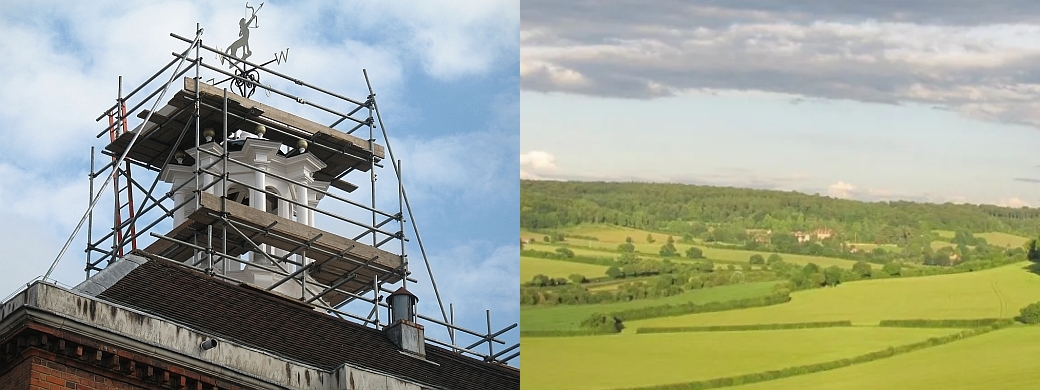

 Things are happening in hedgerow and pasture; a spate of fresh worm-casts; larks twittering; occasional sardonic comments by crows. A suddenly-surprised pheasant flaps away from me, going airborne in its panic, plumage bejewelled and voice like a rusty klaxon. Last year’s sunflower-heads, haggard and desiccated, stand witness to the kindness of supplying winter provender for hungry young pheasants, so they can be shot by businessmen in September. That’s farming, part of the pattern of birth and death.
If I were a farmer I’d be surveying the renaissance of these meadows and hedgerows with a prognostic eye. But I’m merely an observer, with no vested interest, no trained eye. I see how the birds, thorn bushes, nettles and wildflowers awaken, each in turn looking to extend its reach. They must sample the wind, temperature and humidity; note the lengthening days and brighter sky. Intelligence distributed in each being, not just brains and instincts, must surely determine when to continue in hibernal mode, when to let the sap or blood quicken for growth or mating. Merely as a wayfarer tramping by in mud-caked boots, I sense all this; using reason only to unravel what I have sensed and convert it to prose.
People refer to “dumb animals”, but the perception is false. In the universe of all living things there is knowledge and wisdom, equally wondrous in every creature. Instinct, acquired skill and reason are equally wonderful. Naturally we extol reason, as one of the defining attributes of the human ape, a gift which matures in each individual. But it’s no more wondrous than the other two.
Instinct is knowledge and wisdom in its stored form, already present in the seed or ovum. No scientific insight can dim its glory. In us, instinctual nature has not been superseded.
What the autonomous systems do within our bodies cannot be replicated by reason. These systems keep us alive in almost every varied circumstance, till things become too hostile for our continued singular existence, and we revert to the clay from which we were fashioned. Intellect is not the master of all it surveys. We (our conscious intellectual selves) are wholly dependent on hidden bodily mechanisms. We can’t control them and we cannot replace them with thought.
We acquire many skills in life. The baby takes its first steps, speaks its first words. These are observable milestones, but the skills go on becoming more complex. The underlying mechanisms might be understood and documented in books; but their execution is beyond analysis and cannot be learned from books.
As for reason, we won’t get far without it, “we” meaning I writing and you reading. It differs from the other pervasive forms of intelligence, which make the universe hang together as it does, only in one thing: its spontaneous inventiveness. For example, without the faculty of reason we could not make up new sentences to suit the occasion; nor understand them. Our language would be a set of clichés derived from a phrase-book.
At this moment, in this meadow, I don’t want to talk about reason. It seems too lumbering and insensitive. This hedgerow seems almost inert but it responds to a different timescale, hears a different drummer as you might say. If it were filmed and then speeded up, we’d see how exuberantly it lives, how joyously its component plants and living creatures adapt and coexist, in a great jazz-dance of nature. Yet the excitement can still be felt.
Some of the signs of human industry are a mystery in these rolling meadows; archaeological remains of the very recent past. I saw at the edge of a field, in the shade of an ancient hedgerow, some huge paving stones which seemed to hide something beneath, like the entrance to a cave or sewer, with a neat pile of about 50 bricks on one corner, as if to prevent the stone being lifted. I could not make sense of it.
There was a time when most phenomena could be ascribed to God because no other explanation was available, and this ascription had the advantage of uniting everything known or unknown. You could talk of Divine Providence, as I still do, without any prescribed worship. It’s true that today, there are more explanations, but they don’t diminish Providence: they fill out the rough outlines with more detail, a kind of fractal recursiveness. I’m confident that mysteries will always outrun explanations.
What I see in these fields, cultivated for two thousand years at least, is effort: by man but also his near and distant relations. Impulse precedes effort. For the miracle of life there has to be potential energy. Most of it comes from the sun. Then there has to be purpose, at any rate, that’s what I lightly believe. If you say it was randomness I will not burn your books. Potential energy is there but purpose-driven impulse, I think, is what lets off the brakes so that potential energy turns into kinetic. Or to put it another way, Nature doesn’t fool around in mindless interaction for its own sake. Ask James Lovelock; he’s spent his life gathering evidence. Not that nature is perfect. It makes mistakes. We have only to look at ourselves, or (to see them more readily) at one another.
I seem to gain a kind of direct knowledge, tramping these fields: a peripatetic philosophy open even to the illiterate, like a ploughman who walked these fields a few centuries ago, whose entire spoken eloquence derived from the Bible cadences he had heard. I see that human separateness—from one another and from the rest of Nature—is an illusion; a necessary one, whose potential is built-in and whose actuality is gradually learned in early childhood. I call it the primary illusion, from which others
derive along with philosophies and religions. I have no authority to say it’s an illusion, other than personal certainty derived from intuition whilst passing through landscapes, and confirmation from others* who have travelled the same paths, viewed the same reality.
* See for example The Spell of the Sensuous by David Abram
Thoughts on “Let Spring be my muse”, heavily edited after I’d repeated some foolish rumour that the human genome could be stored on a CDROM
Bryan M. White
If there’s a bustle in your hedgerow,
don’t be alarmed now.
It’s just a spring clean for the May Queen…
Instinct is a fascinating thing to me. It’s seems like something almost supernatural, but I’m sure that’s largely because I’m not initiated into the biological mysteries of how it works. Still, the idea that a bird is pre-installed with instructions to build a nest, or a beaver to build a damn, or even a dog to eat it’s own feces so it doesn’t leave its scent lingering for predators, is just mind-boggling.
E.B. White made an observation about instinct that really seems to sum up the essence of it. He observed a lamb being born. As soon as the lamb was dropped, the mother responding to her natural instincts, immediately turned and began licking the after-birth off the lamb’s face, clearing it’s nasal passages so that it could breathe. White said that mother of course didn’t realize that she was doing this so that the lamb could breathe. She just had a sudden, inexplicable craving and urge to lick the after-birth off of its face.
Also, I like what you’ve said about reason here; some common ground for once. And, of course, it goes without saying that you’re right that our bodies run as machines are set to run in an automated factory and not at the discretion of our reason. This much is obvious. The interesting question that arises then is where the line is drawn between the mind and the body, the question that Freud and contemporaries struggled with (and people are struggling with today.) Still, regardless of where the line is drawn, I definitely agree that our reason operates on top of a foundation of physical impulses and drives, and it’s hard to imagine where we would be left if those impulses and drives were removed, if say, the human race were superseded by sentient androids that never got tired, never got hungry or aroused. What would they do with their time?
Bryan M. White
“Or, to use a different simile, suppose that what you get in a sequenced DNA is a radio set pre-tuned to a certain station? The content is then beamed in from some source.”
Yes, this is interesting notion, especially when you consider, as I imply above, that instinct is in the body, rather than the mind, and therefore obviously encoded in the DNA.
This reminds me of a similar conundrum that has puzzled me. If the universe is nothing but inert matter and blind physical forces, and it arose on its own from that matter and those forces, then how has it given rise to consciousness? For instance, if we were to succeed in creating an artificial intelligence that was truly conscious, we would only be able to do so because we are conscious beings ourselves. We would be modeling it after ourselves. The AI would not exceed us on a metaphysical level. The precedent for consciousness is already set and the AI would be outgrowth of that, consciousness born from consciousness. So wouldn’t the same be said for us? Wouldn’t we also have to be an outgrowth of a preexisting consciousness?
There may be some flaws in my logic here, I admit. But I do think that the fact that you can put a bunch of matter and chemicals and code together and make a living aware entity called a human being is a mystery that no one has adequately explained.
Bryan M. White
I think I know what you mean about evolution too. There is always this nagging sense that there’s a sort of…leap of faith required behind it all. Not faith in HOW it works, which is really so simple and elegant that a child could understand it once people get past their basic prejudices and fears about it. No, the faith seems to come in the very notion of the elegance itself. It all works so neatly, that one almost can’t help but sense some spirit of benevolence and order behind it all. Perhaps this is only another layer of prejudice, a yearning that there’s something
Bryan M. White
For instance, you mentioned giraffes a few posts back, I believe. Now, we can all pretty easily wrap our minds around the idea of wild horses living in an area with high growing vegetation, and the horses with the longer necks having an advantage over those with shorter one. In the cruel world of nature where they don’t have programs like “No Child Left Behind” we can see how the shorter horses would die off in a few generations, leaving only the ones with longer necks.
But then, when we expand this idea, generation upon generation, where this competitive process eventually leads to grotesque horses with necks longer than their entire bodies, we have this sense that we’re being rushed headlong into something that we haven’t adequately had the chance to think through, as though we’re signing a legal document that we haven’t had time to read. Again, this could just be our human prejudices, the fact that we’re not really equipped by the limits of our own experience to think in terms of the millions upon millions of years required for these things to work.
Bryan M. White
By the way, I really owe you an apology about the other day. We’ve had our differences before, but I don’t know what the hell I was going on about this time. I was just shook up about those kids dying – everyone has been really shook up about it around here – and it was going round and round in my head all week and I think I just needed to take it out on someone. But of course, I was being ridiculous, and clearly the whole thing has nothing to do with you, and it was unfair to take it out on you, and I really am very sorry.
Vincent
Bryan, I felt that it had nothing to do with me and told you so at the time! One only feels pain when the arrow strikes home.
But I can feel a little of what you must have been going through. Even a street accident involving strangers, viewed from a distance, haunts me for days, though that’s obviously something entirely different.