

Books I’ve recently read convey snatches of the lore whereby sacred places may be recognized and visited. I find myself wanting to quote from them. But I must refer only to what I know, sketchy or part-submerged in the subconscious as that may be. David Abram for example speaks of certain peoples, on the fringes of our civilization or beyond, whose languages don’t stretch to distinguishing space and time; or not as definitely as ours.
For the Hopi, there is what we would call a “manifest” reality, and another that we might call the “manifesting”, or that which has not yet come to pass: including what we call the future and what we call the human mind, with all its dreams and plans. Whenever we make ourselves think rationally, we in this Western civilization (fast becoming a mono-civilization, such is its all-devouring power) apply the template of Science, mono-science, if you will; which asks us to see space and time as separate dimensions.
Abram also examines the phenomenon of synaesthesia, whereby one sense blurs with another. So that for example in our alphabetic written languages, letters strung into words and sentences are read with the eyes yet felt internally as sounds; whereas someone’s spoken words are heard with the ears yet felt internally as spelled a certain way. And in this we see how much our education has shut off our sense of wonder, to the extent that we take for granted vast realms which don’t exist in oral civilizations, those people with vivid traditional culture but no writing. We are not aware of our blinkers. We don’t give indigenous peoples, those “primitive savages”, credit for their own forms of science, which enable them to survive in harmony with nature in ways that we might envy. They have their own scholars and adventurers too, those shamans and hunters and guardians of oral lore.
What is a sacred place? Is it mainstream or occult? Both. I like to define it simply as the place where one might go on a pilgrimage, as to Lourdes or Mecca. In Chaucer’s Canterbury Tales, all kinds of person join for the trip to St Thomas’ tomb. Why? Because there you could touch relics of the murdered Thomas à Becket and benefit from their magic healing powers. People, not all Catholics or even Christians, still flock to Lourdes, for the same reasons. Not all do it for self-healing but they get something from it all the same. My ex-wife used to go, taking one of my socks along to dip in the healing spring, to see if it would cure my chronic illness whilst I stayed behind. Did it work? Possibly, if you allow its effect a long germination period; for it is incontestable that ten years later I was instantaneously cured.
It’s easy to be sceptical and to apply prejudice against superstition. I’ve known my neighbour as a man with many worries, money being not the least of them. He went on the pilgrimage to Mecca, the Hajj. It’s not a cheap package. This was a few months ago. He came back so glowing, I felt it strongly myself and the other Muslims in the street visited his house on their own mini-pilgrimage, to get a taste of it. It might have dimmed a little now, but his worries still don’t seem to have returned. I firmly believe the Hajj to be a superstitious ritual, but as to its beneficial effects, I’m a believer.
For me personally, the sacred place is not superstition but empirical fact. I’ve identified many such places at various times over the last twenty years. You may ask what I mean by this. In the course of my wonderings, I would come to a place where it felt good to be.
Then answered Peter, and said unto Jesus, “Lord, it is good for us to be here: if you will, let us make here three tabernacles; one for you, and one for Moses, and one for Elijah.”
Yes, I felt like making a tabernacle there. But the place would remain unmarked, except in my heart. When I visited again, from curiosity, the feeling would be the same, only more so: stronger each time. So I could imagine from this, that the power of a place revered by many people over hundreds of years would be stronger still. And if this sounds bizarre, consider ferromagnetism, before it was scientifically understood. Stroke a needle with a lodestone, float it in water and see it point North. Magic, surely.
So that’s a kind of introduction to what I have to say. Two weeks ago, I had just finished reading David Abram’s The Spell of the Sensuous. I didn’t feel myself in the position to write a book review. That would require me to stand outside it, with a modicum of objectivity; whereas I had devoured it whole, like a python its prey. A gradual process of absorption was taking place.
That morning, I went to a diagnostic centre to have my neck X-rayed. I asked the technician to show me the images and say what they meant. There turned out to be nothing deadly, more of an age-related, wear-and-tear thing. To get to the X-ray place, I’d gone on foot through a self-styled Nature Reserve, a shrubby hillside criss-crossed with footpaths. It’s my standard route for destinations due South, a little muddy sometimes but perfectly navigable. On the way back I took a different route, different hillside. My house is in the main valley, where a little river winds between the old factories and workers’ cottages. Unless you go due West or East, you have no choice but to climb steep hills or the gentler slopes that separate them. I speaking as one pedestrian to another. Driving a car, you wouldn’t bother yourself much with the lay of the land. I was wandering randomly because lost in thoughts, telling them to my voice recorder. I expressed joy at the sudden realization that reason and science are not, in fact, my enemy. I can use all my intelligence, and even be a scientist, gathering data every day. But it’s a different science, one which has continuity with Abram’s “indigenous oral cultures” as well as the more modern tradition of phenomenology, which could be called the science of subjective experience. I felt I was ready to come in from the cold, no longer alienated from the society all around me. I wasn’t condemned to pointless eccentricity, constantly paddling my boat upstream, against the comfortable flow. I could go on living a half-dream-world existence, but be part of a recognized movement essential to the revitalizing and rebalancing of human society, and therefore the entire ecosphere; for both are going sadly askew. It was a good feeling.
At the end of my rambling monologue came these words: “And at this very moment, I am now discovering new footpaths, the most wonderful birdsong, new vistas—and it’s all so near where I live.” So there it was, a newly-discovered secret, a sacred place just half a mile from my house. Till then, I’d assumed I knew every footpath for a radius of several miles.
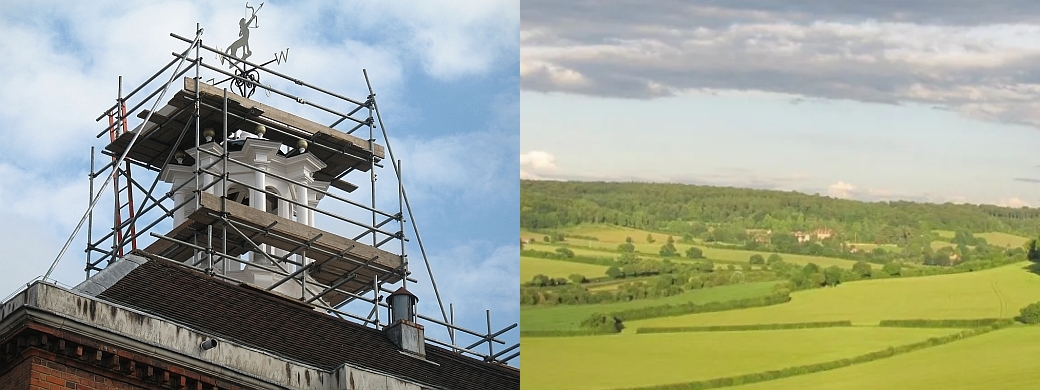
With intent to investigate this wonder, I’ve returned there several times since: to dictate ideas, take photos and record the birdsong. Karleen and I went together yesterday. I’ve put together a short YouTube video, with still photos and ambient sound (birdsong & barking dog), designed to show that a sacred place need be nothing special, just some disregarded part of one’s neighbourhood. In this case a low-rent housing estate managed on behalf of the Council.
Below is what I, in conjunction with the sacred place, dictated. The words sound like a recipe, but I prefer to think of them as a lab report of things which helped me tune to the magical.—–
Find a sacred place, enter into its spirit. It doesn’t matter where or what. New spaces can be created where none existed before, as in literature, painting, cyberspace. But your body, your senses, demand to be outdoors, in the great shared space, breathing shared air under the common sky. Obey those senses.
You have to tune yourself to the magical. There are various ways. You have to be directly connected to the space you are travelling through. You cannot be in a car. You could be on a bus, but the space you connect to will be the interior of the bus, with the specimens of Nature it contains at the time. To help in tuning, try sunrise and sunset; a patch of clear sky; a wall, fence or tree glowing with reflected rays of the sun; a sense of focused expectation, fostered by the performance of ritual; fetish objects, or previous encounters with the place. Fetish objects might be the things you take to the place, such as walking boots, camera, voice recorder, a notebook and pen given by a loved one. For novelist John Cowper Powys, who understood this topic far better than I, it would be a walking stick.
What do you tune to? Lightly banish from your mind all concept of the picturesque, for this can only chain your vision to stereotypical beauty. In some cultures the shaman might use a psychedelic drug, such as peyotl. But these are not necessary, and may coarsen the sensibility. What you are looking for is a crack in the world, through which you can pass, not to escape to a different reality, but to view the same locale in a new, more glowing light. And remember always that you cannot make anything happen. You can only prepare yourself to receive a gift.
Various auspicious signs may occur, which help you tune to the miraculous. I guess they are individual. Their significance arises from your own personal history. The more you cherish them, the more potent they become, just like the sacred place itself. It gathers power with each visit. For me, the following signs are always auspicious: washing hanging out on a line, dogs barking, children playing, bubbles or balloons floating free, a dead-end road which continues in an almost-hidden footpath, the sight and smell of smoke, the loud song of birds especially the blackbird’s, the cheeky behaviour of a group of sparrows, mysterious noises from an unseen source. Scents of every kind. Tutelary clouds that hang above the horizon. Mothers with prams. Small black children. Bicycles thrown carelessly down, trustingly left. Unexpected sudden vistas. Being looked at by any animal, whilst it decides if you are too close for its comfort, especially if it is too young or incapacitated to escape; or a rat which regards you without fear. Become aware that your whole life is magical, its preciousness infinite. Reflect that when your time is up, you’ll be ready to leave without a struggle; because you have truly lived, you have eaten the fruit of the tree called Now. Its abundance exceeds all possible appetite. How can you be greedy for more?
The encounter with a stranger: perhaps a dog-walker, perhaps at a bus stop. The eavesdropping of conversations on a bus, perhaps the loud chatter of girls just come out from school. A gathering of sparrows in a hedgerow of thorn-bushes. A growing awareness that everything is significant—everything human and non-human, including the coloration of the clouds. Everything becomes significant, speaks its own meaning. The riches of Now is too much to take in. It becomes silly to photograph everything, describe everything in words. Even if you (Heaven forbid) lost some of your senses, became simultaneously deaf and blind, like Helen Keller, there would still be an overabundance of significance: the scents, the feelings on your skin, the vibrations of things in the wind, the taste of the air. Yet here and now I have two eyes: I can have my being in this world of perspective, and walk amongst these hills.
Five years later, editing this post, I wondered what cyberspace had to say about “sacred spaces”, and found a book this site, from which I’ve excerpted this, from its author, Martin Gray:
There have been three primary motivations for my research and travels to the world’s sacred sites. One motivation has been to gather evidence showing that pre-industrial cultures throughout the world recognized the Earth to be a sacred being worthy of deep respect and gentle treatment. Studying the development of sanctity at sacred sites, it is clear that many ancient peoples had a reverential relationship with the living earth. If such a relationship can be reawakened and encouraged in our own culture, we will be better able to address the crisis of worldwide ecological degradation. Many people, after viewing this website, report a deepening of their connection to and concern for the Earth. From such deepening arises a commitment to personal behaviors and larger social actions which make positive contributions to life. This website is therefore a powerful tool for assisting the emergence of global ecological consciousness. . . .
“An Error Occurred. Please try again later.” Damn video!
There was a spot that I used to like to visit with my old dog. He required a lot of variety in his walks to…get things moving, so it was necessary to constantly try different paths and routes. One such route took us along a small side street which came to an abrupt end at a large, circular, muddy, clearing that appeared to have been left behind from some long abandoned effort of land development. I had a special affection for the last house on this street, just before the clearing. It was small, cramped little ranch house with a side yard bordered by a wooden fence about ankle high and fringed by all sorts of blue and yellow wildflowers.
I day dreamed a lot about living in that house, and I still do even away from the place. It means so much to me to be able to visit a place like that, even in my mind. Returning there in person is like renewing and refreshing the vitality of the dream, just as the details begin to grow hazy and the colors of the flowers begin to fade.
Unfortunately, my new dog is much more a creature of routine than my old one. She stubbornly follows the same path like an old draft horse, as though she's worn a groove in it. Any attempt to go somewhere new is met with resistance. As a result, I haven't been back down that street in a couple of years. But you've made up my mind. I'm heading back there the first chance I get. (I'll keep my eyes peeled for any “cracks” in the world.)
That “crack in the world”, I must confess, was a borrowed metaphor; in fact a misquotation as far as I can determine. I was thinking of Douglas Adams’ The Long Dark Teatime of the Soul, in which it slowly dawns on the detective Dirk Gently that the tramps hanging round Kings Cross Station, & on their way to the Victorian gothic St Pancras Station, are also immortal gods, going to a big meeting at Valhalla. So he follows them but they all suddenly vanish.
The crucial moment in the text doesn’t talk about a crack in the world at all, as I have just determined by checking. It says “he moved his head round what seemed like a billionth part of a billionth part of a degree, slipped behind a molecule and was gone” – i.e. entered the alternative reality called Valhalla, in the same geographical location.
Walking with a dog, oh yes. That must be a big part of life-experience. I suddenly reflect that only once in my life have I gone out on a proper walk with a dog. I’d almost forgotten about the dog, being more interested in the girl. We had just met. And thereby hangs a tale that I won’t be publishing here.
That would be a good blogging game, to talk about things you’ve only experienced once?
As for the youtube video not working for you, I’m sorry. It’s just birdsong & a few stills, but I wonder why it didn’t work for you.
Now I'm wracking my brain trying to think of something I only experienced once (other than obvious, smart-ass, things like losing my virginity or being born.)
I came back a 2nd time and the video worked. The embedding can be glitchy sometimes. I think I was hoping for some kind of narration, but I like the spots you picked to photograph. Those are the same kind of places that would appeal to me on a walk.
What is it about the British sense of wonder that I find so appealing? Four of the men that have opened my eyes to different things so often as far as the magical/mystical world: Douglas Adams, Neil Gaiman, Terry Pratchett and you.
I hope you consider yourself in good company.
I simply enjoy reading what you write, the phrasing you choose relaxes me. Thanks for a lovely post about the indescribable.
Thanks Rev for introducing me to Neil Gaiman. I've had a look at his writing by downloading some Kindle samples.
& thanks for the compliment too. Yes good company, though D Adams is the only one I've properly read. T Pratchett is fairly local to where I live. He's one of those celebrities now facing Alzheimer's disease, along with Margaret Thatcher and Glen Campbell. I'm reading about another – the late novelist Iris Murdoch – in a biography by her husband, written while she was still alive.
I'm of the age to ponder mortality and the progressive decline of human body parts …
Thanks Susan! The indescribable is a worthy theme. We're not done with it yet. As for the phrasing there is an element of choosing that comes in the editing, but my ambition is to achieve a spontaneous improvisation without conscious choice in the composition. A long way to go.
I could think of many things I've only experienced once, Bryan, but only a few without effort.
1) I've only once seen a human corpse in the flesh.
2) I've only once been on a motor-bike (pillion passenger).
3) I've only once visited New York (for about half an hour, in a frantic taxi-ride from La Guardia to JFK).
Talking about the embedding of videos, it can be extremely glitchy! I've spent the last few days fixing a website for my consulting colleague (the only person who pays me for work these days). The hard part was changing the interface for an embedded video. Then to make sure you have to test it in at least four browsers.
Maybe I'll do more videos, perhaps with voiceover, using the technique of this pioneering one: a series of stills with audio background. My computer is equipped with Windows Movie-Maker, very easy to use.
Does #1 include funerals, or are we talking about just stumbling across a corpse…like, say, in the medicine cabinet?
None of the funerals I have been to has had an open coffin at any stage. My stumbling-on-a-corpse moment is described here.
Neil Gaiman is a wonderful writer in my opinion. As are all the others. Terry Pratchett is a comic genius, right along with Douglas Adams. I'm an avid fan of all four of you.
Well, you've got me beat on floating corpses…and “malodorous” ones as well.
I went to a number of open casket funerals when I was kid, but I don't really consider that “seeing corpses” The whole atmosphere and accoutrements of funerals seem deliberately designed to defuse the sense that you're standing there looking at a dead body. What often caught my attention was the way there was usually something a little off with the hair or the makeup, because it has been done by someone at the funeral home who didn't really know the diseased person in question.
So no, I haven't ever seen a corpse “in the wild”, so to speak. I was with my father when he died, but that's a whole other story.
How did this conversation take such a morbid turn??
I was trying to steer the conversation away from the subject of corpses. To no avail, apparently. I've seen my share of them and prefer to keep the experiences to myself.
So! How about them Broncos?