
Poor blog! Your master has neglected you: deliberately. And taken a vow also to write briefly and more or less spontaneously, as opposed to elaborate literary essays: the better to do other things elsewhere—to be elaborate in a more spacious (i.e. book) format, conducted with an excellent collaborator: sometimes sparring partner, sometimes antagonist. It’s going well. I’ll keep you informed when it’s shaped itself into something more definite.
But it is looking like something new in philosophy, and we hope entertaining too, as well as deep. When I say deep, I mean that the reader will be inspired to go deep, without the intellectual exercise being at all painful. The aim (that is, my aim—Bryan can do what he likes) is to understand why the world—the human world—is the way it is. Not by giving any answers to any big questions. Not giving any recipe for how it can be made better. We have enough of those. But perhaps debunking some misconceptions. I have a feeling we may understand more by knowing less. Unknowing will be encouraged through a list, or even a catalogue—at any rate a catalyst—of absurd possibilities. You see, we tend to force our world into making sense, by following the crowd, by ignoring as best we can the awkward feelings which don’t fit in or seem to make no sense. We call them illusory, or fake, and so on. Which they might well be. Or not. It’s up to you and me to discriminate.
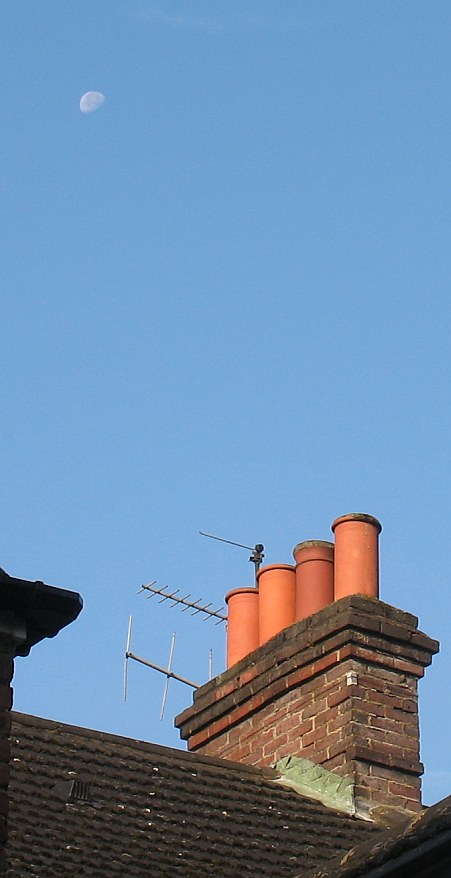
I realized the other day that when I go out wayfaring, or even when I hang out the clothes in the backyard, I have no need of philosophy at all. There, I’m an animal, or perhaps a small child, wide-eyed in wonder connected to all things, merged with my evolutionary roots, in a sensual paradise of birdsong; the exhalations of earth when yesterday’s rains are dried out by today’s sun; the glowing colours of everything; the half-moon in the blue sky above the red chimney-tops. In my body is joy. In my being is timelessness. Photography can’t capture this. Even words can’t.
But I understand now the need for philosophy, and why I need to see its connections to psychology, and theology, and the connection of all these to human biology, and how it has evolved, in a great inseparable whole. I need these studies to understand the society of which I am a part, a society which seems so strange when I’m away from it, in some meadow sown with wildflowers, or when gazing into the eyes of a young bull or goat.
I want to understand it all, not as a scientist, for that requires a specialized way of looking at things, but just as a human with time to stand and stare.
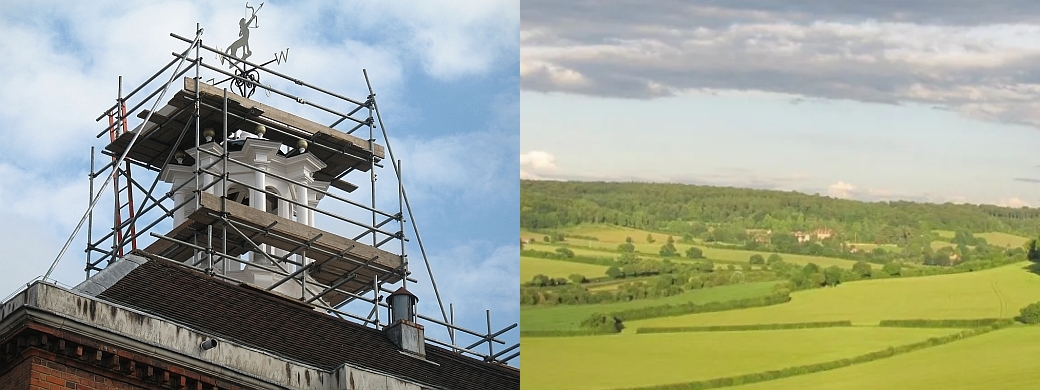
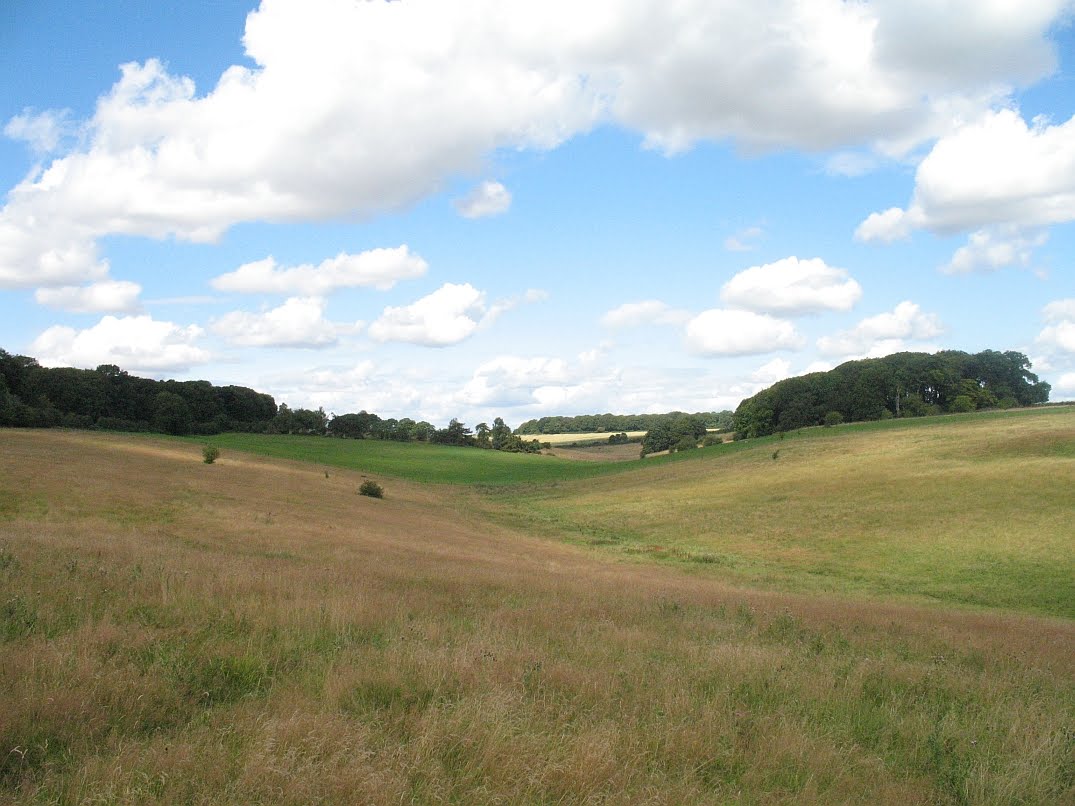
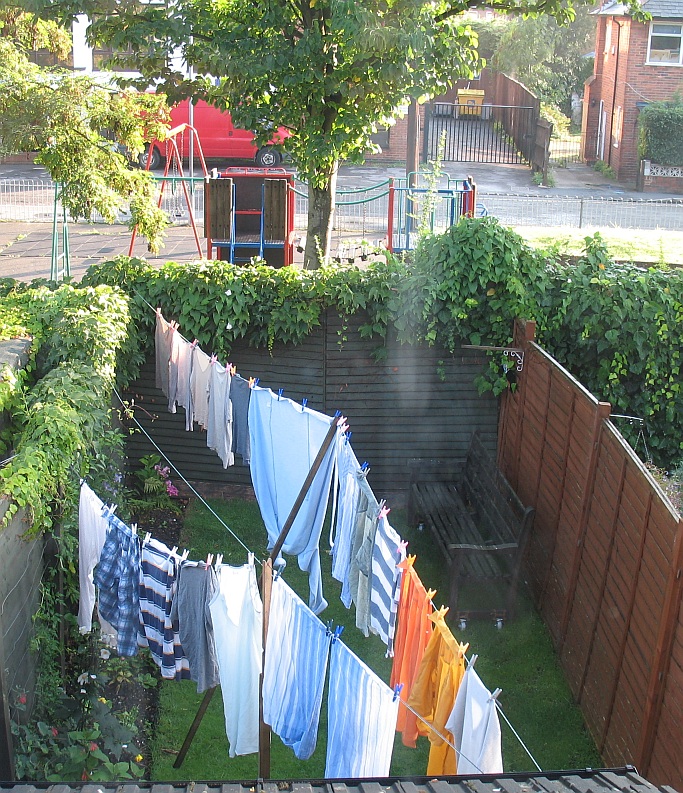
The meadows above are at Beacon’s Bottom, not far from here. The chimneys are as viewed from the backyard, just after hanging the wet clothes on the line. You can’t see anything special in the photos, of course, but from a primitive impulse I like to show you the places where I feel immeasurably rich and blessed.
 a wayfarer’s notes
Vincent, It sounds like you’re hard at work on your collaborative endeavors. That’s great! The book, of course, sounds interesting.
I must say my favorite photo is of your laundry. The whole scene makes me happy because there are so many cheerful colors and stripes, including the red truck peeking through in the background and the attractive wooden fence, ivy, and brick homes. Oh, and look at that, a play ground. Lovely photo indeed!
It’s nice to be able to go in and out of the philosophical mind and then switch to other states of mind.
“I want to understand it all, not as a scientist, for that requires a specialized way of looking at things, but just as a human with time to stand and stare.” Yes, for me this is the best part—to understand things from inside ~ out.
LikeLike
I want to understand it all, not as a scientist, for that requires a specialized way of looking at things, but just as a human with time to stand and stare.
That line, should make it into the book!
I ultimately buy into your perspective inasmuch as I understand it.
I will enjoy very much reading your finished work.
Keep me informed, sir.
LikeLike
By the way, I may have asked you this before, but you have ever read Emerson's short essay: “Self-Reliance?”
LikeLike
Yes, John, I have read “Self-Reliance”. Perhaps I haven’t finished it, for the bookmark is sitting at about the half-way mark. Every sentence is an essay in itself. A paragraph is a series of hammer blows aimed at the same nail. His style is such that the essay is not a rounded whole, but a collection of aphorisms. He is both author and curator of a Museum of Ideas.
There, I’ve only skimmed over a few sentences but his style of short sentences is catching. I started on the paragraph beginning “The civilized man has built a coach, but has lost the use of his feet.”
LikeLike
John & Rebb, I’m grateful to you both for pointing out that one sentence, for on reflection I do believe that it may touch a nerve with many readers.
It’s very apparent to me that in its modern success, science in its public face is bidding to become a new priesthood, before the old one is quite defunct. So now we have several contenders for the succession, uneasily coexisting: religion, science, politics, ecology and consumerism——each with their own Promised Land.
Never was there a better time to learn self-reliance. To quote once more from Emerson’s essay:
‘Thy lot or portion of life,’ said the Caliph Ali, ‘is seeking after thee; therefore be at rest from seeking it.’
LikeLike
Rebb, I'm glad that picture of the washing on the line (laundry, as you would say) struck you, as it did me when pegging it up. I was dazzled by the intensity of the orange & yellow shirts side by side, swept into some ocean of the mind by the striped shades of blue, sharpened aesthetically by the different tints of beige. There were birds singing, the sky sang its sempiternal song, everything told me how blessed I am. Partly what always amazes me is how this backyard can evoke the entire span of the near-seventy years I have lived, all the glories of nature, civilization & the Divine, in a part of town which most middle-class people would consider grossly undesirable, and I mean gross.
LikeLike
John I must thank you for reminding me of that essay on self-reliance. Having skipped through to the subsequent chapter, I discover an essay entitled Compensation:
Ever since I was a boy, I have wished to write a discourse on Compensation: for it seemed to me when very young, that on this subject life was ahead of theology, and the people knew more than the preachers taught….
It's quite delightful in content and expression. Thank you.
LikeLike
Oddly enough, that is not the beginning of my copy, which begins thus:
I read the other day some verses written by an eminent painter which were original and not conventional.
LikeLike
Yes, what you have quoted is the beginning of “Self-Reliance”. What I quoted in my last comment is the beginning of “Compensation.” My earlier quotes, about the man who has lost the use of his feet, and the one from Caliph Ali, are both from the body of “Self-Reliance”.
LikeLike
Snap. I've never read Emerson. Now I believe I'll have to. If nothing else but to be able to keep up with the conversation. I found a link. I'll be back…
LikeLike
I enjoyed Emerson's essay, “Circles.”
LikeLike
as you keep on saying, personal is universal …
then why should be hesitant in showing your personal? we enjoyed it.
LikeLike
“We”, Ghetu? Who is we? have I been introduced already?
LikeLike
“I” enjoyed it. happy?
LikeLike
I'm sure you know that in most places one isn't allowed to hang out washing anymore. We used to have a line that went from a tall post at the top of the slope where our house sat all the way to the high trunk of a cedar tree. There were rollers at either end so the washing could blow on a breezy day. It was wonderful to be outside hanging the sheets and clothes to dry and better still to run out again in a hurry if a sudden storm came by. In winter everything would freeze and folding the laundry to fit in the basket was an exercise in patience. Lines of laundry are honest. Sheets and towels and shirts and socks and underwear are common to us all and there's a deep beauty in acknowledging that essential human quality.
I'm glad you're both involved in writing the book you mentioned some time back. I will look forward to reading whatever you have to say about humanity and our place, understanding, and responsibility in the world. I think much of what we see today isn't mystery but confusion. Mystery is what we experience when our minds are quiet.
LikeLike
No, I didn't know that. Where and why is it forbidden to hang out washing to dry? Surely you can do it on your own land?
LikeLike
Rev, Rebb etc: are we to start an Emerson reading circle, reading “Circles”? To be honest I can only take him in short doses. If I had been his editor, I'd have pared his essays down so short he could have ended up writing mottoes in fortune cookies. Well, not that: but I would have metaphorically shaken him and said “Come ON, Ralph Waldo! I known they're calling you a sage in your own lifetime, possibly your own lunchtime, but can I suggest you come to the point in the first para, say what you have to say, without multiplying examples, then stop! You've only started being this prolix since the publisher foolishly offered to pay you by the word.”
LikeLike
Since you ask here's just one article about the subject in the US.
LikeLike
fascinating. I’m reading this post, along with others, 14 years later, convalescing at home (at last) after many weeks in hospital. The urge to read and write remains strong but…
It’s only 10 in the morning, not long after breakfast, but sleep wants to take me away.
back later — meanwhile thanks to faithful readers, I hope to hear from some of you
LikeLike
Susan, thanks so much for the link to that BBC article. I never realized how political the issue is! One time on this blog I put my profile interests as “hanging clothes on line” to see how many others put the same thing on their profile, little realizing we were a gang of shameless inciters to lawlessness.
It's odd that the plants I have chosen to put in my tiny backyard are inspired by my grandmother's garden (which was the size of 3 plots, as her house was on the corner of the road) yet she (of the social class with armorial bearings) forbade any of her “Paying Guests” (room tenants) to hang their washing anywhere, and never did herself. In consequence (though poor as a church mouse and because washing machines were virtually unknown) she had recourse to a laundry service, which collected once a week and returned everything neatly folded in brown paper parcels. She particularly frowned on items of underwear being hung out, anywhere, as if it undermined the moral fabric of the nation.
LikeLike
Vincent,
I also like your photo of cloth lines. Whenever I use water, washing dishes, doing laundry, or watering garden, I feel I’m cleansing my spirit at the same time. I wonder if you feel the same. So, you woke up on a sunny day and did your laundry, and then, you had luxury of going upstairs to watch that accomplishment. How clean you must have felt!
I didn’t know that it was unlawful in most US States to hang clothes outside. I thought American don’t because using dryer is easier. I tried to do line dry more than a few times, but I couldn’t find good spots, and I’m too short to set lines high above for sheets. American sheets are very large and thick. When my old dryer failed, I wanted to start to hang clothes in my backyard. But my children didn’t take it seriously. My son gave me his old dryer. Come to think of it now, he probably felt sorry for me. I think that they don’t have the good, healthy, earthly, vibrant image I have about clotheslines.
In Japan, most of us hang clothes outside. It is probably not a beautiful sight because most of us don’t have backyard. But, since that helps for environment and good for our health overall, I’m for it.
LikeLike
I think there is nothing more beautiful around human habitations than clothes hanging on lines. To me it has no connection with cleanliness when I hang them out. It is K who selects them & starts them off in machine, & asks me to hang them out after she's gone to work. She has also showed me how to hang them. It's a form of display, you see. The pegs have to be colour-paired. The garments must not be inside out. The labels all have to face the same way. I like to impose additional rules, such as putting the same kinds of items together, or grouping them by colour.
So you create a pleasing display that reflects for your neighbours how aesthetically aware and domestically organised your household is.
When I was a child, in East Cowes, Isle of Wight, many rows of joined together Victorian houses had no front yard. One doorstep and then you were on the sidewalk. The self-respecting householder would be out early in the morning applying “donkey-stone” to her doorstep,though I don't remember it being called that at the time.
LikeLike
Okay. Did some checking on this illegal clothesline business (as it was news to me as well.) From what I've found the upshot seems to be that clotheslines are prohibited in certain communities and private developments, and so on. Laws from some local governments or rules from home owners associations. At some state levels they're considering a prohibition again these local laws and rules, so that people can hang their wash up to dry wherever they like. In fact, even encouraging people to do so because of the energy it saves. This has led to the usual headbutting between individual rights and the idea of the bigger fish of state government interfering in the smaller pond of local government. Plus there's even some whining about the unsightly spectacle of people's underwear. Egads!
This is all just from a few websites, but it makes a certain amount of sense. Home Owners Associations are notoriously restrictive, and local governments are notorious busy-bodies. The idea that the clotheslines would be banned at a state level seems kind of ludicrous. That would be like the federal government concerning itself over how many flowerpots you keep on your window sill. It would be beneath their concern. However, I can see the state governments acting as overseers on the local governments and stepping in if they think rights are being infringed. Then there's an environmental issue on top of that…so yeah.
We use the dryer here. Clotheslines are sublime, but I've got things to do 😉
LikeLike
Now I see that the article Susan linked to says basically the same thing. Well, then there's that too.
LikeLike
Thanks for that, Bryan. To me, hanging out clothes is a kind of spiritual ritual, like making tea in a pre-heated pot, with “loose” tea (no bags) & covering it with a tea-cosy to keep it hot, and serving it in the best china cups. Keiko will understand, though she may think the English tea ceremony inferior to the Japanese one.
To me, it doesn't matter how long it takes to hang clothes on the line. I've got things to do too: hanging out washing.
So this morning I had transferred your mini-treatise on “The World” to my Kindle. K said I should check that it doesn't rain because there were towels on the line. So I said I would sit on the bench outside, reading Kindle, and then I'd know if it started to rain. As it happened the rain started almost immediately, so I came in and rehung the towels on our indoor washing lines (strung across the study where I write this). To me this is the main business of life. Which reminds me of …
(I quote)
… the old story of an American investment banker who was at the pier of a small coastal Mexican village when a small boat with just one fisherman docked. Inside the small boat were several large yellow fin tuna. The American complimented the Mexican on the quality of his fish and asked how long it took to catch them.
The Mexican replied, “only a little while.” The American then asked why didn’t he stay out longer and catch more fish? The Mexican said he had enough to support his family’s immediate needs. The American then asked, “but what do you do with the rest of your time?”
The Mexican fisherman said, “I sleep late, fish a little, play with my
children, take siesta with my wife, Maria, stroll into the village each evening
where I sip wine and play guitar with my amigos, I have a full and busy
life.”
The American scoffed, “I am a Harvard MBA and could help you. You should spend
more time fishing and with the proceeds, buy a bigger boat with the proceeds
from the bigger boat you could buy several boats, eventually you would have a
fleet of fishing boats. Instead of selling your catch to a middleman you would
sell directly to the processor, eventually opening your own cannery. You would
control the product, processing and distribution. You would need to leave this
small coastal fishing village and move to Mexico City, then LA and eventually
NYC where you will run your expanding enterprise.”
The Mexican fisherman asked, “But, how long will this all take?”
To which the American replied, “15-20 years.”
“But what then?”
The American laughed and said that’s the best part. “When the time is right
you would announce an IPO and sell your company stock to the public and become
very rich, you would make millions.”
“Millions..Then what?”
Then the American said, “Then you would retire. Move to a small coastal fishing
village where you would sleep late, fish a little, play with your kids, take
siesta with your wife, stroll to the village in the evenings where you could
sip wine and play your guitar with your amigos.”
LikeLike
Yes, that's a funny story. I get the point. Efficiency is relative. It all depends on what you're trying to get out of life. I absolutely agree.
LikeLike
I remember my mother hanging out the wash on the line in the backyard. I loved the smell of fresh clothes on the line. If we did that now we would have to keep the dogs indoors until things were dry or they'd be all up in our sheets and things. Black dogs and damp sheets don't mix well at all.
LikeLike
” ..understand more by knowing less.” mmm
LikeLike
Your story about the fisherman and the financier was a perfect analogy for just how crazy things have become in the industrial west in particular.
It's interesting to me that the laundry hanging issue became a topic of interest here. The way I remember it going follows much the same path as other elements of one-up-manship that came along with general prosperity in the 1960's. What once was common practice became a sign of impoverishment and thus was banned if not necessarily by local governments but by general consensus. What is a council if not that?
I thought I should mention as well the idea and importance of ceremony in human society. Making tea properly, whether for yourself alone or for guests, is a sign of respect for the gift of life. The same is true of hanging laundry and other hands-on endeavors. We also honor past generations by emulating their skills.
Lastly, and I hope you don't mind, I was reminded of the Buddhist “Eightfold Path” as the way to eliminate desire or extinguish suffering:
Right understanding
Right mindedness (right thought)
Right speech
Right bodily conduct
Right livelihood
Right effort
Right attentiveness
Right concentration
LikeLike
I found one photo I like. A Japanese blogger took this photo this year on the way to fishing, he wrote. After clicking below, go down to see a black and white photo.
http://sky.ap.teacup.com/tegetege/556.html
A clothline and Mt. Fuji.
LikeLike
“half-moon in the blue sky above the red chimney-tops” this is a beautiful photo. and, of course, your washing, which has been much discussed, is also a beautiful sight. another reason, to throw in a few words, for the ban on clotheslines, is safety. people string them down low, across places accessible to foot traffic, and others get hurt. yes, it really happens. i was nearly strangled (or decapitated) once, myself, by a neighbor's wire clothesline, strung low, but empty, on the corner of a lot. i'm happy to say this didn't dampen my love of a good clothesline. i can't think of a better smell than that of freshly laundered and clothesline-dried sheets on my bed at the end of laundry day.
and good luck with your book. do you have a publisher?
LikeLike
That is indeed an amazing picture. The simplicity of life and the complexity of nature itself. Beauty in different forms together. Nice.
And there's a reason why getting “clotheslined” and “hung out to dry” are not really good things. I've been the unwitting victim of a clothesline before. But then I was nearly killed when a dryer fell on me once too, so I guess we're even.
LikeLike
Re the funny story about the Mexican fisherman, I think another one could be written, in which the Mexican fisherman's philosophy catches on amongst a significant proportion of American workers in all walks of life. Any economist reader is welcome to correct me but I think it would cause a financial crash, recession, whatever you call it, like the world has at present but more so.
For it seems that consumerism is the hub principle of the developed world's wealth-distribution system, on which the developing nations are completely dependent.
If we don't work like hell to buy things we don't really want unless persuaded that we do want them, doesn't it mean mass unemployment and so forth?
I rather suspect the world's economy also depends on a rising population in order to pay the pensions of the increasingly long-living legions of the retired.
I don't know how to sort it out, but nature does, of course.
LikeLike
Yes, Susan, but isn't desire a lovely thing? Isn't it what keeps us alive, loving this world. Of course we must pay the price for it, if the price is suffering.
I rather think there is a translation problem here, perhaps a cultural one. I've semi-relinquished consumerist desire, but I think life itself is restlessness. And I'm not sure about Nirvana, either. Passionate living followed by nothing at all when we die seems to suit my temperament these days.
LikeLike
Keiko, it seems a timeless photo. I had to reread your comment to discover it was taken this year. For all its relentless pursuit of modernity, at its very cutting edge, Japan pursues timelessness of tradition. What a contrast!
LikeLike
Thanks gfid. I didn't really feel the photo did justice to the scene.
As for the book, it doesn't have a title or enough of a coherent theme yet to prepare a book proposal for a publisher. We're doing it on trust that whatever the outcome, we won't feel we have wasted our time. (I think I can speak in these terms on behalf my collaborator. If not he'll say.)
LikeLike
I suppose if I had to choose between being killed by a “sublime” clothesline and a heavy drier, a garrotting by clothesline under the wide sky would be the more honourable way to go.
LikeLike
Late in the game on this one. Only time to quickly scan the comments, after reading your post.
Thoughts:
Your wayfaring = taking it in.
Philosophy = our way of creating a ripple in the pond.
We have discussed efficiency before have we not? I have heard that story before I'm sure.
I have fallen into the trap, and I am now digging my way out. More accurately, my family has fallen in, and I am digging them out.
LikeLike
Of the two, the clothesline hurt less but the mark on my neck lasted longer than the bruises from the dryer. It's a toss up.
LikeLike
The washing on the line arrangement is different to the last time I saw it, seasonal differences, no doubt, play a part and a different angle for the picture shot.
There is a definite sense of something spontaneous.
LikeLike
It is such a joy to check in with A Wayfarer's Notes.
I am so weary from present efforts I am engaged in, with no sign of a break in sight, and this blog, and the wonderful discussions in the comments, bring relief to my soul.
Thank you, Vincent, and all you fellow followers!
LikeLike
Referring to this passage, Vincent:
I realized the other day that when I go out wayfaring, or even when I hang out the clothes in the backyard,
I have no need of philosophy at all. There, I’m an animal, or perhaps a small child, wide-eyed in wonder connected to all things, merged with my evolutionary roots, in a sensual paradise of birdsong; the exhalations of earth when yesterday’s rains are dried out by today’s sun; the glowing colours of everything; the half-moon in the blue sky above the red chimney-tops. In my body is joy. In my being is timelessness. Photography can’t capture this. Even words can’t.
It is I writing now:
These are the times for me when I feel truly happy and connected.
A world where one cannot hang up her/his clean wash is not a world I can accept. I love hanging out my wash. I love the simplicity and of the task, the textures and scents and sounds not only of the washing itself but also of the natural world around me in my little oasis of garden, big oaks, pines and ferns and squirrels.
Your book sounds just like something I'd love to wrap my head around right now. Please let me know when it's published.
Happy wayfaring.
LikeLike
P.S. I love the exchange of thoughts and ideas on your blog. It's one of the things that keeps me coming back, although I admit that a lot of what you discuss is over my head in terms of actually participating in the discussion but I absorb and learn and eventually find a place of commonality among it all.
LikeLike
Ah Gina, I think the book collaboration has crumbled. Gives me time to work out another project. It's clear to me now that I must do it on my own.
Your remarks on the wash inspire me to a specialised blog on the subject of hanging out washing in the open air. But no. Let's be sensible. And what happens when we find ourselves in a world we cannot accept? I often think about the year one of my favourite writers died and it seems to me that had he (usually he) lived any longer, it would have become a world he could not accept. Unless by his dying some aspect of the world collapsed like a tent whose central support had been removed.
I really ought to do something about these discussions that you say are over your head. (My recent book project was somehow over my head too.)
LikeLike
Oh gentleeye, I hope you don't need to weary yourself with efforts unworthy of your attention! I was thinking of you in the next post I'm planning. In the same way that you devoted a whole blog to the Thousand and One Nights, I'm planning to devote a single post to another ancient book from a different culture: The Epic of Gilgamesh. I dedicate it to you! (Now I'll have to make sure I publish it.)
LikeLike
ZACL, we ought to start a photo-gallery of washing-line arrangements! Actually my whole garden has been rearranged. You were asking about the turfing. It has been moderately successful. Takes a long time to settle, and some dried out before it went green.
I'm glad there's a sense of something spontaneous. that's always the aim.
LikeLike
The Epic of Gilgamesh! Though I have never actually read it, I have always been a fan and it is on my reading list.
LikeLike
Charles, glad to hear from you. I hope your digging is meeting success. Your equation re wayfaring & philosophy is accurate. Yes, philosophy is a way of creating a ripple in the pond. I'm wondering now if I really want to add another ripple. I think I'd rather write something kind of poetic, that leaves the pond unchanged. But then (referring to the famous Haiku) some frog or two might jump in with a small “plop” and then there would be ripples.
But when you think about it no book ever creates a ripple in the pond, unless the reader flings it into one. It's always the reader, if any, who creates the ripple, if any.
LikeLike
John, there is one version and only one to read, the one by Stephen Mitchell. More in my next.
LikeLike
Enjoyed this post – hope you're well Vincent.
Brett
LikeLike
Hi Brett, thanks for your good wishes. Yes, very well & I enjoy seeing you play your roles on video, which show me how well you are too!
LikeLike