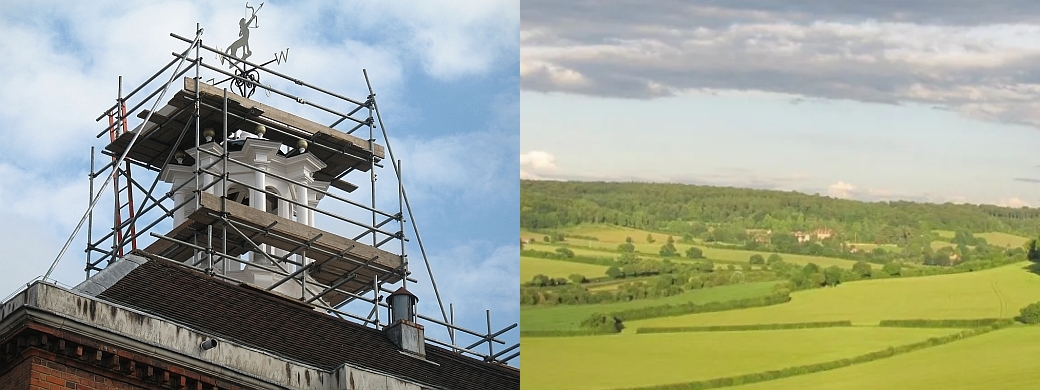

Why do I write, if I can’t write any better? But what would become of me if I didn’t write what I can, however inferior it may be to what I am? In my ambitions, I am a plebeian, because I try to achieve; like someone in a dark room, I’m afraid to be silent. I’m like those who prize the medal more than the struggle to get it, and savour glory with a fur-lined cape. (Fernando Pessoa, The Book of Disquiet, 152)
I look up to Pessoa as the master. He can write about all moods, including the various shades of disquiet. I’m not “afraid to be silent”, but it mostly takes a sense of exaltation, however indefinable, to stir me enough to try and share it. For then I am drawn to enter this mystery, and act as though it can of its own accord translate itself into words, and transcend the plebeian inferiority.

I took a trip to Iver, a village in the extreme south-east corner of Buckinghamshire, drawn by some sense of affinity. Iver, Bucks—an address, a place I’d heard of but never been. I did once live a few miles away, but ‘live’ isn’t the right word. It was little more than an address, the place I kept some of my things while at boarding school and university. But then I could say that for most of my life I’ve not really lived anywhere: not exactly a rolling stone, more an uprooted plant. And this is close to saying I’ve not really lived; except in these last few years, when I’ve learned to write, and feel the exaltation of living. And now there is sometimes the teasing sense of almost recalling from a distant past snatches of living that might have happened but didn’t.
So I went to Iver in search of something. It would be hard to say what, but I found it after five yards of following the public footpaths that led off the High Street. In a moment, it was as if something inside tuned to a frequency, and pretty much stayed locked on to it from there on. I became alert to things, both around and within, as if the mere sensual inputs held a significance, something apprehended yet not quite understood.
From birth to death, man is the slave of the same external dimension that rules animals. Throughout his life he doesn’t live, he vegetatively thrives, with greater intensity and complexity than an animal. He’s guided by norms without knowing that they guide him or even that they exist, and all his ideas, feelings and acts are unconscious—not because there’s no consciousness in them but because there aren’t two consciousnesses.
Flashes of awareness that we live an illusion—that, and no more, is what distinguishes the greatest of men. (ibid,150)
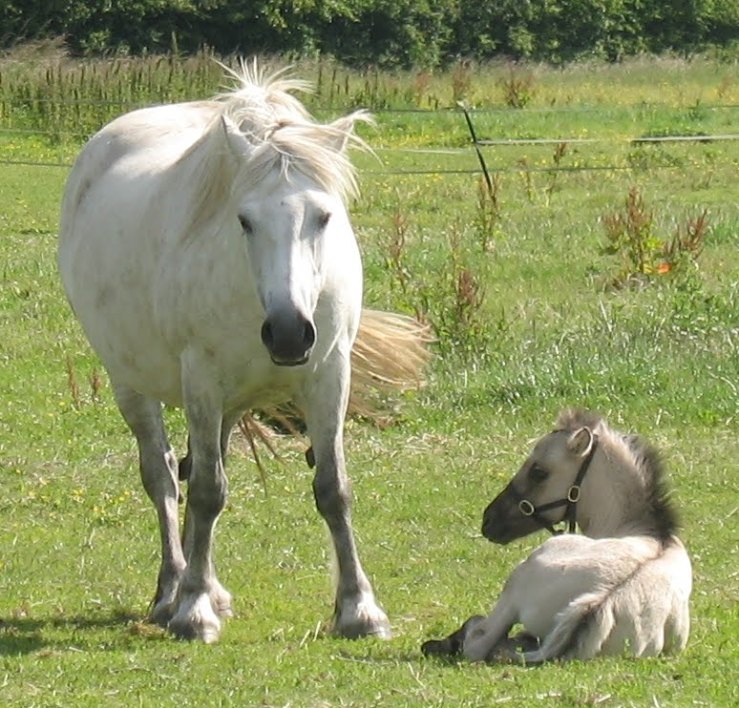
Further on, the footpath was fenced on either side, cutting a meadow in two. There were horses on either side: curious, friendly. A mare stood guard over two resting foals, born in different seasons, so still, as they lay prone, that I thought they might be dead. But they were just relaxed. Later, the younger one became shy, and hid behind the mother.
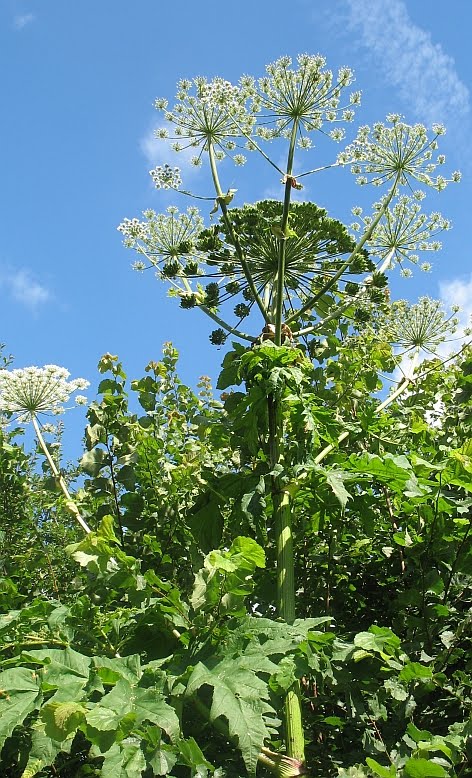
Still further, I saw a giant hogweed in the hedgerow, about nine foot tall. I had a vague idea that handsome as they were, these weeds are undesirable in some way. I checked the Web later, and confirmed that they are very toxic. There were signs that someone had been cutting them down, but hadn’t finished the job. The sap can cause blistery burns whose scars last for years, I learned; or blindness and even death. I’m glad I didn’t get too close. I entered ‘giant hogweed Iver’ into Google and discovered that another walker had photographed the same ones a few days previously (Beeches Way, 18th June, on a site called Pete’s Walks). We are ruled by our enthusiasms. Whatever gives us a buzz, we endlessly seek to repeat it. One day I might run into Pete.
At one point, the paths forked, so I stopped to check the map. I noticed a pair of mature trees whose trunks were so close together that they touched at the base, with their barks fused together. Higher up, the same thing had happened to some major branches. Not uncommon, you may say: but one was an oak and one a horse-chestnut, both displaying their immature fruit. Did their saps combine? Had they grafted themselves together, to produce a hybrid? No, I think it is just a phenomenon of bark. It adapts. It can grow over barbed wire if necessary. Parasites like orchids and mistletoe can penetrate through bark, without any exchange of DNA. Two lovers, however close, don’t merge and become one flesh. Donne notwithstanding, every man or woman is an island.
If I often interrupt a thought with a scenic description that in some way fits in to the real or imagined scheme of my impressions, it’s because the scenery is a door through which I flee from my awareness of my creative impotence. (ibid,152)
As I write this, I feel a similar fusing of trunks with Fernando Pessoa, a porousness of our barks so that they they don’t separate us but allow a merging of thought, theme and style, one way only because he died in 1935. Sometimes I just vegetatively thrive, and have nothing to say. Sometimes I am or wish to be instinctive like a bird, to stand on the highest branch and sing whatever joyful song comes out.
And I live for those “flashes of awareness, that this is all an illusion”, like a window of clear glass, through which we can see through to beyond.


 a wayfarer’s notes
Well in my opinion, you are a writer and more entertaining that Fernando. Your words paint a constantly moving picture of your world in my mind while my eyes scan down the page. His words made me have to stop and try to comprehend what he was saying. He writes like a lawyer… a solicitor. Pedantic and precise. Your words flow and are almost poetic in their rhythm. But that's just my opinion.
LikeLike
I'm going to have to side with the Rev on this one, although I'll give Pessoa a bit more credit than he does. There is some good stuff there. Still, the light grey is a welcome interlude between the solid black. I definitely prefer the grey.
…and I thought I had some nasty weeds growing in my yard. Good lord, those hogweeds must be rooted in Hell itself!!
LikeLike
Also, I wouldn't characterize your writing as “easy”, at least not in the way I take your meaning. It's easy to read as it has an eloquent flow, as well compelling imagery to draw you along. But I most definitely wouldn't call it “easy” in the sense of being simplistic or unambitious. If fact, it's often quite ornate, and when you do tackle a difficult and profound idea you always find an interesting way of putting it.
LikeLike
I too think you write very well if the description of that skill is that your audience gets caught up in your thought process. The marvelous thing about walking in a natural environment is the acceptance of the glory of being alive. You portrayed that feeling beautifully even without the photographs, but I did love the pictures.
LikeLike
Perhaps it was because Pessoa spoke Portuguese as a first language or the fact that he had that style that was so popular around the turn of the century. His words are strong, no doubt. But since I was educated in this century and not that one that your words flow more smoothly in my mind. I wasn't just trying to blow you up, as I think the phrase goes.
LikeLike