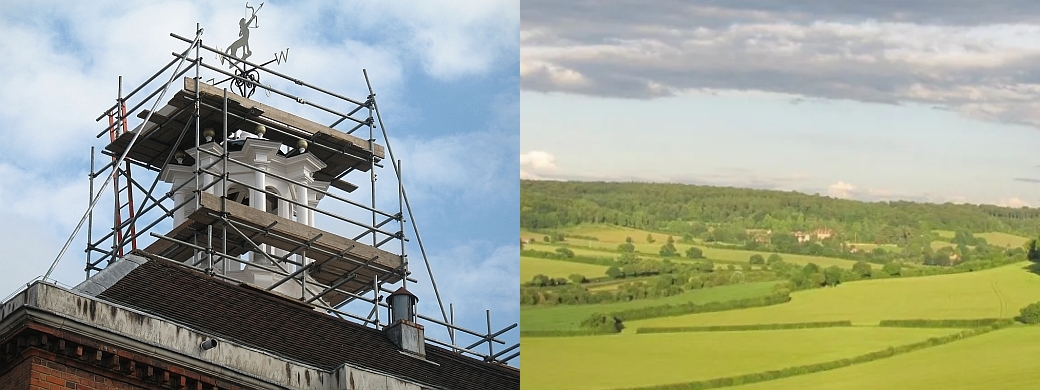


I left the car at The Fox and Hounds in Christmas Common, and made my way down Hollandridge Lane, which has never been more than a cart-track, but offers glorious vistas on a perfect spring day. Not a farmhouse in sight, not a fellow-wayfarer or dog-walker, not even a sheep till I reached Pishill, and saw some huddling in the shade, under a curved shelter of galvanised iron. But the bluebells were on parade. The wild violets and wood anemones, dandelion, primrose, white deadnettle, yellow archangel, all greeted me as I passed. It was a day to feel whole, to abandon care, to live in the simplicity of your own clothed and booted body, covering the ground like a Stone-Age wayfarer on a mission, untroubled by too much thought. At least that is what I supposed, for it seemed to me that I had been just walking, with no particular train of thought.
But in the seventh mile, twenty minutes from regaining sight of the Fox and Hounds, an odd idea popped into my head, out of the blue: it’s not a good idea to try too hard. The world is overheated with it—literally. Enough striving, ambition, “pursuit of excellence”. Teachers should stop urging their pupils on. In any case, they don’t really do it for the pupils’ sake, but for targets. Everything is driven by targets. Result: everyone is insecure.
Reader, I’m not preaching my new doctrine. I’m just reporting the thought that came to me in the dappled sunshine, walking back up to Christmas Common, back up that Hollandridge Lane. And since I didn’t know where it came from, I tried to give it meaning and context. Suppose we each did what we found came naturally: sometimes lazy, sometimes driven by the joy of doing what we can do, even indulging it to excess. The standard of living would fall. We would no longer be such slaves to productivity and economic growth. We would gain in personal dignity.

I thought about the various regions of Africa before the European slave-traders, missionaries and colonists arrived. I felt they would have been better off and more in harmony with the rest of Nature. My grandmother was in Kenya in the Fifties. She justified the white man’s appropriation of the black man’s land in terms of her own recollections. She had gone there for her health, to ease her painful arthritis, and liked to sketch scenes in water colours. She said the Africans loved to sit laughing and lazing in the shade of a tree all day, while the white man strained to get the best yield from the land with his plantations of tea and coffee. There was no doubt in her mind which was the good, strenuous, Christian thing to do. And what did the indigenous people think? The young braves among the Kikuyu showed by their deeds how much they appreciated the kindness of the white settlers. They started the Mau-Mau uprising.
So, I found meaning in the thought: “It’s not a good idea to try too hard.” But where did it come from? The blue sky? Then I remembered. I’d been absorbed in Nature, aware that it was much more than the wild flowers, the trees in their new foliage, the calling birds and the bumbling bumble-bees. I knew that creatures struggling for survival eat each other, sometimes even their own young. When the cuckoo hatches in its foster-parents’ nest (in England typically a reed-warbler’s), it heaves the other eggs out, for its appetite matches that of the whole brood. I thought of cuckoos because at the edge of a field I found olive-coloured shells, four of them scattered, the size of pigeon-eggs, and I wondered how they got there. Then I realized I could not put all my vague notions of Nature into one basket; some of them were second-hand anyway, for I am no naturalist. I traced them to their source: Annie Dillard, the Pilgrim at Tinker Creek. Then I had thought, “I love her writing: but she tries too hard.” It’s none of my business how hard another writer tries, but I thought if she tried less hard, she would be easier to read. Not only that, but she teaches writing too! And in some distant hero-worshipping way, I am her student too, so it matters doubly to me.
I don’t even have to open her book The Writing Life, because the publishers have kindly provided an extract on the dustjacket, from which I take a paragraph to illustrate how hard she tries:
A work in progress quickly becomes feral. It reverts to a wild state overnight. It is barely domesticated, a mustang on which you one day fastened a halter, but which you now can’t catch. It is a lion you cage in your study. As the work grows, it gets harder to control; it is a lion growing in strength. You must visit it every day and reassert your mastery over it. If you skip a day, you are, quite rightly, afraid to open the door to its room. You enter its room with bravura, holding a chair at the thing and shouting, ‘Simba!’
 Phew! After copying it out, I feel I must go and lie down for a bit. Its magnificence is undeniable; but I prefer understatement. It reinforces an already-established conviction: for me, the blog essay is the highest literary molehill which I dare climb. I do try, but not too hard.
Then, this morning, synchronistically, I read Bryan’s comment on my last, which includes these words.
My number one cardinal rule of writing, which I recently passed on to my daughter, is that good writing should be like good acting. If it’s done right, it shouldn’t even be noticed.
I hope Annie teaches that, too.
 a wayfarer’s notes
I prefer understatement as well.
Another great post.
LikeLike
Absorbing post, Vincent. Enjoyed the images and the way you told the story. I had a difficult time reading one of her books, but I’d like to come back to her. An old essay of hers that I read in school that I enjoyed was, “Death of a Moth.”
Yes, not trying too hard is a good reminder.
p.s. Enjoyed a peek at your new photo, which I also see you changed back to your usual one. Isn’t it funny how we get used to a certain image of ourselves, as others do too? Change is good though. I will be changing mine soon enough.
LikeLike
Beautiful Pictures. Thanks for sharing Vincent.
I too believe that one must not try too hard for anything, atleast not to the point of getting stressed.
Rebb, will look forward to a change of photo from you. I did that too a little while ago. Vincent appears to have reverted to his old one.
LikeLike
Thanks all for the comments. I think it may have been my grandfather, or possibly my grandmother, who first expressed something I had noticed without comment in Hollywood movies of the Fifties, that they wanted to make sure that you knew who was the hero and who was the villain, by making sure they looked, sounded and dressed according to their roles, and not just behaved in the appropriate way. Whereas here in Europe, we tend to value a little ambiguity, or subtlety. The same relative offered an explanation: that America was made of such a hotch-potch of immigrants, with so many cultural backgrounds, that it was necessary to ensure that they understood clearly. I rather think that even then, the films were designed for world-wide export just as much as home consumption.
Or maybe it is just a national tendency, to be emphatic in speech.
Was Dillard introduced to school pupils? I had never heard of her till an (English) blogger gave me her name recently.
Not trying too hard may be a good reminder to some, but I wasn’t trying to preach that message, just tell the story of an expedition and a train of thought. (There is enough for another post with other material left over.)
The new photo was taken at a barbecue last year, that's why it's a little smoky. My beloved was resting her head on my shoulder as we both posed obligingly for our host's fiancé. The original photo, on the other hand, was a critical self-portrait in the manner of my namesake: just me & the mirror and the camera’s timer, all alone in the spare room, when the light was right.
Getting stressed just happens. I don’t know any way to prevent it. I wish I could spread the stress, and the trying, more evenly through my life. Then I could be more productive. When there is not enough stress in my day, the energy drains away, and I take naps. Is this abnormal?
LikeLike
Vincent your statement has much food for thought,
“Getting stressed just happens. I don’t know any way to prevent it. I wish I could spread the stress, and the trying, more evenly through my life. Then I could be more productive. When there is not enough stress in my day, the energy drains away, and I take naps. Is this abnormal?”
I suspect understanding and managing this would help us to be appropriately energetic as required. However I do not claim to understand this myself although realising that energy levels do have much to do with the state of the psyche.
However, I think it is a good idea to respond to the signals our body gives. if we feel exhausted we should lie down. I do it too and find it re-energises me.
LikeLike
Dillard was introduced to me in my first year college English class in a book called “The Bedford Reader.” It says that “Death of a Moth” was first published in Harpers 1976. It’s up to the instructor which selections we will read. I kept the book to be able to look back from time to time.
Ashok, yes, in your photo you appear more business like to me; whereas in your other photo you appeared more relaxed an at home. Both nice.
LikeLike
Thanks Rebb, this latest photo is a business photo while I was at work in office whereas the older one was on a weekend holiday. I might return to it soon.
LikeLike
ah, thank you, Vincent! It's raining today and I'm half-caught up on household chores, so I braved a bit of blog-wandering, only to land here! While I've been busy lately, it's in part because some of that time I've been happily doing very little beyond walking and re-walking the narrow perimeters of this piece of land I pay taxes on, observing mole tunnels and birds with absolutely no goal in mind. Amid all of the frenzy of spring, time to wander seems crucial. Yet I chide myself – so I am thrilled to have landed here, and to read your paean to not trying too hard.
LikeLike
“A Perfectly Kept House is the Sign of a Misspent Life.” (Mary Randolph Carter)
Read somewhere a long time back, and totally approved. Offered with a smile.
J'aime beaucoup vos notes et vos photos, Voyageur Vincent.
LikeLike
Thanks for your unfailing encouragement, Hayden. I've been rather quiet over on yours, but still follow the saga of your life regularly – and with awe!
LikeLike
Merci, Claude. I have been trying to look up Mary Randolph Carter, to see what her idea of a wellspent life might be, but discover only a public persona which seems to be about collecting junk, or rather selling books on the subject.
Then, as a sign of a misspent morning, I started looking up “misspent life” and “misspent youth” (“a talent for pool is the sign of a …”).
I like this one a lot:
Time misspent in youth is sometimes all the freedom one ever has.
Anita Brookner
It's very consistent with the kind of quiet feminism, if I may call it that, which emanates from her novels. I have read only one, actually.
I think reading a lot of novels is the sign of a misspent something-or-other. A few selected blogs is quite a different matter!
LikeLike
Thank you! I'm laughing here. You're very thorough.I didn't have a clue about M.R.C. But the quotation made a lot of sense to me when I was a R.N. working full time shifts, and the single mother of two teenaged sons. Dusting the house too often seemed an unrealistic duty. In those days, my other favourite quotation (source unknown!)was: “A house should be clean enough to be healthy, and dirty enough to be happy.” It assuaged any feeling of guilt the boys and I might have had about our often disorganised household. To borrow your post title, we survived by Not trying too hard.
Of course, I'm sure that what you mean is much deeper than forgetting overflowing dishes in the sink. I doubt I would be philosophically adept to write better comments on your blog and the few selected ones you're connected with.
I read very few modern novels. I grew up French. My ambition was to understand Dickens one day. I'm finally succeeding! No quiet feminism there, I can assure you.
All the best!
LikeLike
Apologies, Ashok. I only just found your second comment—in the spam folder! Now reinstat.
LikeLike
It would seem that you equate the Kenyan’s doing as they please, with being who they are, a part of nature, which typically follows its inspiration, with not trying too hard. It is very interesting, and very profound. Perhaps the Kenyan’s are happy. It tells me that I may have to consider correcting one of my “human lists.” I tend to try too hard, I think. As part of this, I have lists, tons of them (well, currently 260, but I create more frequently), and they fall into categories. One of these list categories is “human.” Currently I have exactly ten human lists. Among them are human happiness, human needs, human value, human truths (not to be confused with “truth”), Intelligence factors, relationship criteria and others.
The “Human Needs” list includes the need to achieve, the need to build or to create something (and always be building something), and the need to grow. It would seem that the Kenyans you described either did not have these needs or did not recognize them. I would hate to have to edit my ethnocentric lists, but I also want them to contain as few errors as possible. I guess I could re-title Human Needs to be Western Human Needs.
LikeLike
I find your reply also interesting and profound, John. When you say “The ‘Human Needs’ list includes the need to achieve, the need to build or to create something (and always be building something), and the need to grow,” I do agree with it, that is I observe such needs in myself.
But it’s not for me to deny the same things to others based on a stereotyped observation or interpretation of their behaviour. When my grandmother saw the Kenyans lazing and laughing under a tree, they may have been plotting the downfall of the whites. Her grasp of Swahili was inadequate to know what they were talking about.
It is not for me to say that the Mau-Mau uprising was anything but a natural inspiration: if you returned from a couple of days’ vacation and found a family had decided to move in and live there, you might be ‘inspired’–by an angry instinct–to get rid of them quickly, rather than share the accommodation and provide it rent-free to your visitors.
However the colonial settlers to Africa were fulfilling, in the ways which seemed natural and appropriate to them, their perceived ‘need to achieve, the need to build or to create something (and always be building something), and the need to grow’.
I don’t actually have a philosophy of ‘not trying too hard’ to launch on the world, nor any judgement on what actions are beneficial to the world as an organic whole (Gaia) and what are toxic. All is in flux in this unreliable brain.
As you suggest, we reflect our truths rather than any Truth.
LikeLike
[…] I won’t try, and that is an instance of laziness (or what-you-may-call-it) which was a theme in my last: something which seems to me like a great creative principle. In Nature, or perhaps natural […]
LikeLike
[…] “But in the seventh mile, twenty minutes from regaining sight of the Fox and Hounds pub, an odd idea popped into my head, […]
LikeLike