
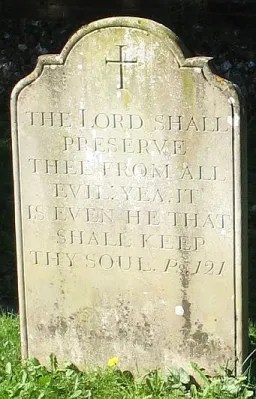
The Lord shall preserve thee from all evil: yea, it is even he that shall keep thy soul.
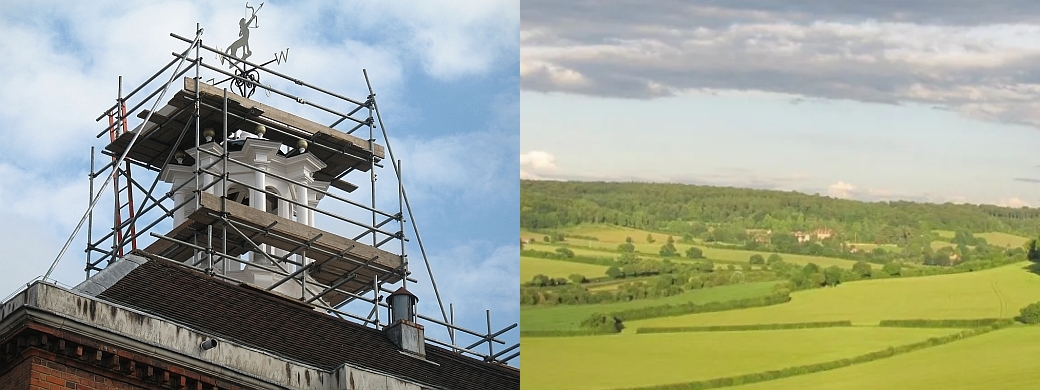
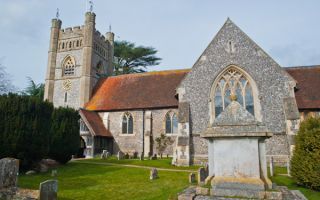
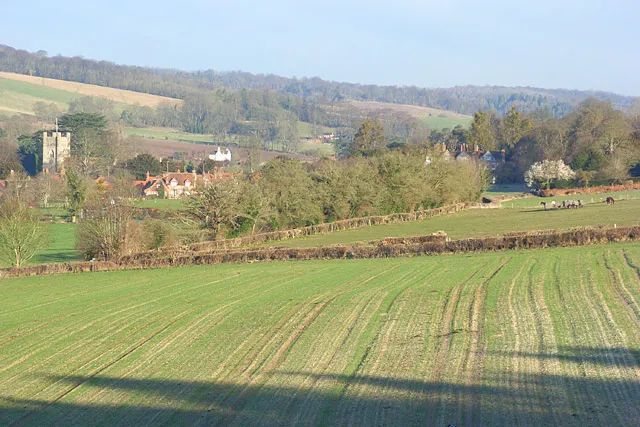
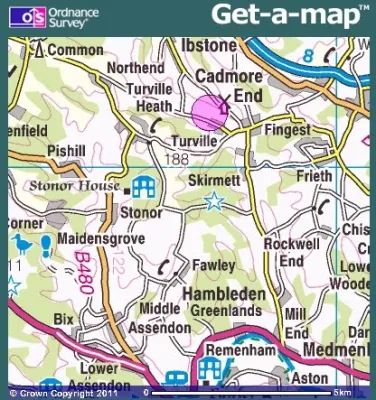
I saw this on a tombstone at Hambleden, a tiny village that doesn’t seem to have changed since the Middle Ages. For all I know it may be still enmeshed in the feudal system, though its origins go further back, as I discover from its page on Wikipedia.
Aimless wayfaring, whether in beautiful places or anywhere you can let your guard down, somehow frees the mind to an undirected reverie, uncovering perspectives far from the well-trodden paths of daily necessity. And so I found myself pondering: what makes us so different from the other animals?
One of the things, the one that seems to me the most significant, is how different we are from each other. I see from my study window a couple of magpies squabbling in a tree. You cannot tell one from the other. They’re like identical twins, clad in the same uniform. Contrariwise, we humans possess individual of uniqueness, to the limit of variations on a single species: “a group of organisms capable of interbreeding and producing fertile offspring”.
In particular, we differ in our ways of seeing things. Consider human variation as a spectrum, with ‘conformity’ at the left and ‘individuality’ at the right. We seem to be moving towards individuality more rapidly than ever before. The effect of global communication is to accelerate difference rather than produce an homogenous mixture. This seems paradoxical: you might expect a blend. Not so: the more humanity travels and mingles, loves and fights, the more diverse the resulting rainbow.
Two mysteries, then: being so different from the other animals, and being so different from each other. I suddenly had an idea. My hunch was that the diversity so characteristic of mankind originates from the incest taboo, which (I thought) probably does not exist in apes, for example.
If we look at all our primate cousins, we find that incest is practised one way or another by all of them, except us.
We suspect, therefore, that the taboo goes back to somewhere around the very origins of humankind, the origins of human culture.
We see the origin of culture as having something to do with the use of tools (sophisticated and complicated tools, as other primates use simple tools) and language (sophisticated and complicated languages, as other primates use simple forms of language).
We now suspect that the three traits, tools, language, and the incest taboo, are all related to each other and related to the origin of humanity.
The incest taboo requires that we must exchange mates between groups, and that exchange was required for us to communicate and develop our tools (increasing our likelihood to survive, thrive and reproduce).
Early ‘families,’ based upon the taboo, were part of those which developed culture, technology and co-operation, and survived while our close cousins (the Neanderthals?) did not.
I’ve been in life-long conflict between the imperative to conform, especially in childhood, and the need to express my individuality. I don’t suppose this is at all unusual, but it’s only now that I can pick up the threads in idleness, as it were, and unravel them from the tight ball of hitherto-unquestioned assumptions. Intellect is useless in telling me ‘who I really am’—as a unique individual, as opposed to a specimen of homo sapiens sapiens. For intellect is forged through language and culture, both of which pull me into their tight centre: conformity.
There’s an urge in me to be on the outside of the fold: well, not quite ‘beyond the pale’, but somewhere near its periphery. At this frontier, I look at what my species sees itself as, in what may be its collective delusion. Homo sapiens, at least in its most dominant culture, is inordinately proud of its thinking, its spirituality, its godlike nature. (Atheists have have more godlike pretensions than devout worshippers!) But gazing from the edge of the community of thinkers, I wonder if mankind is in some way monstrous, neurotic, Nature’s worst mistake. Nature has its balance, its equilibrium, but from Gaia’s point of view (I refer to James Lovelock’s conception of Nature as a single complex organism) man is the biggest catastrophe it has yet had to face.
And so my analysis comes full circle back to Genesis:
And God said, Let us make man in our image, after our likeness: and let them have dominion over the fish of the sea, and over the fowl of the air, and over the cattle, and over all the earth, and over every creeping thing that creepeth over the earth.
 So far so good, for that was just the initial setup, after which it went wrong, as the Hebrew authors of Genesis could clearly see and poetically described, in Adam and Eve’s forced exile from Eden. Man was the renegade animal, the inventor of evil: this was apparent, and required to be explained in a myth. In the Psalms we see that man, this monstrous deviation from normal healthy animalhood, needs God as his comforter: God the Smiter of Enemies and Keeper of Souls.
What foolishness to replace the Comforter with the cold facts of science, and the arrogance of militant atheism! We are not perfectible, but (in Biblical terms) ‘fallen’. For all our science and philosophy and the mixed blessings they offer, we strut on this stage but a short time. It doesn’t mean anything to know if there ‘really is’ a Lord who shall preserve me from evil, and be the keeper of my soul. In faith is comfort; and comfort is real. I feel as if I have solved a mystery.
 a wayfarer’s notes
Every thought we have has been thought before. The oddest thing happened today. I opened this essay, then got busy and did not have time to read it. I was running errands and listening to the radio. This may not seem odd yet, but it will be noteworthy by and by.
For intellect is forged through language and culture, both of which pull me into their tight centre: conformity
You sound like a New England Transcendentalist, sir.
At this frontier, I look at what my species sees itself as, in what may be its collective delusion.
I have often thought this: not only that it may be a delusion, but that it is likely. We feel superior to the flytrap as we watch it respond to its nature. At the same time, we are prone to confirmation bias, cognitive dissonance, and determinism, as we do not choose our wants, but tend to obey them. In short, we also respond to our environment at least as often as we create it. We see ourselves as independent knowing intellects. Yet, how independent are we? Just as the flytrap does what flytraps do, and tigers do what tigers do, humans do what humans do.
Humans seek sexual encounters, and allow much of our lives to be controlled by this desire. Why? We often seek comfort and pleasure over growth, as if we were not in control. If a watcher, a highly evolved being, with a much larger “intellect” than ours exists, and perhaps studies us from a dimension humans cannot yet imagine, this watcher would likely marvel at our simplicity. The act of sex may amuse this being. We are manipulated by this urge, and the act itself is only made possible for men by an excitement produced in our minds. If you watch two flies, or two cats, in the act of mating, you see how utterly controlled they are. Humans are no different.
We prepare elaborate meals, either for the short pleasure it will bring, or because we perceive it to be creative. But a meal, once designed, is not a creative work. The chef fools himself. Writers string words together as they write. They are rarely more than expression of our opinions, our guesses, our false explanations of truths that are well beyond our reach. If we stumbled into reality, we would never have enough data to realize it, and yet, we think we know. The watcher would be amused.
I wonder if mankind is in some way monstrous, neurotic, Nature’s worst mistake. Nature has its balance, its equilibrium
You sound like a New England Transcendentalist. To unjustly summarize the whole philosophy in a few sentences, I would say this: mankind is a part of nature, not above it. When he tries to live as if he were something more than the rest of nature, he manifests aberrant behavior and fools himself. When he accepts that he is a part of nature, the truth is revealed. He cannot go find the truth. It is inside him already. Humans misunderstand what they are and invent questions that make no sense and then struggle endlessly to answer them.
Or to perhaps express it with even more obscurity, I could quote Brahma, a poem written by Emerson:
If the red slayer think he slays,
Or if the slain think he is slain,
They know not well the subtle ways
I keep, and pass, and turn again.
Far or forgot to me is near,
Shadow and sunlight are the same,
The vanished gods to me appear,
And one to me are shame and fame.
They reckon ill who leave me out;
When me they fly, I am the wings;
I am the doubter and the doubt,
And I the hymn the Brahmin sings.
The strong gods pine for my abode,
And pine in vain the sacred Seven;
But thou, meek lover of the good!
Find me, and turn thy back on heaven.
<4096 character word limit… To be continued>
LikeLike
All Things Considered a program on National Public Radio in the United States told one story from a new collection of short stories, I believe called House of Cards.
The narrator told of how he became a Bible scholar and from that place, an atheist. He debated his religious father over the existence of God. His father believed that taking Jesus into his heart saved his life, and while the narrator conceded that it did, he still believed the father had been duped by his charismatic church. He said it was the first debate he ever lost so decisively when discussing the existence of God. His father told him that whether God existed or not was irrelevant and that he was not interested. His faith is what saved him, not the God in whom his faith was placed. His faith is what continues to save him.
It is interesting that I heard this story and then read your essay.
That was just the initial setup, after which it went wrong, as the Hebrew authors of Genesis could clearly see and poetically described, in Adam and Eve’s forced exile from Eden.
That is a very interesting correlation of God to your philosophy. You sound like a New England Transcendentalist. However, you are more tolerant of religion than they were, so I don’t think you can join the club.
It doesn’t mean anything to know if there ‘really is’ a Lord who shall preserve me from evil, and be the keeper of my soul. In faith is comfort; and comfort is real. I feel as if I have solved a mystery.
Did I mention I heard a short story today whose thesis was exactly that?!
The way you put this all together was impressive. As you know, I often post comments and articles that seem to be an attempt to find contradiction in ideas of the devout (thought that is not my exact intention). I have found in your postings a repeated theme of finding reason in the unreasonable. To my surprise, I often find the analyses somewhat persuasive and I always find them to be profound.
LikeLike
I used to listen to “All Things Considered” when I was in Jamaica, rebroadcast by the University of West Indies’ radio station.
I have a strange feeling that you know what I am talking about better than I do.
As if I’m unknowingly rebroadcasting “All Things Considered” and themes from the New England Transcendentalists.
It could be a brain disorder. And it’s not unknown for police car radio to be picked up in metallic tooth fillings.
LikeLike
John
Vow! your comment is a post in itself. Perhaps it needs posting as such in your blog too.
Vincent,
It has been my experience too that our mind works like a radio every now and then, picking up broadcasts from afar.
LikeLike
Reading your post, and also, particularly, John's comments on it, I was reminded of the (in)famous sola fide discussion and Luther's personal insight, based on his understanding of Romans 5, particularly the first verse, taken in combination with verses 15-16. It is, after all, the initial intellectual earthquake which led to the Reformation!
The basic insight which I have always taken from Luther is that, at a certain level, the dialogue between “faith” and “reason” will always break down. Seen from Luther's perspective, the centre of faith must always be a subjective experience – one that is, moreover, something which is initiated by God. If you have had this experience, then – to use the words of Thomas Aquinas in a strangely (given the normal opposition usually posited between the two) similar situation – “all else is straw.” If you haven't, then you really can't know what those who claim “faith” are talking about.
Personally, I have found this argument useful in fending off the attempts of religious fundamentalists to convert me: “You say, faith is absolutely necessary; a personal, experiential gift freely given by God, which I cannot earn. God has obviously chosen not to give me this gift – so how will you seriously expect to “convert” me?”
More generally, Luther's position puts the personal, the experiential, the individual at the centre of the whole question – something which can, I believe, be seen as one of the founding memes of modernity – leading to, among others, Descartes, Kierkegaard, Heidegger and Derrida.
LikeLike
Francis, I had to rescue your comment from the Spam folder. I can’t think how it got there. For me, you seem to summarise the essence of controversies about Christianity. You also give me the flavour of what it may be like to be on the inside of the Catholic Church, that archive of what has been thought by saints and theologians over the centuries, with occasional reference to Jesus as well.
I’m frequently surprised how much I agree with Catholic doctrine, all except for the idea of a Mother Church which gives me protection and intercession. I prefer to roam free outside the fold, making my own mistakes—which is the inevitable side-effect of making one’s own discoveries.
LikeLike
Ashok, I am thinking about ‘Human 3’ as we speak. But I don’t have more of those pictures!
LikeLike
I rescued your comment from the spam folder and restored it in my blog. Looks like it is happening here too. It has happened twice in my blog, the first time was with John's comment and I restored that too. Some bug seems to have gotten into the google comment process.
LikeLike
Ashok has made a point I would have raised about animals and wild life.
The taboo of incest does indeed exist now, it does not mean however, that it is not practiced amongst homo sapiens. (I will not introduce the discussion of consent here). Back to the theme of likeness. In human groups where incest has been a feature, various similarity of features and/or behaviours can be evident.
There again, children who have been conceived in vitro from eggs harvested at the same time, who are born at different times, also have many features in common with their siblings, they also have individual personality traits.
I regularly observe sheep and lambs. Various breeds are distinctive by their features, like floppy vertical or horizontal ears, their bone structure; not necessarily by their colour, unless they are black-faced lambs or sheep or typically coated for a particular breed. The voices/calls of lambs and sheep do vary in tone, pattern and phrasing. I once heard the Paul Robson of Rams calling, it was wonderful, a great deep musical sound.
I like this walk through personal thought.
LikeLike
ZACL, your comments are timely, and give an opportunity to return to Ashok’s earlier point.
Since writing the post I have obtained a copy of Darwin’s On the Origin of Species. It starts off with the very thing you are talking about (not the incest!) – Chapter 1 Variation under Domestication.
Here he demonstrates how in the case of dogs and pigeons in particular (he became a pigeon-fancier for a few years just to study the phenomenon) one can produce different breeds from a single wild species; breeds which are notably distinct from one another.
In wild species we do of course get astonishing forms by means of natural selection, for example those which result from masculine display and female selection. Peacock tails and red deer antlers spring to mind. (This I didn’t get from Darwin, by the way.)
But in domesticated species, whether of animals or plants, survival doesn't depend on survival in the wild, but by finding favour by humans.
Perhaps my surmise about incest was slightly wrong. But it is plain that in human societies, the practice of exogamy has had an effect on our evolution. The more adventurous males have travelled further afield and chosen women from among more alien tribes. (I refer to a time when the victorious tribe would kill the enemy males and abduct their women and children. I have no idea how empowered the women were in those days!)
Darwin is clear that in the wild or otherwise, each offspring has its own characteristics distinguishing it from its peers, which it may take an experienced breeder to notice.
All I know for certain is that in humans our uniqueness is more marked than in any other species. And it is more marked in our pluralist multicultural heterogeneous western civilisation than in any ‘primitive’ tribe.
Technically we are one species because I can interbreed with any of the races of mankind, whatever races are. (Darwin uses the word freely as a kind of breed-group within a plant or animal species.) But as humans we are not reducible to a pattern of instinctive behaviour like our cousins, the other species. Despite John Donne’s famous sermon, in which he says, “No man is an island …”, there is a sense in which each one of us is an island. We accept it! In the Book of Genesis, this acceptance is marked when Abel says to the Lord, “Am I my brother’s keeper?”
And yet I feel, many have felt, a unity in all creation, a oneness.
LikeLike
Allow me to quote a small poem which somehow I feel belongs. FORGIVENESS (W.H.Davies)Stung by a spiteful wasp,I let him go life free:That proved the differenceIn him and me.For, had I killed my foe,It had proved at onceThe stronger wasp, and noMore difference.Et voilà, peut-être, (seulement parfois) notre différence?
LikeLike
Bien sûr, chère Claude, voila notre différence! Et le poème est très joli aussi.
LikeLike