


There is more to inventing something than having the idea. I had the idea of the eWriter in 1978 but never did anything about it. Never mind my inability to build a prototype. I lacked the skills even to write about it coherently. Let’s see if I have improved at all since then.
But I was able to compose a mental specification then, and it hasn’t changed at all. I was convinced that someone would beat me to it, as soon as I did any work on it. Then I was obsessed with keeping it a secret till a patent application had been lodged. I can’t see any reason now, thirty-five years later, for staying quiet. Good luck, if you are the one who makes the money from it. You can call it the Vwriter if you like. It functions as a Personal Universal Input Device. It belongs to you, understands you, translates your input into a digital form that fits every other machine that requires your input. Importantly, it doesn’t render my fountain pens obsolete. Their role is treasured as never before.
Many people know that the qwerty keyboard is an anachronism, invented to stop the rods on a typewriter from getting entangled with one another. It still holds its own in the office, especially for those trained in touch-typing, the required discipline for reaching the highest speed. But as you will know if you own a Blackberry or Kindle Reader* (illustrated in my previous post), its tiny keyboard is not what you’d design if you were starting from scratch. My idea was that everyone would have his own personalised plug-in ‘keyboard’, but it wouldn’t consist of keys on a board.
The Vwriter is operated with one hand. When we learned to write in cursive, one hand was enough to guide the pencil. It was painfully slow but we speeded up to the point where now, as adults, we can hardly read our own scribbled notes—speaking for myself—and have to make efforts addressing an envelope clearly. The Vwriter unlike a keyboard or handwriting doesn’t require a flat surface, or to be held steady with the other hand. You grip it. The thing fits snugly in your hand like a pistol-grip, not that I am familiar with such things; not since I used to swing a toy Colt 45 around my finger, and load it with a paper reel of exploding caps.
Your writing hand—right or left—could do much more, with less movement, than select keys to hit from a two-dimensional array. The movements we make in handwriting are tiny, normally made using two fingers and an opposed thumb. My handheld device can respond to contact with any part of the hand, and is sensitive enough to react to small twitches.
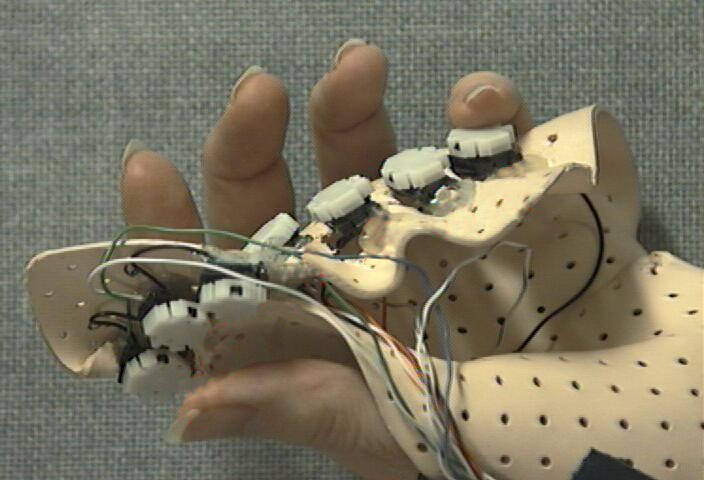
The Vwriter comes with a preprogrammed signal-language, one that is simple and easily understood. There’s a set of keys for one or more fingertips to press as chords (giving binary codes where pressed = 1 and not-pressed = 0). But since each one of us is different, and some of us have disabilities, my user is encouraged to reprogram the device with personal shortcuts, and take advantage of some of the other pressure-pads on the device, besides those designed for fingertips.
At this stage I’d like to refer you to portrayals of two actual devices, both of which use this concept in the pre-programmed manner suggested above First is the MicroWriter, which came out in 1980. I remember seeing one in a shop, but I was never tempted. It was cruder than the device I had in mind. Second is the keyer, which I only discovered whilst researching for this post. In physical design it is probably an improvement on my pistol-grip idea, but in other respects seems to resemble the Vwriter concept very closely. But on its own, when not plugged into another device, it’s not enough. When you are writing, whether shorthand, longhand or keying, you need visual feedback, to make sure that you have not miswritten. If your input is being captured on an electronic device, you need something like a screen to see what you have written, so that you can correct it as necessary. (At the start of my career in the Sixties, computer input employed punched cards and paper tape, with no visual confirmation. Accordingly, these media had to be punched, then verified—the same input re-entered by a different operator, with a warning given of discrepancies. Things have progressed since then!)
So the Vwriter can’t practically be a standalone device. If I am to walk down the Desborough Road recording my thoughts on some kind of keyer, with my hand nonchalantly resting in a jacket pocket, I shall need a discreet head-up display. The combination of keyer and head-up display constitutes a wearable computer.
I’m sure there must be a way to project text characters on the lens of my glasses whilst I’m keying them, without impeding my view of the external scene.
Going back to my ideas in 1978, they were modest, though I’m not entirely sure how achievable they would have been with the technology available in that day. I visualized the Vwriter being sold as a standalone device. It would be your personal keyboard, that you’d plug into any computer you encountered. I’m not sure now what other devices were available then. By programming shortcuts to suit your own dexterity and frequently-used words and phrases, you’d constantly be improving its efficiency and personalization. In ’76, memory was still very expensive. I saw my gadget as incorporating what we then called a microprocessor, with no more than 256k bytes.
I’d still like one, if it were easily available, so that I could write anywhere, without being tied to this desk, this computer screen, this Microsoft ® Natural ® MultiMedia Keyboard 1.0A, which is so ergonomically designed that it has ruined me for any other computer keyboard on the planet.
But failing that, I can still carry my notebook and selection of fountain-pens, with inks in blue-black, green and red. Perhaps I should have faith that the Muse is best coaxed with age-old fetishistic (and time-consuming) rituals.
It was delightful to discover the work of Steve Mann, professor, performance artist and assistant mail-clerk in his own company, or as he puts it: “Empowerment through self-demotion. (© Steve Mann) In the same way that clerks facilitate empowerment of large organizations, I was able to facilitate personal empowerment by being a clerk. My self-demotion provided a deliberate self-inflicted dehumanization of the individual that forced clerks to become human. In summary, I found that humans being clerks can make clerks be human.”
To aid in understanding what he means, I recommend his website http://www.eyetap.org/ and this paper in particular: Existential Technology: Wearable Computing Is Not the Real Issue!
* Since I wrote this, more advanced Kindles, tablets & smartphones have touch screens with predictive text in the form of suggested words. But their on-screen keyboards still have the qwerty keyboard, with the added indignity of different layouts in different countries.
And I suppose frequent users especially the young become so skilled as not to think about what their fingers are doing; thus achieving the goal of technology being “transparent to the user”, as we used to say in the Seventies. It helps without getting in the way, like the perfect assistant in a tiny kitchen.
Where can I buy one?
Fascinating post Vincent. Like you, I have used an MS ergonomic keyboard, and I was concerned it would spoil my efforts to tap out words with different equipment. Not so, thus far.
The 'keyer' reminded me of the action of the accordion artist, I might have enjoyed getting a tune out of it. Arthritic joints would have problems handling anything of that nature. Someone with your abilities could, I am sure, adapt the instrument and the idea to suit differences.