
 A BBC magazine programme about science, Material World on Radio 4, reports an ongoing study into the possible homing instincts of snails. I was interested, as a regular reader of this blog would not be surprised to learn. They are marking the snail shells with white correction fluid for identification; moving the snails somewhere else; seeing if they return to the point of origin. They suggest that pairs of next-door neighbours can mark snails and exchange them, to see if they go back “home”. They are also getting schoolchildren to perform experiments, with much recording of statistics for subsequent analysis. This isn’t the way I’d do it. Collecting data isn’t the same thing as understanding. I don’t think Isaac Newton got children to collect data on apples falling off trees.
I went off yesterday for a trek along the Valley Path, pondering instinct. It’s pointless, I thought, to ignore the instincts, or try to study them in an academic, i.e. non-instinctual way. To me, walking is a way to find out who I really am, that is, what kind of an animal. My instinct told me to wear some solid boots, even though they pinch. The primeval man in me said never mind that, it’s an imperfect world. The amateur student of evolution in me says that walking on two legs is a compromise anyway. Feet are not perfectly designed. Childbirth, especially, is dangerous to our species. You cannot get much more ill-designed than that, whilst still surviving. I went in the direction my feet wanted to take me; and let such thoughts run unfettered in my head as I strode down Desborough Road.
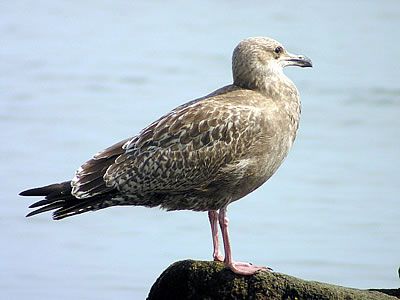
My soliloquy was interrupted by the sight of a young seagull unable to fly. It was big and fat, more so, I would have said, than the adults of its species who burn up fat by flying. But its plumage had the grey-brown mottling of an immature bird, as in the photo. It crossed the road to my side, looking quite lost, but then changed its mind and went back. Then it had the idea of walking along the middle of the road, but cars didn’t bother to slow down and it had to flap madly to get away quickly enough. Adult gulls were wheeling and crying overhead. Just as in my previous post, one of them twice dive-bombed me for taking an interest. I took shelter under a kind of pergola of tubular steel, while the young seagull waddled off to take its own shelter in a grassy area near trees. It’s clear that seagull dive-bombing behaviour is instinctive and takes no account of the target’s good intentions.
I’m trying to imagine some superhuman creature studying the “homing instinct” of humans: marking some of them in a clever way so that their movements can be tracked, then collecting data—rather like an old-fashioned private detective in a divorce case. It wouldn’t be the best way to study the human species. To understand is to look through other eyes whilst still looking through your own eyes.
I don’t understand much, but the mysteries are endlessly seductive.
 a wayfarer’s notes
A very well written piece of prose Vincent and the photograph is perfect. Its the kind that wins a prize and the bird societies/agazines would love to have.
LikeLike
and the photo is something that would be delight framed in a large size
LikeLike
Vincent, Your understanding of the snail experiment is different to mine. I have heard a number of discussions about this. A lady called Ruth, who has a science qualification, started off the experiment with the snail exchange, by the way, marked in different colours for each swop group.
Exeter University are now looking at Ruth's initial findings and expanding the experiment in order to obtain a much larger sampling and range for the research. There are instructions on how it has to be done and reported on. At the end of the experiment there will be the usual analyses of the information in relation to what the experiment set out to find.
Nice bird pic, even if it is not yours; but self preservation always comes first
LikeLike
Well, ZACL, I have no disagreement with your summary. The schoolchildren's participation was covered in yesterday's programme, together with the use of Tippex. They are very pleased with the idea of having children do “real science”.
The state of play is summarised on this BBC web page.
To me, the idea of testing a homing instinct is insufficiently holistic. When I was taught science, I was told it started with a hypothesis, which was then tested. Admittedly Ruth Brooks has a hypothesis that snails return “home” up to ten metres. But it's a very narrow hypothesis if it doesn't cover a theory as to the evolutionary advantage.
Why should it be assumed that the snails are “home” in the first place, when they are deported to some place of exile? Perhaps they were already 9 metres from base when shifted. Why do they want to go back? Do they have friends and family left behind? Do they have some kind of nest where they can return from forays and feel safe? By what sense is it assumed they return? Clearly not to follow their own slime trail because in the experiment they have been lifted up for transportation. I've watched a snail climb 20 foot up my side wall, leaving a criss-crossing trail. I puzzled as to the reason, and then reached the reasonable hypothesis that it was attracted by some invisible deposit left on the bricks by the outflow of the cooker fan. In the bathroom there's an occasional slug at night, moving very slowly indeed, hoovering up some nutrients from the floor, perhaps fragments of human skin.
My point is that any homing instinct is part of a life-strategy for the slug or snail. The homing experiment makes no sense unless homing is understood; just as it would make no sense to track human beings unless you had a hypothesis that made sense of their way of life and reasons for travel.
I was quite cross with the smugness of the programme for implying that children were being exposed to “real science” when it was merely data collection, impoverished of any real ideas. Just like those press releases which reach the newspapers that this or that food is good or bad for you because “studies” have detected some correlation.
Correlation is not understanding.
LikeLike
What I meant to add was that in the case of the snail climbing up the wall, or the slug entering the bathroom (by its own mysterious means) these territories are clearly foreign and unsustainable as a normal place to live, even though the gastropod in question finds a reason to go there and visit. It's perfectly obvious that the creature won't go there without knowing how to get back, so some sort of mechanism is likely, otherwise they wouldn't go on these adventures at all for fear of getting lost.
LikeLike
Vincent,
Talking of the smugness of the programs, I can understand how you feel. If I’m reading or watching such programs, I tend to doubt if they put enough thought into it. To me, most of the programs tend to be one sided observation. But, I figure they are better than endless crime reports, and health and food programs cost much less to produce than other good programs.
About the homing instinct, I think human’s is complex, and there are elements only that person know, and quite often even that person wouldn’t know why he or she wants to go back home or want to make somewhere else a new home.
And the fear of snail or slug, obviously they don’t have complex fears as humans have. So, the fear is different, and our fear is also different among us. And, when people make a hypothesis and state their opinion, often no one takes time to refute the hypothesis. Besides, most of the time, people do not state their hypothesis to speak up their opinion. It’s understood. Most speakers assume the majority agree with their hypothesis. I think that’s inconsiderate. Not everyone is the same, and it’s impossible to explain to others how we feel without writing a novel about it. And even if we write a good novel about it, I don’t know how many people get it.
When Princess Masako was engaged, her father, a career diplomat, had an interview with Bungeishunju, a highly regarded monthly magazine. He said after she graduated she went to job interviews. This was in the eastern U.S. I don’t remember the details, but he said he was surprised at the salary those companies offered for a new hire. So, I thought she contemplated to remain in the U.S. alone. But the father said, in the end she made a decision to go back to Japan because without her family, she would not be happy. So, she returned to Tokyo and lived with her family. I thought that’s quite normal for young Japanese women. For living with the parents even at 29 and single, for the Japanese standard, it is still considered ordinary. Even me, I never thought of living at other than my home in Yokohama if I returned to Japan.
But, I was very disappointed when I read what the father said. He said if she continued to stay in the U.S., she would be like nenashigusa. Nenashigusa means plants with no roots. I could understand if such opinion belonged to a junior diplomat or the people who haven’t lived in oversea long enough. But he spent most of his life in overseas, and still had such a view. If he thought that way, then he must have thought of all the immigrants, Japanese or others in the same way. To those people, own country is the only world.
Whenever I see a Japanese television program reporting such as a plane crash, reporters shamelessly announce how many Japanese were on the particular plane. They keep repeating it and they promise to the audience if the update was available, he or she would report it right away. This gives me heartache knowing many non-Japanese are watching.
LikeLike
Hi Vincent,
Anyway a nice selection of a picture. Perhaps my misunderstood comments will now encourage you to snap a nicer one on another of your walks across the countryside.
LikeLike
Very nice blog. And the comments are of literary quality.
regarding seagulls:
A man lived by the sea. Every day he would go to the shore and hundreds of seagulls would come to stroll with him. One day his father said, “I hear that all the seagulls come to roam with you. Catch some and bring them to me so I can play with them.”
The next day he went to the shore but seagulls would not land.”
Lie Zi, chapter Two
LikeLike
Thanks Raymond. And your little story sounds familiar. Is it in your book?
LikeLike
OK Ashok. I shall be wary of any seagull-snapping, in case they snap back.
LikeLike
Keiko, you are such an ambassador for Japan! Bless you for it.
LikeLike
Been quite a while since I've inhabited the blogosphere and read in these here parts. Thoroughly enjoyed this post Vincent (meant in a genuinely non sychophantic way)and loved that last line, “to understand is to look through other eyes whilst still looking through your own eyes.” That's definitely every writer!
LikeLike
Thanks Lehane! I was delighted to see you are busy online and I loved your new story published here which you were too modest to publicise yourself.
A very satisfying read, and I hope our hero was a carrier of rabies, whilst remaining immune himself.
LikeLike
I love the notion of marking humans and switching them about to see if they return home. I'm afraid I'd be lost for good unless I happened to wander the correct way, being a bit lost feels like part of my nature.
LikeLike