
 When we speak of God or gods, it’s to express the otherwise inexpressible. This is something that atheists and materialists seem to wilfully misunderstand, when they say that it’s irrational to believe what you cannot see. As you’ll see from various entries in this blog, there are two kinds of immortal I can’t do without when trying to make sense of experience: the Angel and the Muse.
The angel’s principal role is to herald and remind, to help bring about a state of consciousness. In my experience the angel is neither male nor female, and may be imagined in any form or none. It may whisper as a voice, in definite words; or in pure meaning, which cannot be expressed to others without translation into a human language. Sometimes the angel simply shows, with gestures or tableaux, even a little silent play with several actors, which unfolds before your eyes, on the fringes of normal reality. Many have met the anonymous helper who turns up when you are in trouble, such as arriving in the form of a stranger who helps get your broken-down car started again. Many of us get the privilege to “be an angel” for someone else. I maintain that the angel’s role is less to intervene and more to prompt a response in our hearts: to lift us up, and make us understand that this world has mysteries beyond the reach of science and atheism; and show that despite all appearances, this world is our friendly home. I get my knowledge of angels from personal experience, often recounted in this blog. Books merely confirm them as universal.
The Muse is formless yet (for me) vaguely female. She doesn’t waste energy by appearing in person, but waits to be invoked, as we know from ancient literature, such as Homer. Her role is to help give birth to form, not her own but the artist’s idea. She whispers words to the poet, to aid the creation of order and sense from chaotic feelings.
When I go a-wayfaring, it’s not just for mundane purposes of exercise and exploring my neighbourhood. The aim of the dog-walker isn’t just the dog’s or even the walker’s health and hygiene. The real purpose is something sublime that stays unsaid, or can’t be said. Only in mental quietness, aided by the Muse’s light prompting, can the inchoate underbelly of existence be wrapped in potent words, and brought to the light of conscious understanding.
“Do you believe in angels, then? Do you believe there is such as a thing as the Muse?”
I answer that I am not talking about belief, only expressing. Action is not in itself a creed. If I talk about unicorns, it doesn’t mean I believe them. What I believe is that you and I can share an understanding.
The other day I walked to Downley, Naphill and Hughenden, a round trip of three hours. For the first hour or so, I was merely present to the scene, absorbed in whatever assailed my sense, from within or without. After a while I began to dictate words in the ever-willing ear of my pocket recorder. When I climb up the Pastures to Downley, this tends to happen, sooner or later. The Muse seems to dwell in those hills, and favours me with whispers when I am ready. I’ll share the latest set with you.
When I hear, for example, a certain birdsong, a repetitive single note plangently celebrating June’s glory, it takes me back down the corridor of years, invoking all the times I’ve ever heard it. Now I’m walking in two worlds at once: this public footpath weaving its way round the backs of houses, and that echoing passageway of time. Between these two worlds, I suspect, is the place to touch Eternity.
And in Eternity’s boundless space, I do things I’ve never done, in a time that’s never been, with memories that don’t fit into my life-story; memories of the Never-Was. And I’m not alone in this. It’s man’s inheritance.
My footsteps traverse a labyrinth of tidy suburban roads, small-scale, leading nowhere, with names like Cherrycroft Gardens, echoing places I’ve lived, like a house called Cherrydown on the Isle of Wight. In my mind’s eye, I’m not seeing that house now, but some place on the furthest shore of consciousness, in a different dimension. Perhaps my whole life is flashing before me in little snapshots, for June birdsongs are still loud in my ear [so loud when I play back the recorder!], and they take me to memories I’d forgotten, in a non-chronological sequence that feels like another life, one I never lived. Then I realize these fleeting memories are not so much scenes from the world, but from my imagination at the time: not the house Cherrydown, but stray images and even angel-encounters from the time I lived there, going back to a still earlier time. Might they be echoes of Eternity?
And now that I’m tuned to the notion of everything I see or hear or smell or think being connected to a memory, there is no stopping me. I look across at a public allotment, where a gardener has left rhubarb and onions unharvested, so that their leaves and stalks have grown huge and unfamiliar, with stylized buds, flowers and seedheads; the onions like decorative turrets of a fairyland castle, the rhubarb with loose bunches of flat seeds resembling those of the dock, Rumex Obtusifolius, for they are related, in the family of Polygonaceae. Just looking at those overgrown vegetables takes me to some fabled court in the kingdom of evolution; a kingdom in which I, too, flourish. Now I wander on, in this outlying suburb of a village, approaching the woods and meadows of I know not where. There’s a map in my trusty wayfaring bag, but I don’t bother to consult it. My route feels all right. I know it will eventually take me home. In the broader sense, I’m already home, for this is my extended neighbourhood. It’s within my foot-travelling reach, so shouldn’t I get to know it? Literally, my backyard is tiny. But in a wider sense my backyard is all around, my journey-zone (journée means day’s travel). It includes that Victorian prime minister Benjamin Disraeli’s Hughenden Manor, though it’s closed to the public today. I’m going south now, I can tell from the position of the sun. That’s the direction of home. My brother confessed the other day to forgetting that the midday sun hangs in the south; for in New Zealand, it hangs in the north. When in doubt I follow a footpath, for they all go somewhere, unlike the roads built for cars, which often lead to dead ends.
Now I see a white-haired grandfather on the road ahead, pushing a little child on a buggy, amusing himself and possibly the child by letting it run free, down the gentle slope. I see that the grandfather could be me. The child could be me. The seedheads in the allotment, anything could be me. Every person I ever see in the street could be me. But I have to admit that I seldom see this unity, seldom have a need to try. Today’s a holiday from normalcy, while the Muse takes me by the hand.
So I see that everything is there all the time. All it needs is a quiet presence, and some kind of trigger, for Oneness to be manifest. Or it might never happen in this lifetime. But is this what I am doing in my life, beyond mere survival: to seek little openings to that Eternity whence I came?
In the words of the late journalist Robert Ripley, Believe it or Not!
For as every writer of fiction knows, the important thing is not to believe, but to imagine. Imagine vividly enough, and you have belief. But that’s no reason to go to war with someone who believes differently.
Such is the Muse, dear reader. Such is the messenger angel. And such is life.
Footnote
Arthur Stace was a reformed alcoholic who for 35 years was inspired to write the word ‘Eternity’ in perfect copperplate in chalk on the streets of Sydney. Many people who lived in Sydney between 1932 and 1967, and those who visited, would have seen the word written on footpaths. It was a mystery for years, until 1956 when it was revealed to be the work of Arthur Stace. He wrote ‘Eternity’ over half a million times. Arthur Stace grew up in poverty, and was jailed at the age of 15. After serving in France during the First World War, he returned to the streets of Sydney, partially blind, unemployed and an alcoholic. One day, drawn into the Burton Street Baptist Tabernacle with the promise of a free meal, Arthur Stace encountered something that changed his life, as he described to a journalist from the Daily Telegraph in June 1965, two years before his death:
John Ridley was a powerful preacher and he shouted, ‘I wish I could shout Eternity through the streets of Sydney.’ He repeated himself and kept shouting, ‘Eternity, Eternity,’ and his words were ringing through my brain as I left the church. Suddenly I began crying and I felt a powerful call from the Lord to write ‘Eternity’. I had a piece of chalk in my pocket, and I bent down right there and wrote it. I’ve been writing it at least 50 times a day ever since, and that’s 30 years ago. The funny thing is that before I wrote it I could hardly write my own name. I had no schooling and I couldn’t have spelled ‘Eternity’ for a hundred quid. But it came out smoothly, in a beautiful copperplate script. I couldn’t understand it, and I still can’t. I’ve tried and tried, but ‘Eternity’ is the only word that comes out in copperplate. Eternity gets the message across, makes people stop and think.
 Arthur Stace’s publications include: “Eternity” self-published and republished approx. half a million times over a thirty-year period in Sydney.
Note on the other photos
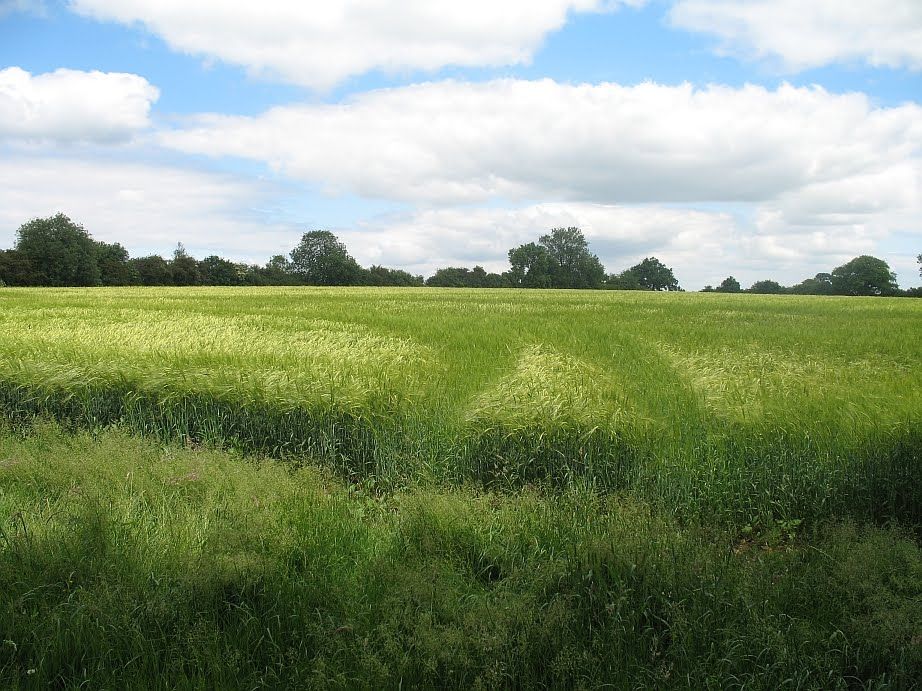
1) A barley field near Naphill
2) A red kite over the field
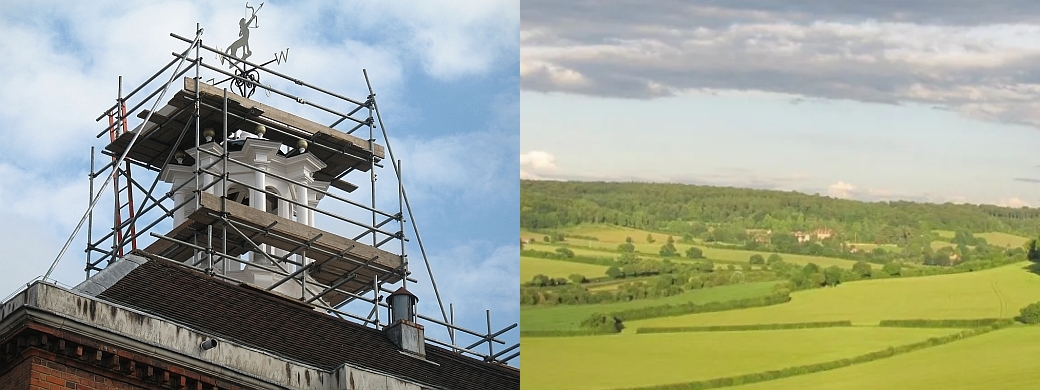
3) (below) a side view of Hughenden Manor

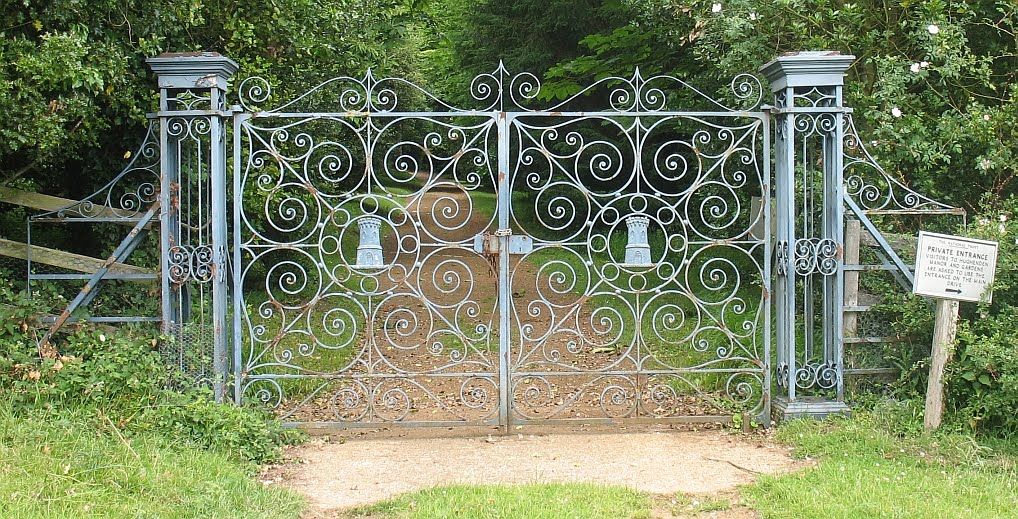
4) (below) Hughenden Manor, the rear gates
 a wayfarer’s notes
ahh, wonderful – I love this story of Arthur Stace! It touches and reminds us of the mystery…
Speaking for myself, and my long period of agnosticism and shorter atheism – it wasn't willful argumentativeness but reflective of my general bewilderment. I can still – although the memories are growing less sure – put one foot in each camp and remember my irritation and confusion, while now being open to/joyfully welcoming encounters with spirit – which seems to be the same as you call angels.
I needed to hear your wise words on The Muse right now. she who “waits to be invoked, as we know from ancient literature, such as Homer.” I am stumbling right now, sniffing out a path I would cut with my pen onto untracked pages, but still struggling to understand, to grasp the Ariadne's thread that will lead me confidently into the maze ahead. I was teasing myself with “shall I do this or that” to find my way: when what is needed right now is a direct plea to the Muse, and an offering of whatever tarnished gold is threaded through my soul…
not as in 'selling my soul': rather a soul-baring attempt to plead for the worth of the project and make my pledges to it, and to the Muse for her help.
Your words inspire me.
Finally, I love your observation that roads end but paths never do…. how obvious, how true, and yet I never noticed this before.
LikeLike
I'm very glad to hear this Hayden, from you who have taken on so much, risked so much in your new life-enterprise.
Do you mean that you have some writing ambition as well when you say “sniffing out a path I would cut with my pen onto untracked pages”?
Certainly you would have plenty to say.
I think the Muse is there as a reminder to all of us who are doers, who act on the world's stage rather than take a lead from others, write rather than read; that it's important for us to be passive too, receivers tuned to the subtle whisperings that we so much need for guidance. I know I do.
Perhaps we may need to do more than “plead for the worth of the project” – or should I say less? I mean, keep letting it go, and then see if it is given back with a blessing. Or not.
LikeLike
to people like us, I think ink is a type of blood without which we can not fully live. I know it's true for me. But weaving all of those words into something that is part of a whole – this I've never been able to pull off. I have many, many bits and pieces that have no obvious throughline – much like my life, now that I think more closely about it!
Your words/advice were prophetic, helpful. I turned from here directly back to my writing project and spent the rest of the day learning how it might work. I had a wonderfully busy weekend.
I need to bring a certain passion and excitement to a project in order to get through the sheer mundane work that is required alongside the gleeful inspiration. And so I did “plead” for my project. It was returned to me with open arms, ample blessings and insights that staggered me. (The old “how could I have missed that?”) So yes, much much listening.
What I find strange and interesting is to recognize how my current, admitted path of working with spirits was predated for years in my writing. In my fiction people take such things for granted, although I still considered it to be purest fantasy.
Perhaps that was the stumbling block- 'spirit' (angels) – I couldn't write without them, couldn't accept them – but also couldn't quite relegate them to 'just pretend' – and so couldn't “go anywhere” in writing without them. In my writing people listen to the whispers that come on the wind, and are driven by winds that have no name. That was very much at odds with my corporate /pragmatic /conventional higher-education self.
Now, loosening the corsets that have restrained my thinking, I feel like I'm closely in touch with my very young self: the dreams that have haunted me, the images that have burned through and yet had no 'context' – all are coming together.
And yes, though I didn't speak of it, writing was the deeper dream that drove me here.
Based on the 40,000 word story I did a few years back, the outline of this looks like 2-3 books of 100,000 words each, and a 2-3 year project. I am THRILLED!
LikeLike
Hi Hayden
“what is needed right now is a direct plea to the Muse”.
I have found the use of a similar dynamic astonishingly effective.
The paradox, I think, is that we are consciously demanding help, help to surrender our articulated/conscious demands.
This is a surrender to escape the calculating function of the mind for a little while, and thus give full reign to the unconscious creativity of the heart. Asking the muse to help us surrender and welcome in its rich treasures.
Which we then, again paradoxically, will articulate more effectively in our writing, painting, singing, whatever.
LikeLike
Hi Vincent
Here's a fine map of the area for those who want a peek at your wayfaring:
http://www.british-towns.net/en/level_4_display.asp?GetL3=9444
LikeLike
Excellent, Raymond. I went on a shorter version of the same this morning, and was thinking of you, imagining you taking a stopover on the way to Israel (we are half an hour's drive from Heathrow Airport), and that I would show you Hughenden Manor!
My house is approximately on the “1” of 1km at the bottom left of the map.
LikeLike
Correction, it is just off the map at the bottom somewhere.
LikeLike
Are you between High Wycombe and West Wycombe?
I would love to see Hughenden Manor. I wonder if it is possible. Maybe if I don't lose too much money in the market this summer.
“despite all appearances, this world is our friendly home.”
Yes, although some religious don't like the word, this comprehensive friendliness can be finessed.
LikeLike
Yes, but High W- is something I try to keep out of the search engines!
LikeLike
May it remain peaceful in non-popularity.
Wiki: Popular “Borrowed from the Latin popularis in 1490, originally meant common or “belonging to the people”. The use of the word popular to mean the “fact or condition of being beloved by the people” is seen originally 1601.”
In this case because it is loved by the people they might like it to remain unpopular
LikeLike
Beautiful pictures Vincent and profound thoughts on the unity of all creation!
I was away for more than a year in the Himalayas (away from the internet too) and returned recently to find that the writer in you is still alive and getting more profound by the day.
LikeLike
Hi Ashok! I had read your long-awaited new post and yet still did not grasp immediately how long you had been away. In this blogging world I seem to be unaware of the passage of time!
Thanks for your remarks—I constantly think that the writer in me is getting worse, and seems to require more effort.
LikeLike
You raise an interesting point, Raymond, about whether this town is loved by its own people or not. There are many tales I could tell about that.
If you love to have beautiful countryside within walking distance, the amenities of a sizeable market town, and can only afford a cheap house, and for one reason or another have settled in south-east England (known for some reason as the Home Counties), then the town I shall call by the pen-name of Wye Vale is the one for you. (I used to call it Chiltern Vale.)
And if you want to live within a stone's throw of a cosmopolitan melting-pot, where the main races are African, Caribbean, Pakistani, Polish, English of the humblest class, then my street with its easy access to the Ledborough Road is the street you will choose. Ledborough Road is another pen-name. When I see my dentist stroll down it to go for lunch (he's a genial member of the middle class that you could imagine in an English domestic sitcom) he looks completely out of place, like Dante or Virgil strolling through the Inferno. Perhaps I look like that too.
And my own street? I don't think I have a pen-name for it. I make sure not to say what goes on here amongst my neighbours, just in case!
LikeLike
[…] Home is home, but what do I call the expanse outside? Two years ago, I wrote a rhapsodic piece about my neighbourhood, Glimpsing Eternity, and said “Literally, my backyard is tiny. But in a wider sense my backyard is all around […]
LikeLike
[…] June 17th August 23rd September 17th October 5th […]
LikeLike
[…] “So I see that everything is there all the time. All it needs is a quiet presence, and some kind of trigger, for Oneness to be manifest. Or it […]
LikeLike