
If Day is the realm of Nature, then Night—at any rate to this brain, at this hour of darkness, still a long way from dawn—is the domain of artificiality. There are other claimants to the imperial mantle of Night. The most democratic, the winner of the majority vote, is Sleep. But I am interested in rarer things, like the notion of a devout vigil. Time was when a knight, on the eve of some noble enterprise, would spend the hours of darkness in a chapel, keeping watch over his armour, dedicating it to the high purpose to which his honour had called him. Monks under the Benedictine Rule would get their sleep in the intervals between the Holy Offices of Compline (9pm) Matins (midnight), Lauds (3am) and Prime (6am). Me, I’ve been awake since Lauds and hope to file this despatch before Prime.

In my youth I seem to have been aware of little that mattered, certainly not any clear distinction between Nature and artifice. If I had been pressed, by the kind of tutor I wish I’d had, I’d have agreed that artifice was the fons et origo of both art and technology; while Nature for its part was the fount and origin of æsthetics and natural philosophy (which we now call science). And religion? In its different aspects, it permeated all four. In myths and music, it was art. In architecture and musical instruments, it was technology. In morality and Love, it was æsthetics. In creation-myths and philosophy, it was science, for science was a sort of divine knowledge. “Therfor ye trewly ber the name Cherubin, fful of scyence And of dyvyne sapyence”, says De Guileville’s Pilgrimage of the life of man penned in those glorious days before the spell-checker.
In my youth (age 22) I hit rock bottom: the world was too big a space and I had no idea of my place in it. Zen Buddhism was the nearest thing I had to a chart of how to live; but in my solitary imagination, derived from certain books which spoke of mind-blowing conundrums (koans), it was a philosophy of the Absurd.
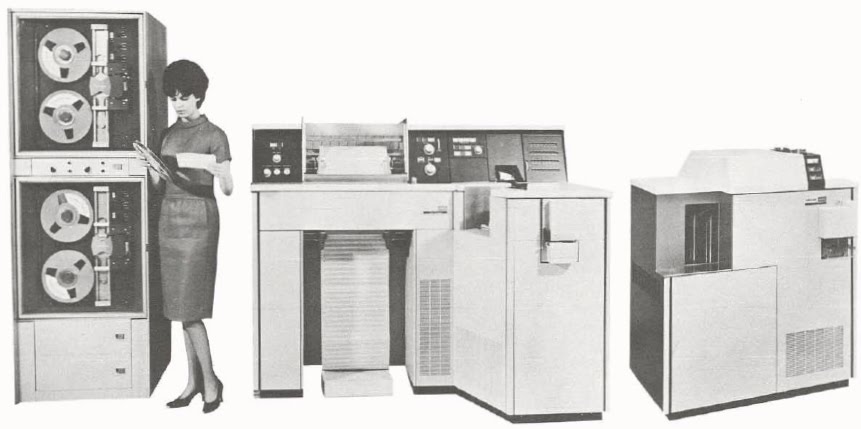
In November 1964, I met an acquaintance on Putney Bridge. He was working at the head office of International Computers and Tabulators (ICT), the very place I was bound for, to attend an interview. I asked him what he did. “Oh, you know . . . softwear,” he replied. Knitwear? Lingerie? I had never heard the word “software” and would not have understood it. Despite my manifest ignorance, they accepted me; and one of the machines I was trained to program was the Univac 1004. It wasn’t granted the name “computer”: the brochures called it a “data processor”.
You put punched cards in at one end and it punched more cards and disgorged them at the other end, till it finally, triumphantly, spewed out gas bills on fanfold stationery. Its memory was a mere 961 characters. Compared with tabulators, which could remember the eighty columns on a card just long enough to print them, this was plenty. The paragraph you are reading would have filled its capacity exactly.
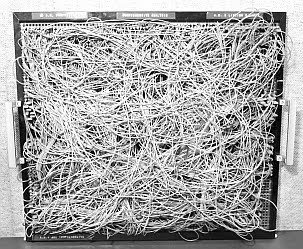
Such a memory was insufficient of course to store the set of instructions which told the machine what to do. That was stuck on the side, in the form of a plugboard, which I the programmer had to “plug” with wires into an array of 5000 holes.
I was an enthusiastic programmer despite a poorly-equipped mind. I had no grasp of management, commercial considerations, office politics, self-organisation or steady routines. All I saw was opportunities for creative brilliance; but my programs were plagued with fatal flaws and seldom finished.
And yet, of all the jobs I’ve had, it seems to have suited me the best, for I’m still doing it, still trying to produce an informatical masterpiece, harvesting 44 years of experience and still not getting the full hang of it.
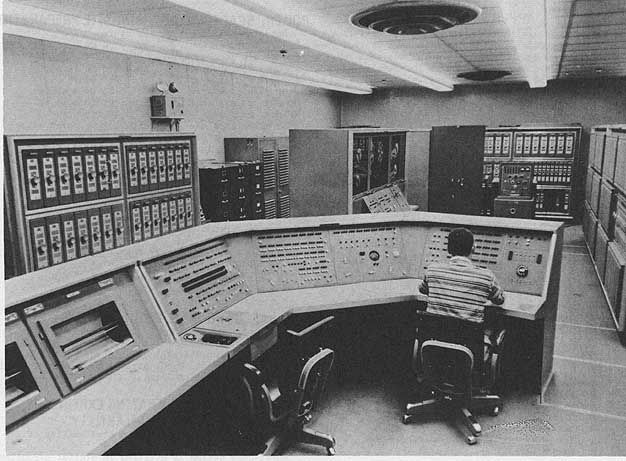
The machines I first worked on survive only as museum pieces, monuments to the all-night vigils I spent in their windowless air-conditioned rooms, with false floor, false ceiling and false claims to efficiency.
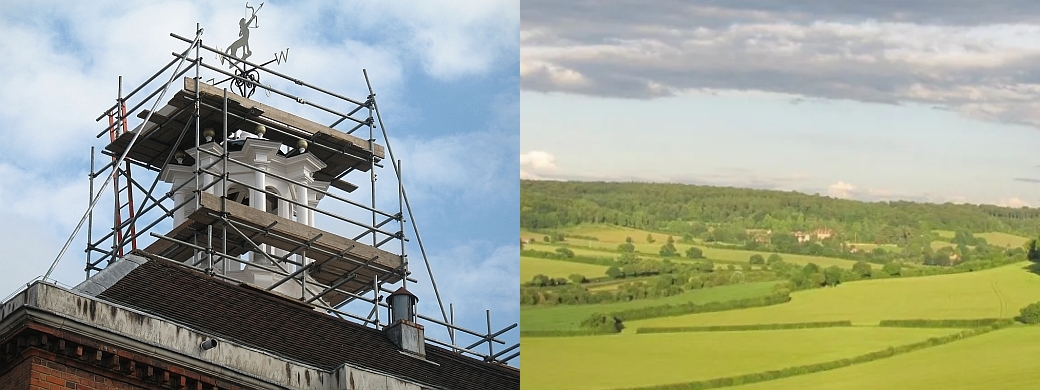
O modern age! How fickle thou art, how soon thou forgettest! But I shall not, for all I see from this hilltop is the eternal Present, stretching out in all directions as far as the eye can see. And beyond.
 a wayfarer’s notes
Vincent,
Thank you for an interesting piece of history in your country. I read your blog with much interest. Maybe I would blog about my computer related story later on.
1964 was the Olympics in Tokyo. Anywhere in Tokyo was under construction.
That year, I danced an Olympic dance in hotels in Tokyo and resort. At home, my mother was teaching ocha, and one of her students was the mother of a Japan IBMer. They were family friends and close to my grandfather. My mother probably didn’t know exactly what computer did, but she knew the company had good technology. My grandfather was engineer, so he probably understood the technology and told her about it. So, I went to work for Japan IBM upon high school graduation for a year. Later, the IBMer became the CEO. I didn’t know it until 1980 or so because I was in the U.S. and had no interest in business. I had always felt guilty not studying about computer even if I had opportunity. So, after my daughter was born, I studied programming and became a systems programmer. .
My mother used to say to me, “Ever since you left Japan, Japan progressed more and more… She was not satisfied with me because I didn’t follow her footsteps.
LikeLike
Not to be to frivolous during prime and lauds, or was lauds and prime, the colourful spaghetti of wires would have been enough to either keep me away, or tie me in knots.
I remember seeing the Burroughs machine on an educational school outing. On reflection I was surprised that us kids, were allowed to breathe in the same hallowed place as the monster that spewed out its binary punched tapes and suchlike.
In those days that you describe, 'computers' were not on the public let alone domestic scene. My next view of anything vaguely computerised was on a visit to a British Telephone unit; it also took up a room and a half, much like the binary machine I saw some years before. This time though I saw the 'brain', the cables and connectors. Such things now, could be prayed for in small form,they are ever becoming tinier.
LikeLike
ah, a lovely meditation, Vincent. Thank you for summoning me from my abstract reveries & solitary battles to enjoy it.
In 1982 I met a woman who was then head of information systems for The GAP, then a notoriously anti-female company. Yet she had survived, having won her spurs hard-wiring computers at University of California in Berkley in the 50's.
These things are mythological, epic in their ability to stir thoughts of what now seem inconceivably ancient times.
I like your juxtapostion of this with long, sleepless nights laced with ancient mysteries. It's appropriate, given what then passed for programing.
It seems it was an arcane art that has now become itself, well, programmed. Systemitized. I don't know this myself, of course, I've never understood these things. I only glean hints from friends who are directly engaged in this world.
It fascinates me the way ancient runes do. Or koans, for that matter. I can't understand, but they stop me in my tracks and I try to listen.
LikeLike
Hayden, you offer a very skilled insight into times that many of us were not involved in. I hear from hubby and his friends how they enthusiastically devised programmes for huge machines, programmes, which used small amounts of memory that worked for the purpose, once they were commissioned.
While the skills have not made the knowledgeable programmers of yore expert computer operators, they do understand 'academically' where a fault or problem may lie, even if they cannot practically do anything about it. I usually get called in to tweak, to the best of limited ability!!
LikeLike
Thanks for these comments. I'll respond to them when the current programming task gives me a breathing space!
LikeLike
Hi Vincent,
Hope you retain some energy for yourself. Looking forward to hearing from in due course.
Take care!
LikeLike
it is indeed a pleasure to know a person who worked with the first computers. typing this so effortlessly and expecting things to get posted immediately and reach you so far away is also a miracle that you saw unfolding and took part of! it's an achievement, i must say.
LikeLike
TS Eliot-tastic
LikeLike