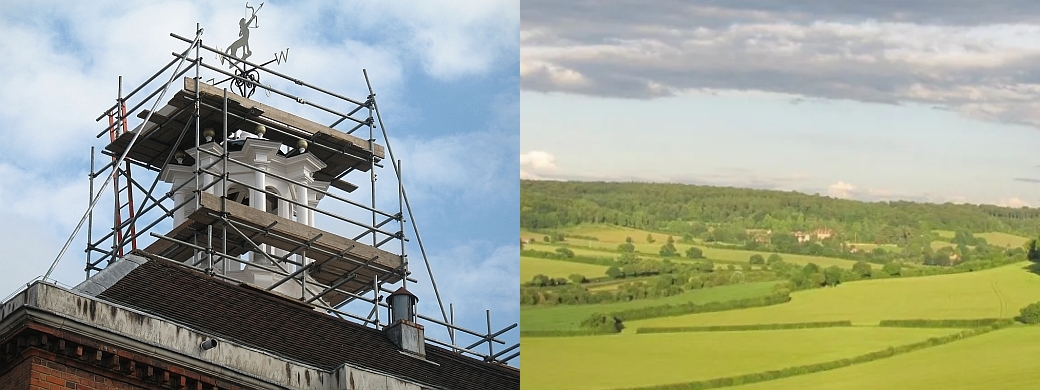

I don’t have a photo of the phenomenon I wish to describe, though I’ve seen it several times in recent days, for example from the upper slopes of the hospital grounds, where I can look down upon the town centre in the valley and across to the hills beyond. These embracing hills touch the sky and sometimes a great bank of roseate cloud creates a false horizon on top of the real one. It may take the shape of a far headland, viewed through a mist from an ocean shore. I become a small figure in a vast seascape, walking at the tide’s margin. I imagine myself beneath raucous herring-gulls, with the tang of seaweed in my nostrils, the shingle crunching under my feet, the waves breaking with a syncopated crash, followed by a prolonged hiss as they suck their salt-spray back through the shingle.
In the world of reality, I’m in a landlocked country, nowhere near a body of water; just another biped among houses ranged in rows, their windows silent, glinting in the afternoon sun, radiating a pathos which I always sense near settled human habitation, especially of the shabbier sort. Somehow I feel the human frustrations, illusions shattered, meaninglessness masked with mundane yearnings. Houses built in the Fifties or earlier remind me of childhood, and an era gone forever; an England unlike today’s.
Because of the clouds’ appearance, I dwell in two places at once. It strikes me on these wanderings how it takes only a slight resemblance to something I’ve known, to set my feelings and memories off on their own parallel path, mingling with today’s sights, sounds and smells. One afternoon stroll could generate a dense volume of feelings and recollections.
Later: On my usual trip to the hospital to meet Karleen from work, I brought along a camera, as the sky looked promising. Perhaps I might capture that illusion after all. I stood outside her office and scanned the horizon for shots. They weren’t what I wanted but I took a few anyway.
Suddenly I heard a woman’s voice behind me.
“Excuse me, do you live here?”
“You mean here at the hospital?” Behind Karleen’s office there are flats for medical staff.
“Yes, what are you doing with the camera?”
“Do you mind telling me why you are asking?”
She explained that the hospital grounds are private property, and she was concerned that I might be planning to photograph patients through the windows. Even if assisted by a gigantic telephoto lens, such as those used by paparazzi to snap royalty in unguarded moments, I would not, from that position on the hillside, have been within reach of any suitable window. I assured her I was interested in nothing but the line where sky meets earth—the horizon. Being English we ended up each apologising to the other, while affirming our willingness to die for the principles of freedom and/or privacy. Especially, I suppose, where the two principles collide. The battlefield might be strewn with corpses, but politeness would reign till the last one standing.
Karleen explained to me later that they are bit jumpy about media interest at the hospital because of some recent government inspection. Naturally the Press and the public are interested to know how their money is spent by the renowned National Health Service; and naturally a hospital doesn’t want to be the subject of gossip, illustrated with intrusive photographs.

A cloud formation which had a faint resemblance to a coastal headland (which I was unable to photograph at the time—the one I display is a poor substitute) showed clearly that we are moved by likeness as much as the real thing; even when the likeness is not great. This is the obvious basis of works of art, ever since the prehistoric cave-paintings. In more inward experiences, we can only use simile or metaphor. But the same susceptibility is provoked; and we are tempted to go a step further.
“This politician speaks as though he were honest. Because I agree with him, I take the effortless leap and say he is honest!” Or disagree, and declare him to be a liar.
“This sense of being protected that I feel (or that I crave) is as if there were an all-knowing, all-loving, all-powerful God. Because I want it to be so, I declare that God exists!”
The rationalist says that the evidence is lacking. But every small child has had to wrestle with likeness from a time preceding its earliest memories. The same thing or the same person look different in different lights or from different angles, but it has to learn that they must be treated as the same. Some it learns at home: something which looks and tastes disgusting is “good food”; someone ugly and unpleasant is its “kind uncle”. it is taught to set instinctive reaction aside. At school it learns to classify experience by assigning words of the language, grouping them together. If all swans are white, the swan-shaped aquatic bird found in Australia cannot be a swan. If one kind of person was or is oppressed—but what is this notion, “kind of person”?
And so on. Being rational and relying on evidence never come naturally. I will go so far as to say they are perversions from our nature and have to be taught, just as a wild mustang has to be tamed before it will accept a rider. I prefer the mustang in every circumstance but the one where survival decrees that just like Richard III, I must cry “A horse! A horse! My kingdom for a horse!”. Only then do I have need of that faculty, so saddled and tamed, that rational mind, so alien to all instinct.
 And what about love? Take cats. People love them, though they are manifestly freeloaders, freebooters to boot. There’s a black cat which sits on our fence waiting for our neighbours to let it in, though it is not “theirs”. It knows that I will never let it in, but in the habit of humans I might address it, stroke its head in passing; whereupon it will perform with soulful eyes and a brief miaow. Millions of people love their cats, for no better reason than this performance, along with purring and so on. It’s a very poor imitation of human love but it suffices.
I’m not trying to be superior about this, but I’m happier with slugs. Last night I went to the bathroom at midnight. Two slugs were on the floor. They freeze when the light goes on, in mute protest at my interruption of their time; significantly refusing to move even a single eyestalk. They don’t bother me at normal hours, this motionlessness implies: how come I break my side of the bargain, and bother them in their time? Do I think myself superior, just because I could squash them with one careless foot? Of all God’s creatures, they must be amongst the least well-defended, but they survive, they have their dignity. Perhaps Thoreau actually had slugs in mind, when he wrote “If a man does not keep pace with his companions, perhaps it is because he hears a different drummer. Let him step to the music which he hears, however measured or far away.” Slugs don’t try to seduce me with soulful eyes, miaowing and purring. They leave their convoluted trail of slime on the bathmat like the tyremarks of teenagers playing with stolen cars; but silently, at a time when they had hoped for privacy. I prefer slugs to cats.
I have my illusions like the next person. But I try not to believe in them.
there were 15 comments. None have survived.