
 I drafted this article five years ago and two years later promised a post on the topic:
“I will some time tell here the story of my visit to the Mustardseed community in Jamaica, where I encountered a shining human being. Aged 21, she had been severely brain-damaged from birth and in consequence was no taller than a three-year old. She could not speak, she could not feed herself. Her twisted limbs were stick-like and useless. She could not sit up. She even had to be turned over on her daybed from time to time to avoid bedsores. But she could laugh more beautifully than anyone I have met. Adorned by her carers with makeup and braided hair, she directed a regal glance at me. I felt in the presence of a superior soul.”
It’s time I told the whole story.
“In my father’s house are many mansions,” said Jesus according to St John’s gospel. I have been to one of them—“My Father’s House” in Mahoe Drive, off the Spanish Town Road. It’s a rough area, though I can’t say how rough, seeing only the evidence of poverty and devastation as I pass through swiftly in a taxi. We reach a pair of gates ten foot high, solid iron, bulletproof. There’s a small peephole, through which a Rastafarian gatekeeper scrutinises all would-be visitors, before pulling back the doors and granting you entrance to this Heaven-haven. Something saturates the air, at any rate I feel it strongly. I’m not talking of the relative well-being and good order compared with the desolation outside the gate. I mean there’s a kind of pervading love—not that the territory outside was hateful. On the contrary, huge amateur efforts had been poured on to that desolation in the form of murals and inspirational graffiti, improvised structures. But there was still a sense of stigma and lack of escape routes, where the only choices were despair, crime or Rastafari.
At the end of my second visit, my regular taxi-driver came to pick me up. He was shaken, could talk of one thing only. Outside those gates, waiting for them to be opened, he’d been held up by gunmen, one each side. I always had difficulty understanding his patois, but I got it eventually. He was telling me that he’d been held up before, more than once, and had managed to talk his way out of the situation; but never with two guns, one at each side of his taxi. The worst of it was, the gates didn’t open till the gangsters left, for the loyal gatekeeper refused to put his precious flock at risk. And that was the last time my taxi-driver, Stafford, consented to go to that destination.
First visit
I’ve undergone two interviews offering myself as a volunteer and now finally I get to see the children. I wonder how I can possibly help them. They are eager but unco-ordinated. Perhaps I can read them a story? The staff have no book to offer me except one about Jesus. It’s a Catholic mission and I have no religion, but it doesn’t bother me and I feel I can use it, for in this place they must already know something of Jesus, if the concept has any meaning for them. We never reach the end of this little book because it’s time to go to chapel.
This is a circular paved area with a beautifully-constructed wooden roof for shade, but no walls, except for glass blocks round the back of the altar. It takes as long for the congregation to assemble as for the service itself. The children who can walk arrive first, and bang tambourines tirelessly, followed at intervals by children in many shapes and sizes of custom-built wheelchairs, pushed mainly by uniformed carers. Some sit, some lie prone, some look round delightedly, some are hardly conscious of their changed surroundings. Some have cloths tied round one or both hands to stop them hurting themselves; and some have an arm strapped to the wheelchair. The limbs of these non-walking children are mostly stick-like. Their muscles have not developed. Their knees and other joints are big but the rest is skin and bone, like children in famine-stricken areas. One boy—perhaps a young man—gracefully propels himself to his seat on a specially padded skateboard, his legs being withered and folded up under him, so that he appears to have none.
When we are ready to start, two of the carers retrieve the tambourines and we start to sing various catchy rhythmical hymns. We recite the Lord’s Prayer twice in all and one middle-aged lady—I gather she is a regular volunteer—exhorts the carers to join in her vigorous repetition of Hail Marys.
One girl lies helpless on pillows and seemingly unable to move. Of all the varied humanity here, her limbs are the most twisted. Her wrists are bent double, her arms and legs an indistinguishable tangle. The “Hail Mary” lady bends over and whispers some secret to the girl. I hear the loud response: musical laughter, ending in naughty giggles. I shall call the girl “Laughing Water”.
She is not the only one to give expression to spontaneous joy. A boy who dribbles continuously from his open mouth (many of the most disabled have wide-open mouths) smiles, laughs and sings praises, so to speak, very frequently. Others make odd noises of various kinds.
There are so many kinds of disability. Many of the children reach out to me, with words, with eyes, with holding hands, or in one case with sitting on my lap and hugging.
I have no problem with the religion. Whether or not it makes sense to the residents, it’s patently a comfort to the staff, reminds them why they are here, shares the burden of responsibility with an Almighty who has caused his creatures to take such diverse forms. The Chapel assembly is like the gathering of different species around a watering-hole in the desert, united in purpose and gratitude. No one tries to disrupt, everyone responds positively in some way. Even the fidgeting and fooling, when it occurs, is part of the worship, or so it seems to me. Perhaps I am just sentimental, and why shouldn’t I be?
When I get back, the dormitory where I was reading to a group is having its floor washed: there was some “accident”, I think. So I go to sit with the most disabled boys, who are still in the customized wheelchairs in which they have been wheeled to chapel. My role now is to give drinks to a couple of them. They cannot hold their own cups. I wonder what would have happened if the Mustardseed community did not exist.  Despite my best efforts, I can’t stop most of the drink from spilling on to the towel tied round a boy’s neck, and soaking his lap. I feel as helpless as he, look mutely into his uncomprehending eyes to say “sorry”.
My visit lasts a mere two hours, hardly enough to glimpse the labour of giving them clean clothes, managing the excretions, washing, feeding, dealing with pain and crises and who knows what night terrors or medical emergencies. Amongst the more ambulant children, behavioural problems will have to be dealt with too. The worst I saw was one or two children pushing others out of the way; in each case it appeared to be a jealous reaction to another child getting more attention. Would any of these children ever experience a real parent, exclusive attention? But their carers are devoted, and volunteers come from far to rejoice in the simplicities of life with them. I understand they were abandoned by parents, unable to cope with a child’s disability on top of living in poverty in a slum.
People might say “If there is a God, how can he allow such suffering in the world, for example that of innocent children, born deformed and retarded?” People have a horror (sometimes expressed in a lurid fascination) of such “imperfections”. Or perhaps in a careless substitute for compassion, they would wish to eliminate such births through abortion or other eugenic procedures. I suppose for every child I saw cared-for in Mustardseed, there may be thousands elsewhere in the world with similar afflictions, but illtreated.
At least it is consistent that Catholics, who frown on abortion and contraception, should have amongst their numbers those who find a vocation in caring for unwanted children.
Second visit
It was a week before I went back to Mustardseed. I had thought of taking a more congenial storybook with me, but reflected that most of them didn’t have much language. Suppose I just came with pictures, could we extemporise from them in some way? What kind of pictures? As I had no book, I decided I would hand out pictures, and then had the idea of making masks which they could wear. I got hold of some very colourful masks (some I designed, some I bought as “clip art” from the Internet), as well as pictures of angels and various animals. All were in a modern African style, full of the most exciting colours and patterns, so that even if a child did not know the animal, or even have much idea of animals, the colours and shapes would be interesting. Due to my own disability and relative poverty, I was stuck in a small apartment and in need of some creative project, some good cause, to devote my energies to.
I printed the pictures on our computer and then K took them to work and had them laminated at the University Library. I cut out the masks and other shapes. Altogether it cost a bit but the children loved them. Despite the lamination, the masks did not last long! They were chewed and torn, the elastic broken. My week’s labour provided an hour’s entertainment, but that’s the way it goes, whether you prepare a training course or an act on the stage.
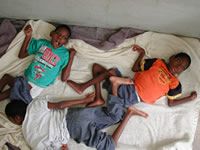 Whilst I was there, a bunch of white American teenagers from Atlanta came through and spent a while with the children. They had been spending the week with Mustardseed. Many had come on previous summers, it was a regular sponsorship by their school. One resident, who has long arms, useless legs and severe spinal curvature (the one who sits on the skateboard to get around), posed brilliantly for their photographs, with his arm round one of the prettiest girls. Then one of the American boys pretended to arm-wrestle with him.
I never saw any distress amongst the children. This time I had the chance to spend quite a while asking questions of the carers. I could see how dedicated they are to the children, whom they treat as if they were their own. One said she continues to think about them when she is off-duty. The work is split into two shifts, 8am-5pm and 5pm-8am.
 I spent a while with the severely brain-damaged girls. They never grow to normal size. None of these girls living in this room can even sit up. At night they lie in cots, in the day they are placed together on day-beds. Though their limbs usually can move a bit, it may be involuntary and they cannot turn themselves over, so even this has to be done for them, to prevent bedsores. One child, who appeared asleep the whole time I was there, is unable to swallow, and receives nutrition through a tube that goes into her abdomen. Another has hydrocephalus.
I fed one of the girls in her wheelchair. A carer showed me how to spoon the rice and chicken into her mouth, but being very sensitive to her response, I concluded she was not very hungry, and we did not get far. So then the carer came back and shovelled it all into her without any trouble. I conclude that when I was trying to feed her she was more interested in, shall we say, “flirting” than eating.
One young lady is 21 and has a regal presence, despite being the size of a skeletal three-year-old, with daunting deformities. She’s the one I called Laughing Water when writing up my first visit. She lay on her day-bed returning my gaze defiantly, putting me in my place with her stare. I have wondered about her many times since: what soul is there, what intelligence, what passion, what laughter. She was elegant with braided hair, lipstick and other makeup. Her portion in life was not victimhood, but grace and dignity.
Thus the youthful Hiawatha
Said within himself and pondered,
Much perplexed by various feelings,
Listless, longing, hoping, fearing,
Dreaming still of Minnehaha,
Of the lovely Laughing Water …
 a wayfarer’s notes
About the second photo: It's from http://www.tjphoto.com/MainStructure/Indexes/Pages/MainFrame.html – the bio of Todd Johnson, professional photographer. Perhaps he posed the children on the bed.
LikeLike
I'm glad you kept your promise, Vincent. A moving and beautiful account.
LikeLike
a brilliant moving piece. i must say, i was depressed reading this, but something in my soul told me, this is not to be mourned, but to teach us living.
we have such insignificant problems that we love to blow them up and say they are BIG!
LikeLike
Kathleen thanks. I was rather shocked reading the original draft of 5 years ago, at how poorly I wrote then, relatively speaking, so I think that justifies the interval of time.
LikeLike