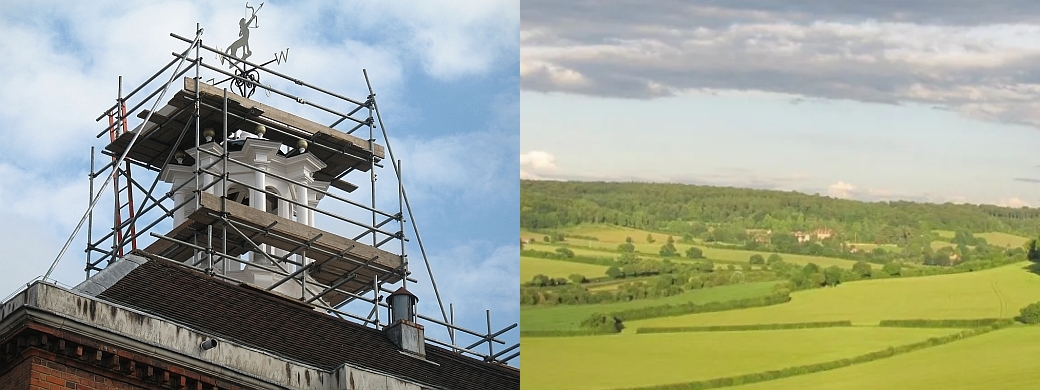


I had intended to take my well-trodden valley path, a fruitful place for broodings which I’ve several times captured and preserved in essays on this site. But a different plan revealed itself as I progressed. The first leg was walking with Karleen to her work at the hospital, about a mile away. After we said goodbye I passed through the back gate on to the main road down the hill. At the front of Maternity stands an old boundary wall. It’s not pretty but seemed to glow with meaning, as if I suddenly discovered a different way of seeing. Sometimes it happens the moment I walk out of the house, and I used to think it was the ultraviolet rays, the birdsong, the fresh air or the clouds. There’s nothing more ordinary than a dull grey wall. It was just a matter of getting on the right wavelength and it happened in that moment. Suddenly I thought of shamanism and the special kind of seeing taught to Carlos Castaneda by his mentor Don Juan; I decided to go where my feet and eyes led me, not a predetermined trail. I was carrying a map but used it only to avoid getting lost. How could it guide me where to go? I’ve stopped believing in guides. I have to journey alone.
I’m walking up a hill now, cheap housing above me on the right, thickets in a kind of ravine on the left, where I stand above the broken roofs of old sheds. I want to explore them, crawl through this convenient hole in the fence, clinging to branches as I descend, to discover what these sheds were once used for, and see if any treasures remain. I resist the urge, reflecting that I’m half a century too old to be doing that.
I continue through a wide expanse of rough-cut grass: it’s the common land adjoining the estate of council flats, a place for children to have adventures, though deserted at present. A child’s homework diary has been torn from its loose-leaf binding, its pages now wind-blown over a wide area. I pick up one or two for close examination. Archaeology fascinates me, it doesn’t matter how recent the artefacts. There are notes from teacher to parent; from mother to teacher; from pupil to self. There’s an appointment to see a welfare officer, and a note from the officer apologising for keeping the boy late.
I mentally compose some anthropological notes: In this ravaged landscape I have found a valuable picture of life in the year 2009: how tribe members worked communally to impart traditional lore to their young, sending messages with coded squiggles using various dyes marked on sheets fashioned from wood-pulp. Do not imagine the homo sapiens of Britain to have been crass and ignorant, for these well-preserved “Homework Pages” provide convincing evidence of a fascinating culture. One might almost call it advanced.
I’m in the mood to notice everything: expressions on the faces of dog-walkers and their dogs; litter—sometimes dismembered toys, but mostly snack-wrappers, cans, plastic bottles. From which we can deduce much about twenty-first century diet and the social norms of their civilization.
I pass Hillary Road, where twenty years ago, I had the intuition that my father (whom I had never known, or even known about) was still alive; started trying to find him; and succeeded. Whereby hangs a different tale. A mile or so later, I enter King’s Wood, about which I wrote three years ago. Police had conducted an elaborate search over several weeks for bomb-making materials. They were tipped off about a plot to blow up transatlantic airliners. The Wood shows no sign of this activity. It’s so litter-free that I take great care to hide my banana-skin after stopping for a snack there.
 After an hour and a half of vigorous walking, I get my “second wind”: an interesting phenomenon written up in Wikipedia. They don’t have a definitive explanation, I’m glad to say: I prefer mysteries. I get into an easy rhythm, I feel I could walk all day, and was born to walk. In fact I was, it’s a gift of evolution, or if you prefer, of God—via evolution. I might be a descendant of Ötzi the Iceman from 3300 BC. “By examining the proportions of Ötzi’s tibia, femur and pelvis, Christopher Ruff has determined that Ötzi’s lifestyle included long walks over hilly terrain. (Wikipedia)”. I enjoy walking for five hours at a stretch, but hate to sit down at a desk for more than an hour. [Subconsciously, I’ve colluded in making my desk uncomfortable: the sharp table-edge almost cuts my forearms as I type; my bottom aches on the plain wooden chair.}
What happened at the grey wall, when it seemed to transform into the pearly gates of Heaven? Wayfaring is my meditation. When I leave the house and walk alone, I turn my back on “cares”, and open myself to membership of the “All”, the Universe. It doesn’t need pretty scenery, so long as I allow sensual inputs from all around to stream into my consciousness. Not just those from all around but those from my own body too—bones, flesh, guts; whether my legs feel heavy; feeling hot or cold; sweat, pain or fatigue; insect bites, grazes, aching joints. In short, whatever happens, saying “Yes!” to it.
I don’t want to say that wayfaring is a method to achieve something. Does it need to be mapped? Maps are good to prevent getting lost, that’s all. They can’t tell you where to go.
Here in the stillness of these woods, with birds echoing across the clearings and strange sounds—clickings, creakings—I pick up quite a different sense of what it is to be human. A sense that links to dim memories of the past, and not just early childhood. It’s a good feeling, that’s all I can say. In writing, I try to be a voice for all those silent others I encounter, or might have encountered centuries ago: joggers, workers, peasants, dog walkers, everyone who follows paths in wild places like our ancestors the hunters, or Ötzi the iceman; those who touch Nature and let themselves be subsumed in it; yet don’t have the words. I don’t really have words either. They have to be invented.
There are enough books, I don’t want to compete, but just give a taste of what it is like to be an ordinary person. And you may ask why, because ordinary persons know already what it is like. This other evolutionary gift, this organ called the imaginative mind, gets in the way, allowing us to deceive ourselves, adapt to inhuman ways, deny the facts of our evolution. It’s tempting to follow the fake culture and forget deeper knowledge.
I write to remind and undeceive. That is what impels me to write about ordinary things. Here on this last day of June, in the shade of this footpath which cuts through another estate of cheap houses like a sharp knife (it was here before the houses and is protected by law), I feel enormous privilege. I came with no purpose but gratitude for the gift of feet. I don’t know what else to say. This is life and I am glad to be part of it.
 a wayfarer’s notes
This is excellent, Vincent. I wonder if your efforts to place yourself in the experience of simply existing is starting to become “second nature.”
LikeLike
thanks Tim. Your question has partly inspired my latest post “Risk Assessment”, and provides the answer “sometimes yes, sometimes no”.
LikeLike
[…] “Here in the stillness of these woods, with birds echoing across the clearings and strange sounds—clickings, creakings—I pick up […]
LikeLike