

From an extinct blog called Fiaschi (quotidianstuff.blogspot.com
Easter excites me more than Christmas: not for the long-ago drama of torture, execution and rebirth, but for the immediate signs of rebirth that orchestrate the miracle of Spring. I respect the Christian traditions only because they were respected by my ancestors and formed a backdrop to my childhood. On the day, I woke in a certain excitement, before it was light, like a child at Christmas. But it was an intellectual excitement, perhaps brought on by making myself the disciple of three thinkers: Porphyry of Tyre, AD 233-309; Ali Allawi, a minister in the government of Iraq after the invasion of 2003; Gerad Kite, fashionable London acupuncturist.
What got me out of bed early on Easter morning was realising that I had used newspaper to protect coffee-table and floor whilst I was cutting, joining and varnishing plywood, with the aim of copying a bookshelf. I’d bought the original cheap in a second-hand bookshop and found the ideal position for it on my side of the bed. K wanted one too, not so much for the book-space but for the Art Deco curvaceousness and symmetry, qualities which certainly enhance a bedroom and give purpose to a restless handyman. I’d stacked the paper in a bin for recycling in the front yard, where it was softly drizzling. Would the object of my quest, that remembered interview with the acupuncturist, be a sodden mass of papier-mâché now, or soiled with dark varnish? Karleen stirred but didn’t raise an eyebrow at my intentions, accustomed to the madcap impulses of what I like to call the “creative temperament” (as if it drags me along like an ill-trained puppy).

Fortunately or otherwise, I succumbed to the Internet’s lure before venturing out and getting drizzle on my dressing-gown. Tamely, my fingers did the walking and discovered that the article was available on the newspaper’s web archive. It’s so much less adventurous to find things simply by sitting at a desk. Perhaps I feel this especially because I’ve disposed of an ugly typist’s chair in favour of a traditional Windsor one which gives me backache. How much better to emulate the peripatetic philosophers! To think and talk like Socrates, whilst walking.
What connected Porphyry, Allawi and Kite in my mind was the aim of finding a pivot between the seesaw swinging of opposing ideas. Plato or Aristotle? Militant Islamism or George W Bush? Western scientific medicine or traditional models of health and treatment? Following on from my last post, which danced nervously around the “placebo” concept, I wanted to follow in the footsteps of intellectuals to try and understand better certain dichotomies which rive the world.
What got me going first of all was the quaint notion that students in Paris and elsewhere in the twelfth century were endlessly sharpening their rhetorical skills in passionate disputation about something which Porphyry, in his Introduction (or Isagoge) to the Logical Categories of Aristotle, carefully forbears to determine:
“Concerning genera or species, the question indeed whether they have substantial existence, or whether they consist in bare intellectual concepts only, or whether, if they have a substantial existence they are corporeal or incorporeal, and whether they are separable from the sensible properties of the things (or particulars of sense) or are only in those properties and subsisting about them, I shall forbear to determine.”
Roger Lloyd, in The Golden Middle Age (1939) remarks that the above sentence “has a vital effect on the course of the history of human thought”, whilst admitting that it “does not look epoch-making: it looks extremely dull.” We shall forbear to add further comment.
Back to the topic of placebo. Gerad Kite was interviewed for the Sunday Telegraph by Ann Murphy so you can easily find the story online for more details, allowing me to summarise rather than quote.
According to Kite, I am healthy when I succeed in being who I am. My symptoms are merely an expression of my body’s complaint against my heedless mind, which careers along in its own imagined trajectory, away from my essential me-ness. He would restore me to health by diagnosing not the particular symptoms—cracks which appear along a weak point which may be congenital—but his understanding of where I have left my proper track. From there, he applies the remedy: sticking some needles in so as to hit the appropriate meridians.
Ah, said the interviewer at this point. There’s been a study which shows that acupuncture works no matter where you stick the pins. Kite gave a cunning reply, acknowledging that the placebo effect contributes 40% to the cure. Add 20% for the patient/practitioner relationship. He insisted that the remaining 40% of a cure was from putting the needles in the right place. He claimed the clinical trials were not relevant to the method he practises. He practises “five element” acupuncture, the elements being earth, fire, water, wood and metal, each representing what Kite calls “a distinct energetic movement within the body, just as there are seasons in nature”.
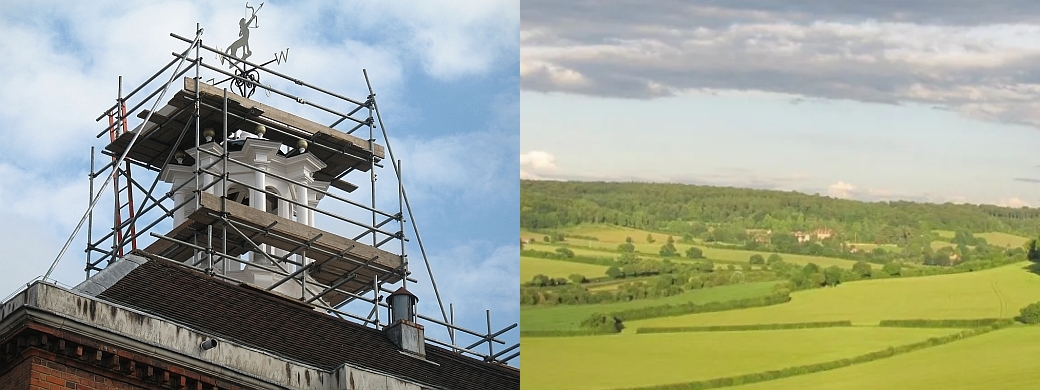
Now when you talk about seasons it reminds me how I love this Spring! It only happens in regions where there is also Winter. Nature works with the materials it has, and its own creative temperament, to fashion this miracle we call life in the world.
I’m still looking for a pivot, so far undefined, which makes our medical systems into a seesaw: science-based medicine at one end, traditional therapies like acupuncture at the other—different schools of thought which don’t connect in a unified field theory. Why not? Where do I find the answer?
I don’t know how much this bothers you, but I’d like to understand what happened to me four years ago, when I was cured instantly of an illness which had plagued me for thirty years—with no subsequent relapse. Placebo? Depends what you mean by that word. Something that touched the right spot, with words, no needles.
I’ll talk about Ali Allawi, and more about Spring, in my next.
Posted by Vincent at 06:51 1 comment (not survived)