

It was a Sunday morning in March and I was just 16. I’d been writing an essay on a stanza from a poem by William Wordsworth:
A violet by a mossy stone
Half hidden from the eye
Fair as a star when only one
is shining in the sky
I’d been sitting by the warm kitchen hearth in the country cottage where I was boarding with Mr & Mrs Jenkins. My parents had moved from the Isle of Wight after my stepfather was made redundant from the aircraft factory. He couldn’t find another job on the Island. They knew Mrs Jenkins from the Spiritualist Church. It wasn’t a good time for me to change schools, so this makeshift arrangement made sure I could continue with my Sixth Form studies. Mr Jenkins used to wheeze and rattle with every breath, after inhaling poison gas during the Great War. They were a kindly couple and I appreciated the independence from my parents.
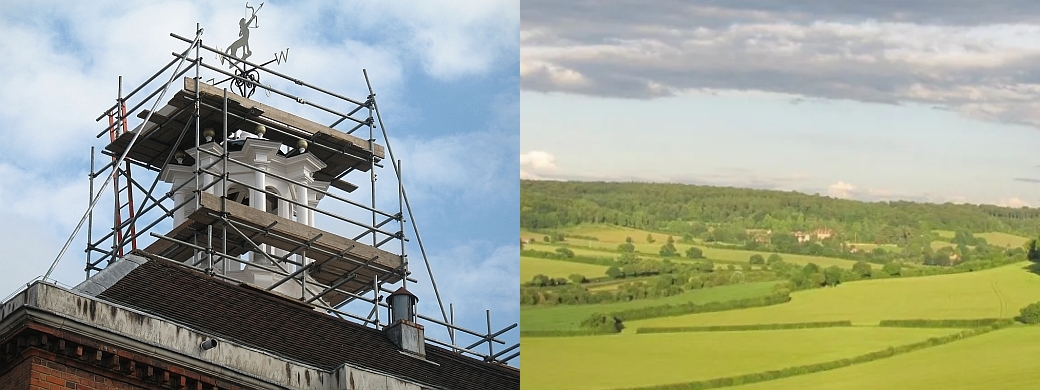
When I saw that the heavy rain had stopped, I took my chance to step out from the stuffy cottage to clear my head. Rivulets had formed on either side of the steep lane, sparkling in the sun, making V-shaped waves as they flowed; then went milky as they washed away mud, leaving grains of sand caught in the rough road surface; then went clear again so that the waves made a lens for the sunlight, with highlights and shadows dappling the rivulet bed; then carried little twigs and leaves as they flooded in wide pools and narrowed to swift rapids. Birds sang in the budding hedgerows. I never thought I might write about it fifty years later, but we tend to remember “firsts” in our lives. Till then I had not been tuned to Nature in that particular way, as a boy might not be tuned to a girl glancing at him with a particular look. Nature took my heart before any girl did, and I’ve just described the moment.
Relating this incident serves the function of unblocking the flow of my memoirs, which got dammed up in February (page 261), but that’s coincidental. I just happened to recall it today, on this Sunday morning, on a mundane errand under an umbrella. Early snow had turned to sleet and then heavy rain; finally the sky lightened and the road shone like a mirror made of dark metal. It made me think of that Spring morning in 1958.
I actually intended to write about a book by Bill Plotkin, but all in good time. Let me be honest: I find writing hard and it keeps getting harder. Plotkin has his agenda, which I try and understand, and whilst I agree with his plot, and feel closely kin to his ideas, had no bill to pay, having borrowed it from the library, I have my agenda too, which his book helps me see. I write for the lonely soul. I’m not a writer by vocation, just an amateur craftsman, with questionable loyalty to my craft. Mostly now I prefer to work with my hands: building a door from scratch for an old man’s shed, cooking a lemon meringue pie (having recently learned the secrets of this magical dish), renovating traditional country chairs made of elm and ash; taking walks in all weathers to quell thought and connect with the elemental universe.

I could write a book if only my ideas stood still long enough, but they don’t, and I can only see here and now, not what happens round the next corner. My writing is about the moment, and has to take place in the moment.
Plotkin is an academic and mystic. The two mix together like oil and water—with difficulty—but he does a tolerable job. I try to de-emulsify his prose and disregard the heavy verbiage, letting his more illumined sentences rise to the top, like this one:
“Soul-initiated adults serve both nature and culture by serving their own souls.”
Cool: it means I can do what I like. Looking at it a different way, I just like to mine the nuggets I already agree with. Everyone likes to do this, let’s not be killjoys by calling it a waste of time. For we can change sides, and argue the opposite case. Then we learn something.
Plotkin’s title is Nature and the Human Soul*: perfect. Even the subtitle is good: Cultivating Wholeness and Community in a Fragmented World. He wants us to recognize the stages of maturity that each person ought to pass through, and has lovely names for them:
- the innocent in the nest
- the explorer in the garden
- the thespian at the oasis
- the wanderer in the cocoon
- the apprentice at the wellspring
- the artisan in the wild orchard
- the master in the grove of elders
- the sage in the mountain cave.
And where am I? Stage 2, by the sound of it, corresponding to Middle Childhood. Time I got moving.
* For extracts, see Google Books here
 a wayfarer’s notes
. . what a supportive cast and you use them all . . just by sharing this awareness . . your style interviews them all, thanks
LikeLike
“ought to get moving?” why, pray tell? it can only be that fiend 'time' that is urging you to make haste!
Now with this I'm tempted to put Sheldrake aside and return to Plotkin!
I wander through books quite frivolously, these days. The school marm in me has stopped rapping my own knuckles when I do, and I can't seem to care whether I finish or not. All that matters is whether the print feeds my soul this day.
I want my days to be like the ones you describe, my soul filled and transfixed by a mirror of wet pavement.
LikeLike
I didn't mean that “ought to get moving” at all seriously, Hayden! I was having some private fun at Plotkin's expense. I feel a moral obligation to finish his book, because the public library purchases committee so kindly agreed to my request that they stock it! I would like to be frivolous and wander through it in the manner you suggest, but some dogged puritanism in me plods on reading Plodkin. And i don't really disagree with him!
Anyway, it will be interesting to read each chapter which describes the exciting things that happen to the Thespian at the oasis and so on, and see what resonance it has with my own life and that of my various descendants.
One thing that stands out very clearly for me is that I am very one-sided. A child ought to be raised with equal emphasis on development in Nature and Culture. I recognise myself when Plotkin says this:
“A person at home in nature but not among people will feel like a stranger in a strange land when among his fellow humans, unable to embody his creative, soul-infused self in society.” (p 120)
He's got me described to a T there. That is how I have felt, almost always.
LikeLike
brad4d – I do want to use all eight of the “supportive cast”, but as I remarked in my previous comment, I'm left with what Plotkin (p 262, though I haven't yet reached that page) calls “the sacred wound”: in my case the sense of being a stranger in a strange land, unable to integrate with a culture.
LikeLike
Vincent,
The master in the grove of elders brings a chainsaw, writes a few best-sellers, and cuts them all down.
Good god you can write, man.
When I do it, when by my lights I really write, it hurts, and I have to pour it out of me slow. It's like a meditation, like straining to sing the tenor parts in the Messiah, only for a private session. Mistrusting myself, and self-corrected.
But I see you're getting the practice down, and as you do, your voice will catch up enough, not much, and you'll be able to write anything.
LikeLike
Marc it is my dearest wish to be able to write “anything” but the angel which hands me the pen also dictates what I may write; so not being lord of my own domain but merely a servant, I cannot call myself a writer.
I like your chainsaw image. It did occur to me that a grove of elders is some kind of thicket, from which elderflowers and berries may be harvested for homemade wines. And I must at least check out that chapter to see if Plodkin is up for the punning.
And I thank you for the compliment, but am envious of your own writing, which I see as being dashed off in a moment—I mean inspired and spontaneous, not at all slapdash. If it does in fact hurt, I admire more but envy less.
LikeLike
vincent, Plotkin may be right that it's essential to be at home among people, but without nature most will never find their 'creative, soul-infused self.' I think growing up within nature is essential to soul.
having both, now, there's the trick!
LikeLike
But you are already am amazing writer! May be it's that old thinking that a writer is a writer with printed material you can touch. i wonder if all thosem famous writers were born in our age would they have taken the pain of physically writing all those words. My impression towards the medium is also changing. I am no longer thinking of a publisher. Thanks to google. Of course, we need good editors. I am glad and secured to have you my verse polisher and idea influencier.
LikeLike
Ghetu, we are in accord on this, but I love books, and it's my wish (not even a consciously-pursued goal) to have some of my words gathered into a real physical book; but only as a secondary thing, as private correspondence is sometimes published in book form.
The more I look at it, the more I see that the blog medium is perfect for my immediate needs!
LikeLike
Hayden, you are doubtless right in a sense that “having both, now, there's the trick”. But you can't teach an old dog new tricks, they say. And from Plotkin himself I get the idea of “innate vulnerability” which he calls the “sacred wound”. And my take on that is to consider the sacredness of the wound: perhaps it (any individual deficit) can become the source of that person's greatest strength. After all, life is short, and as artists we will do better to work with what we have than whitewash the flawed canvas to try and start again.
As we used to say in the software industry, “Think of it as a feature, not a bug!”
LikeLike