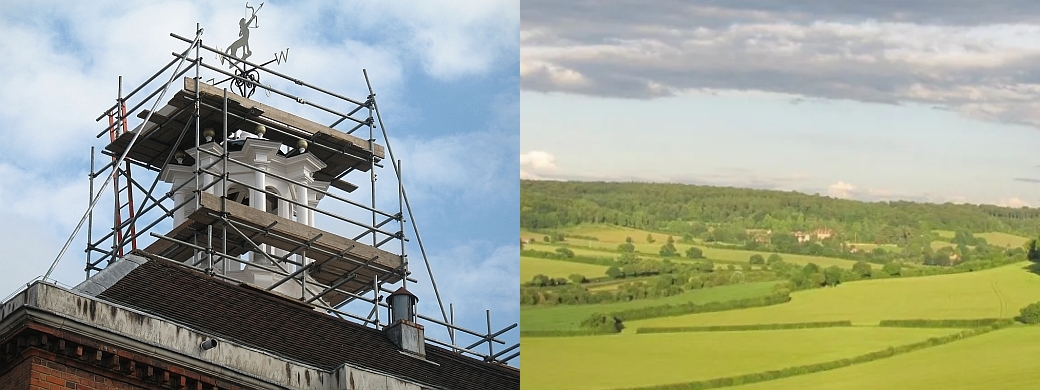


“Place does affect the way I write, maybe the tone and always has an influence. Does place matter in your work?” Poet Scot Young asked the question in his blog and I said yes. When I go walking, thoughts come to me, and they seem to resonate with the sky and the trees and the roadside litter, and the sounds, and everything. I said it would take a series of essays to amplify my “yes”.
Time comes into it too. My best is the early morning and ideally I’d be abroad on highways and byways as the sky lightened, ready to greet every dawn. But there’s so much to squeeze into one’s best time! Last Friday I did manage to get out by 8, with camera and voice recorder—the joy is doubled in trying to recapture it afterwards. So this is the tale I bring back, not verbatim but trying to convey the essence.
There’s a fresh breeze and it’s damp rather than cold. A weak new-born sun lights the hurrying pedestrians on their way to work. I pretend the cars are not there and I’m in the nineteenth century. It works pretty well except when I have to cross a road, when self-preservation takes priority.
Karleen has lent me a pedometer which she got on loan for a week from her employers, the National Health Service, that symbol of socialistic kindness which blesses her Majesty’s subjects with its concern for their wellbeing. 10,000 steps per day is recommended. Let’s see what I do on this walk along the Wye Valley to Loudwater. (It came to 24,000.)
The ground is covered with fresh-fallen leaves. For a moment, I wonder why they appear so poignant, like fresh-fallen snow. I imagine a small child seeing them for the first time; and then a man in the autumn of his life remembering all the autumns he has known—including the first time he noticed the fallen leaves stuck damply to the ground; or dry ones blown into heaps that he shuffled his way through. And who is that man? Everyman; also me.

After the first mile, I leave those streets with their streams of workers, and go diagonally through the park, reaching the trail of public footpaths which penetrate every obstacle: woods, meadows, housing developments, factories. There used to be several papermills along this valley, powered by waterwheels, one of which has been reconstructed out of a respect for history. On special occasions they use it to grind a few sackfuls of wheat, but mostly it lies silent, desolate, the millrace diverted by sluice-gates.
I move to another branch of the river which has squirrels dashing along the path to take the bread and seed which people had scattered to feed the ducks and swans. I encounter a rat near the place where the river disappears into a culvert. It regards me coolly with whiskers a-twitch before going about its business, in no particular hurry. Being classified as “vermin” and unworthy of humane treatment hasn’t made it hate or fear me. Its forebears spread bubonic plague throughout old Europe. Could it be blamed for that? White sailors spread syphilis wherever they went; white missionaries spread the idea of sin and redemption to savages who were fine without it. And now, there are those who may consider white man vermin. I don’t want to blame them either.
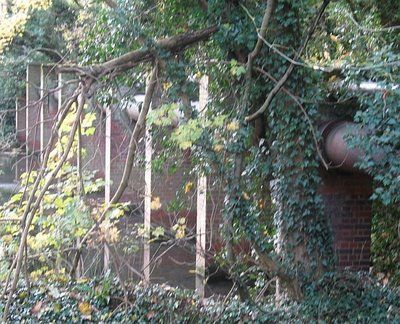
I pass through meadows, paths, the alleys between the backyards of suburban houses, and reach the embankment of a disused railway line. Nearby there’s a wastewater treatment plant which collects from a big pipe and pumps effluent into the river. It’s good to see the infrastructure of this town, and I pass all kinds on this walk: red Royal Mail vans, postmen on foot, electricity transformer substations, gas distribution, water, and now sewerage, which I feel moved to photograph. It works for us invisibly, we depend on it, so it’s a kind of God, really.
The idea – the ideal, the slogan – of Freedom comes into my head. I suppose in the recent Presidential election it was a word of mystical power. I can understand how it would still be so—to a slave. Why is Freedom so important to those who see themselves as already free? Because, I suppose, they feel burdened with the duty to defend it. It makes more sense to generalize and say that everyone acts to protect what’s sacred in their society. Attack that and there will be a fierce response. One society values sexual freedom. Another society would prefer to be free from AIDS.
For some reason I have always found it easy to identify with the downtrodden, and have had little sympathy with the powerful. I don’t mean to attack freedom, or any other concept of the sacred: just to scrutinize it. I think of a peasant as freer than an ambitious office-worker, but that’s just my bias. I’m in a meadow, closely following the meandering river. On the other side are newish apartment blocks, with balconies and neat communal gardens. They need no fence because the water makes a natural boundary.

I think about Americans, in a week momentous in their history. They seem like an Old Testament people. We only hear the Israelite side of the story. The Philistines and followers of Ba’al would have had their story too: their own myths, their own heroes and tales of inspiration, but we don’t know them, only the biased winners’ history, that has somehow been forged into the scriptures of two separate religions.
The things that matter to a tribe are often encoded within a religious belief-structure, that may seem like superstition or prejudice. It is not surprising that in a progressive society, the urge is to let rationality sweep those things away, ignorant of the precious secret: that the sacred is hidden, wrapped up in the mumbo-jumbo. What is the sacred? It’s something revered because it is necessary for the healthy existence—and coexistence—of mankind.
[Later, I recall an illustrative example: the astonishing findings of the anthropologist Steve Lansing in Bali, you can see videos here. The irrigation system for the terraced paddy-fields was controlled by a network of Hindu priests each in his own temple according to a complex balancing of various factors. The Indonesian Government swept it away and spent money on concrete dams and consultant engineers, nearly wrecking an age-old method which was subsequently realized to have been highly optimized.]
I’m on a narrow footpath now, beside a bit of river straight like a canal. I was here before. I never got to write about that walk, though for weeks I wanted to. It was a hot day after rain, and the wet undergrowth was steaming with aromatic exhalations given a special flavour no doubt by the luxuriant Himalayan balsam, a species which has escaped into the wild. Today the vegetation is declining. The day is warm enough but the native species know they should save their strength for spring.
The footpath debouches into a retail park. I come face-to-face with “Kentucky Fried Cruelty”, as Scot’s daughter calls it.
Where was I? The sacred. Locked up like a seed within the pod of superstitions, posturing and corruption, there is something lively and noble in every culture. You can’t talk about any axis of evil. Here, in this morning, in this valley, it seems totally clear to me that the only sensible thing to do with Al-Qaeda and the Taliban is talk to them. Then we’ll discover that we are exactly like them. We have our ideas of the sacred, which we feel is threatened by the enemy, and so do they. This is what “enemy” means! Instead of fighting, we need to respect one another’s sacred things.
And if it is true, as someone told me, that Obama has “political ties with convicted and accused terrorists … does in fact have ties with Muslim and more specifically Palestinian sympathizers (including radicals)” then this makes him the safest possible President for our age.
Enemies should approach one another bearing gifts, ready to listen and be magnanimous. The conflicts would evaporate. And that is exactly how the derided “savages” used to do business.
[Later: I don’t see this happening even within America’s own borders yet, even amongst its own people. Get unity at home if you want to work for world peace.]
Where is “freedom” on the Maslow hierarchy of needs? [Later: I’ve just checked. It’s nowhere.] Of what value is freedom if you are hungry, or fleeing for your life?

The footpath takes a zig-zag route through meadows; a recreation-ground where dogs taking their owners for walks lift their legs against goalposts; an overgrown alley between backyards and warehouses; then debouches into a suburban development of modest houses. In the UK it seems you can’t build over a public footpath, even though you’ve bought the land, so these ways have longevity; humble but strong. There’s one called the Ridgway Path which dates back several thousand years. I recall the same thought I had last time I was here: only a terrible calamity would erase these footpaths. The cars would go first. Then the complex infrastructure: mail, electricity, gas, piped water, sewerage. The supermarkets, presently bursting with food like Christmas every day, would empty and become derelict.
Only if the fertile land were blasted or buried in toxic floods, or some very unBritish power took over the government, would the footpaths disappear; and I expect them to be here long after me. One day I’ll be struggling to take my final breaths, and my memory, if it survives, might allow me to wander these neglected paths one last time, bidding them farewell, recalling a few reveries like this one.
While I ponder thus, a couple of elderly ladies approach from the opposite direction. There’s something incongruous about their greeting, as if this is a moment for great joy, and all three of us have been let into a secret, here in the narrow lane between backyards. I’m caught unawares, tongue-tied. What can one say in a few moments of greeting? I smile and say something conventional. What can I share with strangers?
Nearly a week later, I try to share it with you.
 a wayfarer’s notes
you bet Vincent–place matters. I think the moment matters as much. I guess I need a voice recorder because when the words come influenced by place and I don't get them down, they may be gone blown away by the wind or age–the moment lost.
LikeLike
I am a bit envious of these long walks, and find even in the reading that for me too, place is important. I hadn't ever thought of carrying a voice recorder and it could be an interesting exercise to try out. These days stuck at a desk staring at a box for more hours than I care to admit to, or care to be doing for that matter, and finding that in these last days of immense server crises, etc., I have so hungered for a breaking of the shackles, for freedom, that all I could do was throw some paint around and do some frantic doodling in the wee hours to try and connect to some other place.
And then I come here and find I am transported, as if I were your walking companion…such vivid descriptions that make it so real.
LikeLike
Ah, Serenity, I just came back from another walk, and I was going down a muddy path thinking of you and your server problems and how I would tell you that your blog reminds me of the Book of Job. Which has a happy ending of course.
LikeLike
Yes, Scot, try the voice recorder. I find it helps one remember the original experience, but it doesn't capture the feeling. It's just notes and reminders. The best part, I find, is you can tell the machine and let go of the thought!
LikeLike
Serenity, if you are physically up to it, and have somewhere to go where you feel safe, there is nothing like walking to clear the head, and connect you with something more primitive and fulfilling than all this technology! The liberation for me came after the walk I described here, because I discovered I can walk four hours at a stretch and probably more. It takes time to build up the stamina especially after illness but the benefits are multi-dimensional.
LikeLike
The most powerful writing transports one to place too – and I was there, if not walking in your shoes, seeing with your words. Place matters to everything. We all long and need to be somewhere – whether it be standing still or travelling – and wherever that somewhere is it will influence our moods and emotions.
LikeLike
Perhaps this is why I don't aspire myself a writer — I also experience this journey “with” you, but realize that the journey you lead me on with words is my journey, not yours. Of course, my use of “you” here implies the “other person” in any sort of literary piece.
Having said that, I do enjoy reading this sort of experimental literature you're producing, Vincent. It's well suited to the blog-sphere, but it leaves me wanting to know what's left on the cutting room floor.
I do see your point about the political advantages by association — which we discussed on my blog — just as I understand your point about seeing a battle from both sides. These are ideological battles over right and wrong. Naturally, both sides think they are only on one side of the battle. However, truth permeates both sides and stands alone as the winner — regardless of the outcome. Maybe this is what you mean, but in verbiage I struggle to resonate with.
No matter, please continue to produce — it's refreshing to go on these journeys “with” you. Perhaps the one line that stuck out most at me in this whole piece was:
“I pretend the cars are not there and I’m in the nineteenth century.”
I do something similar… trying to take in a perspective of what a place was before, long before it is now.
LikeLike
Tim it is precisely your journey that my words aspire to lead you on.
Well, there is a great deal left on the cutting-room floor. You have inspired me to start another blog entitled “The cutting-room floor”, in which I could put some of what is left out from here. I cannot decide if that would be a good idea or not. Brilliant, yes, but not necessarily advisable.
It doesn't surprise me that you struggle to resonate with my verbiage on some matters. I throw out those ideas as belonging to a valley reverie: as being a kind of fiction, the thoughts of a character, or an opposition politician who, not expecting to be ever in office, can offer low taxes and high social handouts. Of which more in my next—not politics but a kind of anti-politics which I will explain.
Yes, glad you responded to the nineteenth-century thing. You see, I am not sure that the past is entirely gone. It's just as real. It offers itself to connect with, though we can only connect with it today.
LikeLike
Lehane (do you mind me calling you by surname only, it makes you like a fellow-pupil at my boys-only schools a century or so ago?):
Yes that longing to be somewhere, or more accurately the acceptance of actually being somewhere – not a reference on a GPS map, but actually having two feet planted on the ground, or pacing the earth or the tarmac – that is what keeps us sane in the way that an animal is sane.
Or perhaps gets us sane, if the vibes and circs are right. For how can we live (truly, madly, deeply) without the embracing of our precise current environment? Can we really be content unless we are able to say that wherever we call home is the best place in the world to be? And is it not possible somehow by an heroic effort of embracing, to love that which surrounds and touches us? Effort is always involved, even if it comes automatically; for there is also a part of us which finds this whole world alien, as if we have dropped from a heavenly cloud, with vague memories of something so much better than this.
LikeLike
I want to add a comment, a year later (20th November 2009). I mentioned the paths being sacrosanct, but yesterday I tried to join that same valley path, near the sewerage plant, and found it closed. Major building works are afoot, the place abuzz with bulldozers, mud and workers in yellow reflective jackets. I remember there had been a sign about this. I do hope the path will open again!
LikeLike
[…] From Valley Reverie: […]
LikeLike
[…] “The ground is covered with fresh-fallen leaves. For a moment, I wonder why they appear so poignant, like fresh-fallen snow. I imagine a small […]
LikeLike