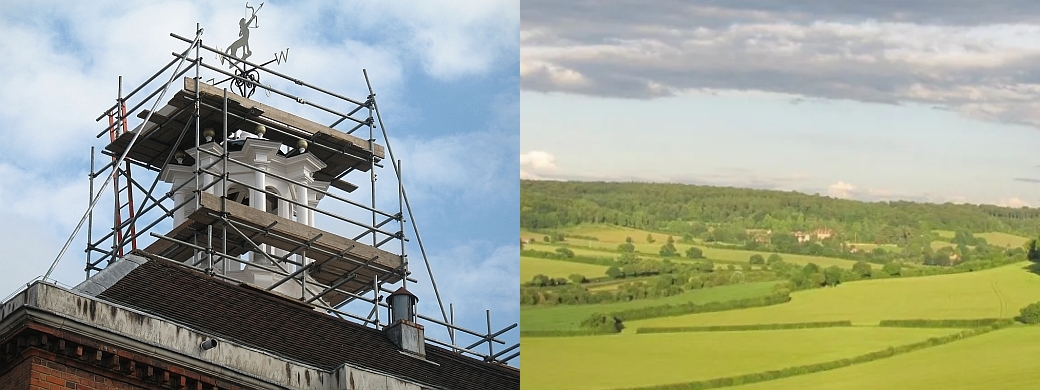


Days pass. Not much wayfaring and not much writing. The two are connected. I had promised to dedicate a post to Lady in Red, who writes “I love it when you describe the places you walk through, bringing it alive for those of us who can only imagine both the countryside and the industrial areas around you.”
And about those industrial areas, a friend writes “Remember that you live in a tough district of a tough town” as if it excused anything. Living here was my choice & I couldn’t wish for better.
What is life, but to enter into a relationship with one’s immediate environment and to survive — physically of course, but emotionally too? To live alongside manual workers, and be one myself — this is what I want, whilst I have the strength.
Each day I make choices, according to my feeling. I sit here at the keyboard a little, reading my regular list of blogs, commenting on them sometimes. I write things too, draft out blog posts — that’s my highest literary ambition — and usually abandon them incomplete. Something is missing and I can’t fake it. So I give priority to the manual work. I can always complete that, even when a project takes days or weeks. I do things on my own house: a succession of jobs which make a real difference. Currently it’s to freshen up the bathroom, to deal with mould on the ceiling and between the tiles, caused by condensation and inappropriate materials used during the last refurbishment. Other projects are to assist elderly people, who can still fend for themselves in their own homes with a bit of extra help. There are stories I could tell, but confidentiality forbids. One customer questions everything I do, treats me like a servant. She has lots of money but counts every penny; so, though it’s not businesslike, I undercharge her, knowing she’ll appreciate it. She hasn’t long to live, and though she can be rude, is my favourite client: so little time and seemingly so far from peace. Who would have thought that working as a handyman could be a meditation on death?
So my wayfaring is mainly to visit the timber yard for wood and the ironmonger’s for nails, grout and tools. They’re within easy walking distance and on the street I pass people from Zimbabwe, Poland, Nigeria, South Africa, St Vincent, Jamaica, Philippines, Pakistan, Kashmir, China, Thailand, the USA (two Mormons who carry out their missionary work on the street). Survival is everyone’s game, and being at the bottom of the heap concentrates the mind. It’s easy to spot those who don’t work. There’s a middle-aged trio who meet each morning and shuffle through the town, raggedly dressed. I don’t know what disabilities they have, but you can see they are enjoying every minute and need no one’s pity.
The UK has a universal benefits system. If you can’t or won’t work, you get handouts (as Americans would call them) and you can live in whatever style suits you. It reduces crime and misery: surely it’s worth every penny. Some are drunks or junkies; others are dealers — I saw one of them being questioned by two young policewomen, humiliated when one of them searched his pockets. I didn’t want to make it worse by watching, but heard his loud mutterings as he walked away after the ordeal.
Another man was the main dealer in these parts a few years ago but was jailed after a police raid on his “International Club”. Now he’s released and back in the same premises, selling old furniture and bric-a-brac. He still has the gold chains round his neck but the arrogance has gone. His trading skills have risen like Phoenix from the fire. His business flourishes, the premises are neat and he employs various down-and-outs — all legal. I have my sources of information on the latter.
Out of my study window, or when I hang out clothes on the line, wildlife parades before me. Little birds come to get seeds from the feeder. A Red Admiral butterfly took advantage of today’s sunshine and fluttered by, though at first I took it for a fallen leaf fluttering from a tree. A woodpecker tapped out its rhythm on a tall tree in the playground the other side of my fence.
These days, I write to investigate my writer’s block, to see what lies behind it. I attempt nothing more than to capture the essence of the present moment. That’s what makes it so difficult. The unfinished notes have to be thrown away. They go stale faster than bread. My sleeping gets disordered: I take naps in the day from the hard physical work, then wake in the night determined to write.
Night is a different world. It’s astonishing that every twenty-four hours a vast drama is enacted: never the same, but always consisting of four acts: Dawn, Day, Dusk, Night. And within them, the various scenes: getting dressed, eating and so on. We could be forgiven for thinking birth, life and death is a similar repeating cycle, but how can we be sure? Oblivion wipes the memories clean. I have no hope for life after death. Let me live for the joy of this moment, in “Eternity’s sunrise”, as Blake says. Then I may face my own death without regret.


 a wayfarer’s notes
Once again, a pleasure to read, Ian.
LikeLike
Thanks, Anton. Once again, I'm afraid, I've done some editing since: not to whitewash the things described but to sharpen the writing.
I don't usually write about people in this blog, just as I seldom include them in photos: inhibited about depicting the living. It seems disrespectful. The only way out would be fiction. I hope you're still writing it!
LikeLike
Wow Ian,
So many aspects of my life are validated by this post, the power of your honesty is e~valu~ation without critical karma, your energy is so supportive.
LikeLike
Hi Vincent,
What an interesting set of photographs. It's amazing how things change so quickly in such a short amount of time, well that's how it seems to me.
Best wishes,
Annie
LikeLike
I just visited a small town called Santa Claus, Indiana.
My grandfather visited there 70 years ago and marked a meeting of two of the most famous men to don the red suit.
I was there to re-enact the meeting and to initiate an oath to be signed by current day Santas.
The town was indeed small. Only 38 residents 70 years ago, about 3,000 today. Most of the current residents live in a gated community away from the plaza and big time amusement park that dominate the “downtown”.
The Amusement Park seems out of place, in the small farming community. I stayed at Santa's lodge and spent a great amount of time in a place called Santa's candy castle, a remnant from the days my Grandfather was there.
Not sure what this has to do with your story, but I as usual, I felt compelled to contribute, here in the place where great stories are told.
LikeLike
We share the same wistful respect for the past, for what is gone or has been replaced, eroded away; and maybe too for the dignity of places or people gone away, or eroded away by disrespect or indifference…
I wish I could absolve you from trying to read anything related to “Trashland”. At first glance the novel is as far from Zen as Zebra is from Aardvark in a dictionary. At first glance, it seems that a world of experience and temperament divides our literary characters. I wrote Trashland many years ago and would not write it again. I thought of it then as an external ulcer, a colostomy bag. Yet, curiously, looking deeper, I see it is not so far from Zen after all. If you read the satirical story of Barbra (expunged from the novel and there on the blog page), you see an individual for whom the world is strictly a reflection of her own ego — such that she fails to see that her husband, George the hunchback, has crawled back into the maple tree and died there, with his nose propped over the birds' nest. (George is the snow-covered lump in the tree at the end of the story.) And so the story asks: can we so obsess upon our own pride that we no longer see the other people in the world?… I think you are wise enough to see how a love for the world can twist into such a harsh defense of it, a defense against those who see in the sand of the beach only their own footprints. Indifference would leave no story. And, of course, here is where our temperaments diverge. Perhaps children who leave behind a beautiful childhood remain ever wistful for it; others, who leave behind a childhood that had its beautiful moments amidst much harshness, may come out fighting, swinging their little fists…
LikeLike
Thank you Brad for your Bradism on anger management.
I don't see a place on your site to leave comments.
LikeLike
How is it you write so well in the midst of writer's block?
Your life sounds well-lived. There's no need for regret…
LikeLike
I love those photos, and the “before and after” of the waste land. So much could be (again) beautiful if we would but put our hands to work.
LikeLike
“So much could be (again) beautiful if we would but put our hands to work.”
Now there's a motto for you and me, and everyone else who cares to adopt it, Hayden!
Myself I feel pulled in primitive fashion to put my hands to work much more than writing these days.
Yesterday I had thoughts to tap out and organize on this machine, but what pulled me with more fascination was to shape a coil of wire I'd just bought into a kind of collar to place on the gas stove, so that K could balance a breadfruit on the flames to roast it, as she used to do in Jamaica. And so it goes, each day: the manual challenges more intriguing than the literary. (A nuisance really!)
LikeLike
Pauline, that writer's block has now been overcome, I think. It was caused by arguing too much with my environment, and consequently with my own life. For instead of believing in God, which I consider a cop-out, I believe in my own oneness with the All. To fall out with anyone or anything splits me apart & makes me false.
LikeLike
Anton, to call Trashland a colostomy bag is a good way of weaning me off trying to read it!
Yes, I have experienced how a love for the world can twist into a harsh defence of how it was once or how it should be now. That suits some but it doesn't suit me, for I seem to be in need of immediate satisfactions, like a child and not as a Puritan or member of middle-class who can postpone fulfilment.]
I mean I cannot wait for the world to be perfected. It has to be perfect now; and so I have to see through the surfaces to the essence residing in everything, which though it may be an angry drunken man in a narrow alley, lurching from side to side, who curses at me and swings a wild punch at me as we pass one another, is still part of me and to be loved accordingly.
LikeLike
Ah Charles, it's good that you mention your unusual background here, as descendant of the man who hatched the idea of putting Santa Claus in a department store, which caught on big time.
Feel free to decorate this site with your tales, any time, and let us celebrate whatever it is that sparks off our reminiscences!
LikeLike
Annie, yes, there is a constant renewal especially in urban environments, isn't there? We may consider ourselves lucky that so much is preserved. Here they put preservation orders on any of the old factories that still survive, even though it may be hard to find a use for them. As for the rows of workers' cottages, including mine, no one wants to pull those down, fortunately, because they are still desirable residences, and excellent value too, often comparing in price with one-bedroom flats recently built in blocks which to me feel like prisons.
LikeLike
brad4d, thanks, you have hit on the essence of my intent.
LikeLike