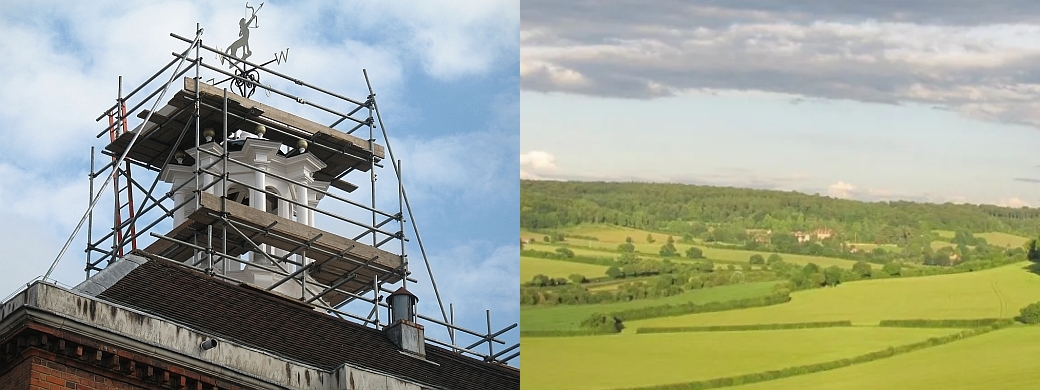


Belatedly, I discover that manual work is better than being desk-bound, better for the soul—and the world too, probably. But first some words to continue from yesterday’s set of photos.
One of them shows part of the track I walked: down the hill through the nature reserve where the wild roses grew, then through high hedges, with ox-eye daisies on either side, across the barley-field, round the farm, up the zig-zag path and then it’s hidden by trees before disppearing over the horizon. Up there is where I met John Holdsworth coming the other way. We exchanged greetings, in the country fashion. To engage a stranger in conversation is less common in town, especially for me. Yet round here, sometimes when I see a mature white person, we may smile or say hello, sharing the sense of being an ethnic minority, clinging to our almost-forgotten ways in the shadow of the mosque and the preponderance of immigrants. Now that the Shopping Centre construction is over, many of the Poles who rented rooms in our street have been replaced by Africans or Afro-Caribbeans. (Funny how a black person in America is an Afro-American, but here is an Afro-Caribbean. I’ve never heard “Afro-British”.) Either way, it is refreshing to meet a white retired person like myself. Retired! Yes, I can’t fight it now. I have to accept that’s what I am, and embrace it positively. So when I stop and speak to ladies and gentlemen in their seventies and eighties, I don’t mention my Jamaican wife. I treasure the the encounters with other members of my own tribe, or the nearest equivalent; and don’t want to see their uncomprehending eyes cloud over. On Sundays the congregation of the Baptist Church next to the mosque come down the road back to their parked cars. They stand chatting and joking before returning to their suburbs, lingering as if their very presence might lighten the street’s heathenness. Naturally, they make a point of greeting the more official & better-dressed Muslims: it makes them feel good to be tolerant and ecumenical. Mostly they are white women of my own vintage and they look at me wondering for a moment if I am one of theirs. But the Baptists are a different tribe, I know them not, and they find no sign of kinship in me. In 1965 with my first wife I went on a coach trip with a congregation of Methodists to a Billy Graham convention in Leicester. They too were of a different tribe: they spake shibboleth differently. I’d been brought up by the Church of England: not as its member but its protégé, like Amala and Kamala, the wolf-girls of Midnapore, whom the missionaries could not tame.
John Holdsworth recognized me all right. Just before he hove in sight, I smelt dog. I have a pretty sensitive nose myself, not as good as a dog’s, though I may have reincarnated from one. Yes, it was the smell of damp dog, and I expected to see one at any minute. I realize now it must have been the scent of some rank wildflower, but when John appeared on the path, walking down the hill, I expected to see his dog too, for ninety percent of path-walkers are brought there by their pet. They are easy to say hello to: you can address the dog directly, as shy people do, or it is acceptable and welcome to speak to the owner in praise of the dog. John and I found an immediate bond in our doglessness and our striding the country without ulterior motive. So we exchanged life-stories; and ended up shaking hands and exchanging names too.

He’d spent his entire career in one of those furniture factories for which my town was once famous. Some are derelict now, or turned into small workshops, where the grandchildren of the men who came from Kashmir and Pakistan (& St Vincent, in the Caribbean) fit tyres, or make engineering products to order, for customers far away. John was made redundant at fifty-eight, and used the money to buy a country cottage near where we met, and found a job as a cleaner, at a railway station a few stops up the line. He did this job for seven years till he retired and looking back says it was the most fulfilling of his life; for he could see the fruits of his labours and the appreciation of his travelling public. We didn’t talk about his family, though he mentioned getting married in 1966. I may have mentioned in passing my four children and three grandchildren, but I never mention being a stray who married three times and rolled like a stone gathering no moss.
I briefly told him about my new job. It’s only occasional at present. I work as a handyman. My customer pays £15 in cash or cheque which I submit to Age Concern. Its aim is to provide services to the elderly so that they can go on living at home and not be scooped up into one of those waiting-rooms for death known as care homes. I may claim expenses: petrol and materials. I visit my customers in the luxurious Gift Horse Granada I mentioned the other day, which itself is in a poor state. I managed to find a spare tyre from the scrapyard only for this task, being capacious enough to hold my tools, step-ladder, fence-timber etc. At least I cannot be stereotyped as belonging to the tribe of “white van man” notorious in British society. Yes, I am lucky because the car (nickname “the Gift Horse”) arrived the day before I started the job, as if on purpose to facilitate my new career.
Don’t imagine I will tell you interesting anecdotes about my customers. I shall rigorously protect their privacy. Suffice to say that they want to talk to whomever provides congenial company in their lives; whilst I want to get on with the job. Life-stories are exchanged, as well as an exchange of views as to how the job should be done. Sometimes I may stand patiently with the paint ready to drip off my brush, waiting to go back upstairs and continue. So the challenges are on many levels, both interpersonal and technical. I could not ask for more.
When I took on the job, I had it in mind to develop my skills and confidence to the point where I could work for customers directly, without the charity in the middle. Just as I was writing this piece, the doorbell rang and a neighbour wanted to know if I would consider doing some painting and decorating in her house. I haven’t put the word around, but they see me pottering in the front yard or carrying tools to the car. She wanted to know my price of course. That’s the hardest part: I don’t know how to work it out yet.
I seem to be lucky. The more I get what I desire, the more modest are my requests from the Universe. A dear friend who never reads my blog writes:
“I am glad, on the other hand, that you are so involved with & immersed in your writing. That is a noble occupation, and I know you were always fascinated by the world of the word. Do you still keep a blog? It’s funny but I still can’t understand the reason for blogs. I mean, if something is worth imparting to the world at large, why not try to have it published? At least, then it might have an impact.”
She edits a literary magazine and is too noble herself to see how ignoble the occupation of writing can be: just another chase of fame and fortune. Make an impact? I used to imagine signing books at some prestigious bookseller’s, or being wined and dined by publishers: pathetic dreams of glory which have no value in reality. Though I get what I desire, I remain destiny’s child, loyal to the source and not the froth. Of all the hymns I had to sing as a child, the words which stick in my mind, apart from John Bunyan’s To be a pilgrim, mentioned in an earlier post, are these:
“The trivial round, the common task / Will furnish all we need to ask.”
I shall dwell in the tribe of the Senior Citizens, and cultivate the present moment.
Good post Vincent. So if you had a chance to do it over again…
Yes, you and I share a common view of luck. One may work fingers to the bone – still luck is the master.
And I do agree about the rewards of labor as well. That is a central conviction that is sending me back to Michigan, where working hard with my hands – gardening, building, caring for animals – will, I believe, be a satisfying way to live.
You have a fascinating life to write about. You also are able to, I am impressed with this post. You are a wordsmith.
Does not your friend realise that writing a blog which is writing in a very public forum is a form of publishing.
You are indelibly on my tabs bar so I can easily visit your blog.
I wonder why it is that Methodists spake such differently…
Even so, it seems our lot in life to simply exist where we are and do what we can in ways that we can. It seems you've done that successfully.
I've always preferred manual work.
Vincent, this is another of those rich and wealthy posts, the true art piece, the microcosm of the macrocosm that you can most often touch thru the personal.
I was outside a short bit earlier in the dusky darkness to smoke, as I turned to come back in the door, in the darkness of the brown wall I spied the vague form of one of those eldertree bugs waiting for me to open the door, this caused the leap of my mind to the subject of the intelligence possessed by this bugtype and to the power of its sensory apartus to know the door and especially, maybe, its eye to see the doorway locale. I thought of the soul which some article told me the bug had none of, but with which I disagree.
I thought then of the soul of anything, the intelligence that is instinct and informs as to how to live and what to do at this or that time of day, mo, year, the vine to which that seemingly loose bug is connected to.
Of course, I thought of us, humans, and everything inbetween us and the bug.
I was very interested in the perception of your type in the protestant sort of christian, and in your deviancy even within your type. I of course, have my own deviations relative to my clime and sort, mine are large and have driven me from my type, I rarely even reach the level of recognition with one of them that would enable a nod of greeting, though cordial is the rule of day regardless. It is almost as if I reject the very stream, as of soul, in which I was born to swim in, reject some aspect of the vine that would feed me. And even so, I don't feel in anyway outcast or deprived nor do I rush to join up with another strand even as I live with and among different types and am treated with more respect therefrom than with 'my own', even with or without the greater knowing by them of me personally. In thinking about this, it seems to me, that white anglosaxons are the source of nonacceptance of others of the human race well before anyother 'naturally' rejects them.
Of course, individuals are all different, very so, no matter their typing in these cultural and geographical matters of birth and circumstance. Like your fascination with words and their world, even as you are not interested in the more usual place of such an interest.
In Hebrew there is a specific word for 'froth', and that is textually very important in usuage therein, one might say that a large portion of the words of the Torah are meant to do for a person what you have seemed to do for yourself, or have found of better service to yourself, that is, to stay simply real and not to go off after the layers of froth that are kicked up by, possibly, each and any soul intelligence.
Lol, not to be preaching, you know I myself am not a practising Jew, but I hear in this the understanding that the Jew is trying to simply say when he praises his 'doing of the commandments' in his rituals, the attempt to stay on the ground in the mainstream of soul and not become part of the layer of froth. I hope you don't mind me saying that, if I offend, strike it, for I too am busy cultivating the present and not worrying about having this or that impact at large by widespread reach in the usual manners.
Anyway, thanks for a great read, I enjoyed the thoughts and the chance to respond as I was moved, much appreciation for this post Vincent.
Vincent, I very much like and agree with your conclusion about the literary aspect of blogging. It is very much the writing of letter to groups of individuals, it is very personal as it is at the same time literature in the most universal sense.
Nice to read so much consistent appreciation of the “little” things in life here…
They're the best.
it's no harm if you start identifying yourself with your clan. in the arrogance of youth many of us try to embrace what is not us. we have this fake belief that we are all cosmopolitan. whereas deep in our mind, we all try to relate to our kin. all we want is to exchange a few local dialect and feel at home.
it's no harm if you get back to your own people. it's no sin if you choose to ignore others and just be yourself, you are afterall, not taking others' right to live by any chance.
thanks for the amala and kamala part. it's the height of ignorance that i never knew about them, though they were from midnapore, bengal.
very good writing vincent. very controlled and well weighed use of words.