
 I’ve been wanting to dedicate a whole post to my cherry tree but couldn’t justify it. When commenting on other people’s blogs, I have fewer inhibitions, as in this, to Michael Peverett, re his post “Prunus continued”:
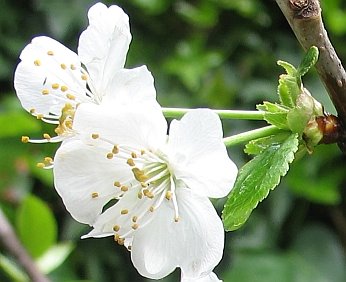
. . . I was interested in your prunus pictures because I bought a small fruiting cherry tree and planted it recently. I don’t know whether it will produce cherries though. It has pretty white single flowers. To me the wonder of it is to plant my own tree which will outgrow and outlive me, and provide a perch for birds. Since I planted it in February, I have stood next to it almost daily, to examine its buds.
Sorry to be mystical but it feels as though it has a greater wisdom than its human observer. As its leaves and blossoms unfold, it fulfils itself perfectly, with a perfection that I can only perceive with its, and the rest of Nature’s, help.
After writing that, I went into Woolworth’s looking for plant pots. Some pop music blared and the shop was warm, deprived of natural lighting, stuffed with spuriously ornamented merchandise. Amongst all this were some cherry trees packaged in cellophane, still for sale. I looked through the beads of condensation to the branches inside. They longed to put forth seasonal leaves and blossoms, but in such conditions these had decomposed to black slime. Carl Rogers had seen something comparable which inspired him to found a school of psychotherapy. In his own words:
I remember that in my boyhood the potato bin in which we stored our winter supply of potatoes was in the basement, several feet below a small basement window. The conditions were unfavorable, but the potatoes would begin to sprout—pale white sprouts so unlike the healthy green shoots they sent up when planted in the soil in the spring. But these sad, spindly sprouts would grow two or three feet in length as they reached toward the distant light of the window. They were, in their bizarre futile growth, a sort of desperate expression of the directional tendency I have been describing. They would never become a plant, never mature, never fulfill their real potentiality. But under the most adverse circumstances they were striving to become. Life would not give up even if it could not flourish. In dealing with clients whose lives have been terribly warped, in working with men and women on the back wards of state hospitals, I often think of those potato sprouts. So unfavorable have been the conditions in which these people have developed that their lives often seem abnormal, twisted, scarcely human. Yet the directional tendency in them is to be trusted.
In the news, we hear of the man who kept his daughter in a cellar for 24 years.
As Hayden writes:
kindness practised in consideration of the welfare of a bumble bee helps acclimatize the human heart to the practice of compassion and kindness to fellow humans.
At the root of this will-to-good is connectedness, which it appears we once had in abundance. In many cultures throughout the world man saw himself as brother to crow, to wolf. My Christian readers may forgive me for the observation that, in the west, the heart of the disconnect was excused by the religious teaching that nature and man were distinct, separable, and nature was to be used for man’s ease.
. . .
The other disruptor was that other western god, Science, which feeds off hubris and, while telling us we are inseparable with nature and cannot live alone, contradictorily is continually pushing us towards the attempt to do so.
Both science and religions insist that we need their insights. We see the results. A child in rural Jamaica had its own chicken to look after, or a goat if older. Then came the battery farms, and the bauxite company to take the land. And now the biofuel interests to take what’s left.
The cherry tree and the bumble bee know how to be connected.
And when I think of those cherry trees languishing in Woolworth’s, missing the springtime, it reminds me of a story by Ghetufool which tells of a sparrow trapped in an office block:
It had given up its struggle and just looked intently through the window, where a flock of sparrows twittered in the darkened sky. This district was virtually treeless, as if nature were a just a memory. But there was still romance. It was the sparrows’ mating season.
Will the man watching understand that he too is trapped, in a web of his own making?
I had planned to write a much harder piece, to try and convey the sense of pathos I felt walking through the town, seeing the faces of . . . I cannot call them “the poor”. It would imply that money would replace what they lacked, when such is not the case.
Every cherry tree has the wisdom to blossom forth in spring if it is not trapped in a close dark place.
 a wayfarer’s notes
I felt there was more to say. Some instinct took me to Blake's Songs of Experience. Here is the last stanza of “The Chimney Sweeper”:
'And because I am happy and dance and sing,
They think they have done me no injury,
And are gone to praise God and his priest and king,
Who make up a Heaven of our misery.'
LikeLike
a wonderful analogy
LikeLike
Vincent, I've been reading your blog for a while now, and never left a comment yet (which is not to say that I haven't had many interesting thoughts inspired by your words).
Today I feel an impulse to leave a response, driven by the coincidence of my wandering off my beaten track this morning to explore a side road often passed by. This took me up the side of a hill, through a pleasant suburbanish estate where everyone tends their gardens diligently and the cherry trees and the azaleas are in full bloom amid pretty lawns and brick driveways, while the camellias are now fading.
The road wound on, passing a house clearly much older than the surrounding estate, Victorian, possibly Georgian, tall and square over four floors. A very new bare concrete wall surrounds this dilapidated mansion, pink paint peeling from the walls, the iron grill balconettes (is that the word?) all orange and brown with rust, the thin uneven glass in the windows smudged and nearly opaque with dirt, so you can barely see the old wooden shutters at the sides.
I thought at first that it was deserted, but on peering over the wall I could see a kind of modern glass 'extension' at the base of the house, with a 'deck', and a shiny new door, and vertical blinds hanging down all fresh and new – as if someone had built a new modern home in the husk of the old place falling down around and above it. The grounds are practically buried under briars and nettles, with some fine old trees poking up. A disused squash court extrudes its ugly concrete blotch out of the undergrowth at the side. On that bare concrete wall someone has painted a rather neat graffiti, in a 'thought bubble': 'Politics are corrupt. Vote for the genuine.'
The road continued on up the hill, and led into an estate every bit as neat and manicured as the one below, but here the houses – all bungalows – were all tiny, with tiny plots with miniature flowerbeds and borders, and the cars (such as there were) in the driveways were all small and well over ten years old. There were two large open grassy spaces between the houses. All around the views stretch out over the harbour, to the hills and mountains in the distance. It is beautiful. I was amazed to find such a place in such a location.
These were clearly not council houses, but nor were they the homes of Ireland's new rich who are colonising the area all around, and who would surely have commandeered this wonderful spot for themselves if it had been available.
Now I've written all that and re-read it, and wonder what my point was!
But your post inspired me to write it down.
Kathleen
LikeLike
Vincent, in reading this… I wonder if you are in a stage in your life, much like these trees or potatoes in the story. You've mentioned before that you were somewhat of an engineer of sorts, leaning toward things that can be invented, manipulated. It seems to me that you are much more an artist than an engineer in the traditional sense.
LikeLike
Bravo, Vincent – beautifully expressed! This analogy – the striving to Become under 'impossible'
circumstances – is so poignant!
And the difference between that packaged cherry tree slowly dissolving into slime and the one in your yard is YOU. A simple act, planting a tree, but a profound vote for Life.
I am reminded of the recent Nobel Peace prize winner who planted a forest – one tree at a time. If we all planted just one or two (as you have!) the world would be transformed.
LikeLike
It occurs to me that the pressures of my life, which have become almost overwhelming as of late, are like a powerful magnet. A magnet that pulls my attention away from those sparks of inspiration you spoke of in your previous post, the details of life you speak of in this one.
I do value such things, and in spite of these pressures I am intent on keeping them at the forefront of my consciousness. It is just that at this time it has been a struggle.
Your blog helps fill the void left by my current distractions.
LikeLike
thanks for honouring me in this way. i am touched.
LikeLike
You shouldn't have to justify writing a post about a tree. If you want to write it … write it! :o)
Now, to be serious, let me see if this quote will fit:
“We are an exceptional model of the human race. We no longer know how to produce food. We no longer can heal ourselves. We no longer raise our young. We have forgotten the names of the stars, fail to notice the phases of the moon. We do not know the plants and they no longer protect us. We tell ourselves we are the most powerful specimens of our kind who have ever lived. But when the lights are off we are helpless. We cannot move without traffic signals. We must attend classes in order to learn by rote numbered steps toward love or how to breast-feed our baby. We justify anything, anything at all by the need to maintain our way of life. And then we go to the doctor and tell the professionals we have no life. We have a simple test for making decisions: our way of life, which we cleverly call our standard of living, must not change except to grow yet more grand. We have a simple reality we live with each and every day: our way of life is killing us.”
~Charles Bowden, Blood Orchid
LikeLike
I'm so glad you let it build up to a full post! – there's a lot to think about in it.
LikeLike
Beth, I could have just written about a diary entry expressing pride in my tree, as others do posting photos of their babies, but that wouldn't fulfil my or my readers' expectations. So as Michael points out in his comment, I let it build up to something with a bit more to think about!
Ghetu, I wanted to publish your whole story here in the latest edit, but still waiting for your response yes or no.
Charles, yes, the pressures of life – this is a reason why I want to publish Ghetufool's whole story because it is all about those pressures, taken to a nightmarish but believable extreme.
Hayden, there was a novel in which someone went planting acorns in France, to recreate forests. But you are referring to a real person in Africa who was awarded a Nobel Prize. I just looked her up. I don't know what kind of activist she is – I know she has been physically attacked for her work – but I think that the essence of true activism is to do what one strongly feels one must do. “As opposed to what?” I ask myself. Ah! The internal debates. As someone quoted the other day, probably Beth, it takes only one to make a quarrel.
LikeLike
Kathleen, I'm delighted at your most descriptive tale, & I know what you mean by the lack of point. But there is a point because you took trouble to write it and to me it resonates because there is a kind of similar tale I thought of telling too. I took a bus to the village of Penn and then walked on public footpaths and thought I would reach one by going down a very neat and prosperous cul-de-sac. But they had closed off entry to that footpath with a high chain-link fence & I had to retrace my steps. The houses seemed deserted, apart from gardeners and builders who were further prettifying them, and I imagined that the owners were busy at their stressed-out high-paying jobs to pay the mortgages. What was their life-purpose? It seemed so circular: buy a grand house in a rural backwater and then slave for its sake. All my imagination of course: who am I to judge?
But Kathleen, have you thought of starting your own blog?
LikeLike
Scot, I am sorry you have been over-exerting your poetic muscles to the point where you confess to having strained them a little. National Poetry Month, eh? How many poets will be suffering the same? Where do they go for the poetic equivalent of physiotherapy?
I feel sure that your inspiration will return and hope you'll stay on your site or leave a trail to wherever you go.
LikeLike
I can only add that I too am touched by this beautifully expressed post, feeling you have captured so brilliantly what so many of us feel and experience. This is your writing expressed from the beauty of the heart inside of you. Thank you for putting into words so wonderfully something that has caused me to pause this morning in my own self awareness.
LikeLike
Tim, thanks for what you said. I would like to think of it as engineering with words – building a bridge from here to there – but it seems to need something I cannot pull out just by wanting to.
LikeLike
Vincent, I bow to your majesty, whilst I praise Blake for his righteousness!
And Artistically, magnificent work with much light woven into a dark subject, much research, much labor behind the ease and joy of its' expression of the disease, the hope for the cure.
Inspiring is all ways, even makes me want to paint what I just read!
Hope is in the speaking and writing of the realities that are perverted, more and more we need to say it, varied and in all degrees, God must be reasoned with strongly and directly and without fear, in the face of that which would destroy Him too!
Thanks for a beautiful tree and post, thanks Vincent for them all that you do!
LikeLike
Thanks so much Jim. Your encouragement is something so valuable to me, for it is not empty flattery. Your comments tell me you understand everything – that is the encouragement.
LikeLike
[…] Preface Ghetufool has given me permission to publish his short story here. His pen-name indicates modesty but not in the way you may think: “ghetu phool” is the Bengali for calotropis gigantea, a wayside wildflower. We have collaborated for a year or so (he writes, I edit). You may have seen a brief quote from this story in my previous piece Cherry Tree. […]
LikeLike