

The day after posting my last, I felt cleansed, as a Catholic might feel after a visit to the confessional. Burdens removed, joy restored. I had published only a small selection of what I’d drafted, but had never felt such catharsis from writing, if it is justifiable to link effect and cause in this way.
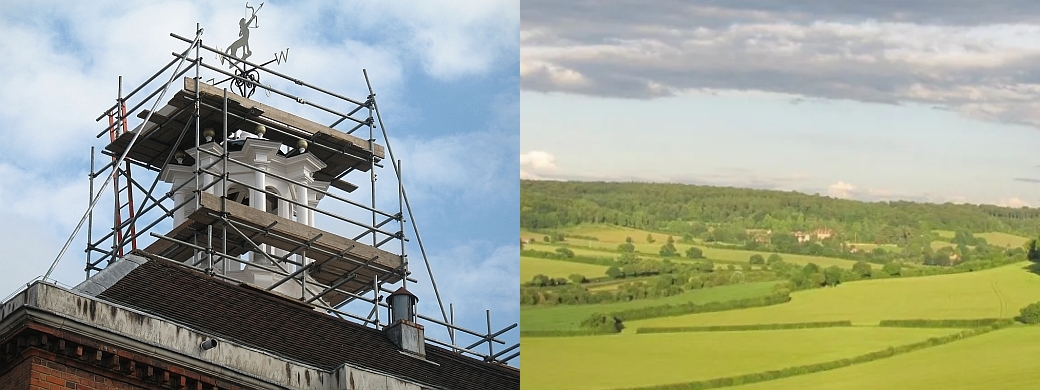
The day after that post—the Snowdrop Garden—I took off to Bledlow Ridge, a village on the spine of a hill, and zig-zagged its footpaths on the eastern slope. You can see a stile I climbed over, and a view from that slope—please click it to see the panorama full size, with a restored windmill on the horizon. There was hardly any breeze and the February sun actually warmed my face. Near the top of the ridge, my path took me down to a hollow where the tracks had been churned up by vehicles and logs were stacked at the side and there was something, I don’t know what—the lie of the land, the scent of the resin?—which gave me the sense of an earlier time, a Golden Age of my early childhood. I’d been taught to associate Golden Age with the pastoral idylls celebrated by Latin poets, but have observed that old men always look back sixty years to a time—good or bad—when they formed their ideas of how the world should be. Now I have reached that stage of life myself. I don’t want to condemn the world of now, but still I rejoice when I discover seeds and echoes of its heyday as imprinted in childhood.
Cocks crowed and dogs barked. Birdsong echoed across the clearing. “I have everything,” I reflected, as if in heaven. But humans are not made to be satisfied with singing “Alleluia” on a cloud, so I turned my reverie into a quest. I imagined some object lying about, not a burnished museum piece but some rusty relic, that I’d take home as souvenir of time past. Conventionally we may think it’s evidence of old age when the past fascinates more than the future, but what if it always did? When my mind is calm and reflective like a pond, its surface is rippled by odd memories or a sense of familiarity. Till I was four, I lived in Australia, and soon after that I spent time in post-war Holland, with horse-drawn milk-carts and a smithy where on my way from school I’d be drawn to watch the farrier making a horse-shoe and nailing it on a horse’s foot whilst still hot. There remains in my head—perhaps in everyone’s head—a library of smells from early childhood; and the same with the other senses. That doesn’t explain why I’m so glad to recognise these old friends now, and to relive the peculiar feeling that even as a child, I recognised from a yet earlier time, perhaps imprinted in my genes. I have always been interested in discovering old things. Relics! I can almost understand how it was for those medieval Christians who revered a holy relic: almost. I’d like to understand everyone. A novelist, or a film director and crew, can help us understand the fictional depiction of a person: sometimes. Even then the reader or viewer has to work at it. For I believe—no, I somehow feel—that we’re all one. Most of the time a merciful veil gives protection from the world of others. But in art that veil is rent and we glimpse.
Of late I’ve been reclusive, passing the time of day only with neighbours, many of whom hardly speak English; every day a perennial exile, a retired man pottering unnoticed in his tiny plot, venturing out only on trivial errands. So it was a big deal to go to a training workshop presented by the eminent British Standards Institution, on the topic “Business Continuity Management”. At a luxury hotel and golf complex in remotest Northamptonshire, I met the other thirty-five delegates, each with a background in rarefied forms of management consultancy. Yes, I have dipped into those waters too, though I have been more like the frog in the well who knows not the great ocean.

Being rusty in these matters, I’d planned to keep quiet throughout the day. But at one point I felt prompted to speak, to correct the impression conveyed by another delegate that running business continuity exercises might disrupt an entire organisation. I told a tale from my days of Eurotunnel, when we had conducted a literal “table-top exercise”. On a set of ping-pong tables, there had been constructed a Lego model of the shuttle railway. With just that plus telephones and the participation of external parties—the Fire and Ambulance Service representatives, and the Mayors of Folkestone and Calais—we had simulated an emergency in the tunnel, with a train broken down and passengers injured. Outcome: chaos. The exercise showed we were ignorant and uncoordinated. Injured passengers were taken out of the tunnel and left untended on a platform, whilst simultaneously paramedics went into the tunnel looking for them vainly.
My tale was hardly longer than that, but it made a vivid impression, and at the next break, whilst queuing for coffee, a tall man introduced himself to me, an ex-cavalry officer who now advised the Royal Signals about communications. We were able to converse very easily. I mentioned the American armed forces who are so dependent on satellites for almost everything, and he smiled. The strength of the British Army, he said, was its poor communications which put local officers on their mettle and created heroes. Ah yes, I said, like the Light Brigade: we are famous for heroic cockups, or was it Lord Tennyson who made The Charge of the Light Brigade famous through his poem? Oh, he said, Tennyson wrote another poem, The Charge of the Heavy Brigade in which the British had done another insane charge and actually won; but that poem was not so famous, and we had sustained even heavier losses. We briefly touched on the misfortune of winning a war: losers seem to benefit more. I mentioned that Milton’s Paradise Lost was a better poem than Paradise Regained. He said he has Paradise Lost on an audio tape he listens to in the car. He reads Homer’s Odyssey whenever he can, little bits at a time (surely the only way!). He said his father had read to him when he was young and now he reads to his children: rare authors whose names I failed to note but when uttered by him seemed uniquely magical. I didn’t even get his name, this literary cavalry officer, but he was like a long-lost brother. He was what I might have been if brought up in a prosperous nurturing family. I told him of the tattered banners captured by my great-grandfather at the battle of Tel-El-Kebir, and being in the cadet force at school—he had too—and the true reason for my teenage pacifism. It wasn’t a hatred of killing but a hatred of arbitrary authority. I was astonished at my own words for I hadn’t till that moment realised this. He smiled and understood perfectly, as if he were no stranger to such thoughts. I think there was a subconscious connection between us that made me say it.
That this encounter made such an impression on me was, I now reflect, the truest snobbery: the urge to belong and be accepted. I have been so long out on a limb, adrift from the herd—every herd, that I have sought to belong to nothing but Nature herself. I have secretly claimed descent from the Australian aborigines, as an excuse for feeling alienated. But in the last few days I have found I belong to several fraternities: my street is one, the ranks of senior citizens is another—in the supermarket an old man told me his vividly tragic life-story whilst we waited at the checkout. So I must have changed somehow. Perhaps I no longer carry the scent of a Steppenwolf. Or maybe the officer was just humouring me? Perhaps his old-fashioned English manners charm everyone equally? I say no, it was special, but my subsequent dream tells me that unconsciously I’m still insecure.
I walk into the office chatting with a colleague, who looks very much like the model and actress Liz Hurley, once the girl-friend of Hugh Grant. If that cavalry officer were a woman, she’s the one he would be. She goes into a cupboard to hang up her coat, while I continue talking to her through the closed door, raising my voice. She doesn’t come back out. I look round and all my other team colleagues, who were sitting in our section, have disappeared too. A couple of staff from another project look up disdainfully across the open-plan office to see me talking to myself.
Next post I want to talk more about understanding others, and about the conditions for the highest creative work. Does it help to be mad? Or unhappy?
Hi Vincent,
I'm mid-forties and I notice more and more my mind harkening back to earlier days.
I lost a good friend a year ago and that really cranked the churn. Reminds me of the song with the line “I turned around and they were gone”.
I find myself drawn back to those places where the memories were made and just take it in in quiet solitude.
Thanks for sharing your perspective…in words and photos.
Don
I spent 24 years of my life at a corporation. This corporation built it's reputation on the conquests of “heroes”.
Rather than spending time on careful planning, intelligent design, coherent strategy, it was expected that any emergency would cultivate a collection of heroic acts that would then save the day.
Anyone who complained about the chaotic results of such an organization, was the anti-hero.
And yet, the environment did produce friendships that have lasted beyond my years there at the corporation. Many times we were cast into battle together with little or no armor. This established a lasting bond.
I would not recommend this scenario as a means of building friendships. Many who I was very close to in battle, were cast aside soon after. Memories were too harsh to re-live through friendship.
I enjoy artifacts from the past as well. I feel many connections to previous generations. It is as if I would have got along much better in an earlier time. But I don't fool myself into thinking that my romantic views of the past are a reflection of how things really were.
For that matter, my romantic views of how things are or could be today, are no more accurate.
But I prefer them to reality sometimes.
My most joyful moments in life are when I can make a connection with someone through a measure of beauty we each have recognized and appreciated. Whether it comes from past, present or future, it matters not.
At 41 I find a lot of time spent too in memories of the past, and have always sort of had a sense of being older than I am, even when I was a little girl, having friends who were older and preferring the company of “grownups” and older people to those my own age. I am happy to wander into a field and lie down in the grass and stare at the sky, gaze into the ocean waves for hours, or just sit by the pool and watch the ducks wade by, happy to be with people, content to be reclusive as well.
Then there are those moods of longing, searching, a sort of restless or loneliness that is hard to quite put my finger on; I've always just assumed it was my quest for God, to feel at peace with something more eternal than what I can see and hear and feel in the here and now in front of me.
Wonderful to see you writing again Vincent. You bring about much to think about and to feel and to remember.
Vincent, this is amazing stuff. If this truly flows freely from your own recollection (note my own skepticism), you are a brilliant artist who has lived a life trodden with scientific analysis. One such artist who lived a live tethered to the physical sciences that I know is my own grandfather – Grandaddy, as we call him. He spent his adult life serving in roles of physical, material, and electrical engineering. He’s confided in me that, in all his time, he is truly an artist and poet at heart. He is wise. He has been through thick and thin. He has been involved in both secretive and public engagements, which, to me, seem the kind of life I desire…. but fail to see such available in our current culture, unless one is born unto it.
Before reading this latest post of yours, I thought you to be, perhaps, middle-aged, if not younger. When you compared yourself to a senior-citizen… the connection I feel to your writings makes far more sense to me now. I have hardly ever felt connectedness with folks of my age. When my grandfather (in his middle 70’s) reads my blog, he has told me in the past that I see things in much the same way he does…. and it concerns him, for he doesn't know where such “knowledge” (for lack of a better description) will lead me. He has explained that his concern is due to his feeling that he has no further advice to prescribe – a worrisome situation, considering the state of current events and circumstances.
I love my grandfather dearly, and don't know whom I could sincerely talk openly with when the Good Lord decides his time is up. Reading this latest post of yours fills me with a sense of wonder, adventure, fulfillment, sadness, and emptiness… all at once.
Having heard my grandfather voice his own concerns for my state of mind relative to my age… it makes me proud and determined and concerned and worried… all at once. On one hand, I feel as though I stand on the shoulders of a giant, with a penchant for moving forward for the sake of future generations (including my own daughter). On the other hand, I feel as though I may be entering uncharted territory… without a guide.
Perhaps, the latter is my destiny. Perhaps I am to be like those brave souls who crossed the pond in search of a different life. Perhaps I am like those who, after settling the eastern coast of the U.S., look toward even newer horizons in the west. Though I am one who travels East in search of Light, I often feel as though I am surrounded by darkness… in spite of the great and wise people I have been fortunate enough to meet.
There's nothing quite like dumping random thoughts on someone else's blog page. I hope, if nothing else, I find a relic of significant interest, which will keep me motivated toward the ultimate goal – connectedness with our creator.
Thanks for sharing, Vincent.
Tim
I haven't taken a a good spiritual, earthy, cleansing walk since I last left Kenya – 13 years ago. I've walked … it just doesn't do me any good other than physical exercise. Maybe if I lived in Montana where there are wide open spaces without noise pollution I could feel the same here in the USA. Still, I think not.
Ah Beth, do you have a sense of exile to be in the States? My patron saint of walking, John Cowper Powys, spent decades of his life on lecture tours around the States, and walked in every town – usually in the direction of city limits and beyond. But that was nearly 100 years ago. And then he lived in Phudd Bottom, New York State, a rural area that he found much like England . . .
Tim your comment is a wonderful essay in itself and I'm glad to see your photo too. This business of being an old man, it's a persona one can take on or discard, but I'm only 10 years younger than your grandfather. And sometimes you can look at a small child and see a pensioner in the making … And in general a small child has the potential to be anything. It is a grave mistake to think we need to leave behind the small child in us in order to become an adult, don't you think?
From blogging – I am particularly referring to readong the blogs of others – it gradually dawns on me that living in the US particularly must be a terrible travail for the human spirit for it is a great country in rapid and scary decline, a frightening time that is hard to understand and stay sane. No, “stay sane” is wrong. From the chaos of American craziness – which has got so much worse since the Beats for example complained of it in the Fifties – there may one day, perhaps in fifty years' time, emerge a new-old definition of sanity that is truly propitious rather than destructive to the human spirit.
Joanne, yes I think it could well be described as a quest for God, but that is not the way I would put it, for that seems to stifle the quest, put a lid on it, deliver us up to the dogmas, kill our imagination and so on. (a very personal view)
Charles, your corporation seems to have been modelled with some pride and nostalgia on the military, in particular its vulnerability to chaos and cockup.
Your looking to the past seems entirely healthy and beneficial, especially when as you say it is not necessarily the real past, but a concoction from fantasy. We both know that there is more fairness, less poverty and cruelty today than in almost any time in the past, always with notable exceptions of course. But that advancement has come at a terrible price which should concern us all.
Yes, N2, I was wrong to categorize nostalgia as the preserve of the older person, if I did so.
Yes, where has the past gone? Where are those we loved?
Vincent
Good post and I suppose I am at the age to appreciate it. Thanks for the visit.
midwestpoet.wordpress.com
I've always been fascinated by relics too, I took part in an archeology dig while I was a student.
I like all the connections you make in this post and then how you take it into a discussion of community
Congratulations, Vincent, for achieving your aim so well in The Snowdrop Garden! I don't think I've ever been so well pleased with anything I've done – absolutely wonderful that you so well mirrored your interior in words that it relieved the pressure of the foment!
do you really think it snobbery to feel joy and relief at finding fellowship? Although many of us manage living alone well, humans are a social species, born to living in close communion w/ each other. For those whose thinking is complex, finding fellowship is often a challenge. Your reaction seems to me – from the outside – be be completely natural. Perhaps even a shade of relief at finding a fellow wayfarer.
I don't challenge that you know yourself – clearly it would be silly to do that – only express amazement, surprise – as a friend would say “really? seriously?”
Ah, Hayden, I do appreciate your questioning my use of words! The snobbery lay in this, that I was particularly delighted to find a fellow-wayfarer in the form of an establishment figure, a person in what I envisaged as the heart of society: a cavalry officer. Just a soldier you may say but in a certain class of British society, one in which I was brought up but somehow exiled from, this was linked to aristocracy. Meeting this man though briefly helped heal a wound that had long festered.
Crafty Green Poet, thanks for saying “community” for I had not begun to see it that way till you said!
Scot, I don't know what age you are but certainly I admire your view of reality – the things you pick out as worthy of poetry, prose and photography, one that takes me back to what seems like a few minutes ago, when i first discovered Kerouac, Miller & co.
vincent ~ You are having a birthday today … correct? I do hope I remember that correctly. If so, I hope it has (so far) been a good one for you!
Beth you must be psychic, or else I shall have to be a lot more discreet in future. And thanks for your good wishes!
Vincent, I think losers do often become the winners, personal experience tells me so, but that is not measured by the usual means of measure.
I would say your encounter was special, the recognition of that being MORE special, we all have the specialness, awareness of the occurence tho is most often lost. Still works tho in peoples lives, but good to be aware of it, it is like another added dimension to life. Dynamic, unseeable.
When it is over at a given time, it is over, it will come again, carry on.
I think that most have had EVERY thot, they are not strangers, just that preferences are exercised, but all can relate, if they will.
Your last paragraph leaves me speechless, for the moment, how does it work, what is required, insanity is intrinsic to the time period, maddness may be outside of time. The real Art of Communication is too outside of time. I would say that it is beyond the words saying it.
I am not a literary judge, but this post seems a leap, a push ahead, not to belittle any before it. And your inferences speak more loudly, or maybe I am listening better.
Love to you Vincent.
Vincent, reading the comments and replies, I have a couple of issues…
I don't think there is LESS poverty and misery, I think that the ratio is the same, the numbers differ but the reality is the same, the methods of both side are different, but the reality is the same.
I don't think it changes in any given period of evolution of our kind, to change it, I think, is the goal, given that, each period may be different, but that would not be 'historicly provable' due to the huge intervals. History brings together intervals within, Spirit is intended to bring awareness of the greater 'history', that is part of the goal.
So, just my opinion.
Hayden remarked about the snobbery thing, I think this is real, but is learned, it exists even in the USA, but I think it is more real in UK and Europe due to the sense of 'living history'. I think it is a cover for feeling 'human' realizing that even the class distinctions are false.
And that 'human-ness', I don't think of as complexity, that sense is also a cover, the truth of it, I think, is a simplicity of humanity, how we are all subject to the same realities of life, the seeming complexity is a projection of the difficulty we share in this reality of snobbishness. Your awareness of this is making you different perhaps?, and that is because, for you, it is important enough to make a point of it. Making a point of it is communicating it, communicating it causes change, that is raising the bar.
Beth is psychic, hear it in her poems. Happy Birthday Vincent!
Jim, your two comments above are full of insights and as soon as I read the first, I had the determination to do a new post sooner rather than later (despite finding them harder and harder to write).
Above all, Jim, I see you as a teacher: not in the role of imparting knowledge so much as offering encouragement and insight, both of which you do with great generosity, as all who have been in receipt of your comments will attest and doubtless generations (I'm guessing there) of art students too. So I'll absorb your comments as pointers to my next.
Fossils are good for that: “taking home as souvenir of time past”. Although I am not sure what fossils may lay in wait embedded in your english stone.
It is nice that you can walk about and collect stories of your area.
I like your photos as well.
Thanks for the kind words here and left on my site…I am 53.
Thanks Vincent, you are very kind, I am very appreciative, and I am pleased with the qualification regarding 'teaching'. Thanks, your work inspires me!
I really like the top pic, close up with the fence in mid ground going into the distance. Great composition, lots of artistic possibles.
Speaking personally, the only thing that has helped me creatively is noticing what conditions conduce to that and structuring my life around it as well as I've been able to.
Once I'm in that “creative space,” then there's no room in that zone for anger or unhappiness.
Outside of that zone, I've found that diminished emotional turbulence seems to positively contribute to when I “go back inside” by opening me up to the world more, giving me more material to bring back inside…
Thanks for posing such an interesting question. I never articulated that before. Maybe just as well! No idea if that makes sense when I try to put it in black and white…
tell me, who is not insecure?
Splendid post! I’m glad I’ve finally read it, twelve years on.
I really enjoyed revisiting this after 12 years. A rich, rich post – and rich comments too.
Then I look at the comments and realize they’re almost all from ‘08, like the whispers of fading ghosts in an empty house.
Always amazed at the stories of your life. Tim’s incredulousness is understandable, I suppose, but I’d be doubly impressed with your imagination if it turned out it was all made up.
I like the comedic touch with the dream at the end, the disdainful glances from across the room “WHO are you talking to?” (or should it be “With WHOM are you talking?” Yes, that settles right on the end of the nose like a little pair of spectacles.)
[…] Belonging Perspectives and Remembrance Kindness (audio podcast) England Have My Bones Hasty sketch map From […]