

>Somewhere along the course of my life I became “spiritual”, or perhaps it would be better to say that I realized I could never be an atheist. Till possibly now …
In approaching this I must tread delicately. Let us not excite our brain-boxes with the wording of the “God-question”, not yet. Our brain is a toolbox of different instruments, and we need to know which to use and in what order. First we need to set aside our formal education. It has taught us to glue facts together using reason; to distort language by using strict definitions; to distinguish real from unreal, true from false. These are artificial constructs. They help us fit in to their own world of artificiality, which is the world of politics and universities and technology and law and sciences.
I wasn’t introduced to God via reason, but through repetition: “Our Father, which art in Heaven …” But then I learned arithmetic the same way: “Once two is two; twice two is four; three twos are six …”
None of this helps with the God-question.
I hope we can stay together on this exploration. Forgive me if it meanders, as if it’s somehow aimless. That’s only because it’s an honest reflection of life, yours and mine. In childhood, events fall upon our head like sunshine and rain. Or they are pieces of a puzzle, which we can only collect at first, for we don’t know what pattern they form. I would claim in fact that it is we, individually, who decide what pattern the pieces form. So I’ll set before us, in case we get separated on the journey, what I see as the final rendezvous, the place we can try and meet up if we get lost. I’ll express this rendezvous as a proposition, that sits waiting for us until we can understand it:
What we need to know is stored within us, inviolate, unconscious, largely inexpressible
I won’t even formulate the God-question, except in the terms what we need to know.
Naturally, parents and teachers do their best to teach us what we need to know. The Australian aborigines used to draw diagrams with a stick in the sand, to illustrate the Dream-Time legends of their race. They would paint similar designs on their bodies and on rocks using ochre; they made music and dance: all for the purposes of passing on the vital traditions of their culture. For my part, I started Latin at the age of 8, conjugating “amo, amas, amat, amamus, amatis, amant”. Latin was the language of the Romans, whose law and Empire Britain took as a role-model, with Greek there behind Latin as the poetic and philosophic inspiration of the Romans. That was part of the secular side. To teach us about the ways of God, we had lessons called Scripture.
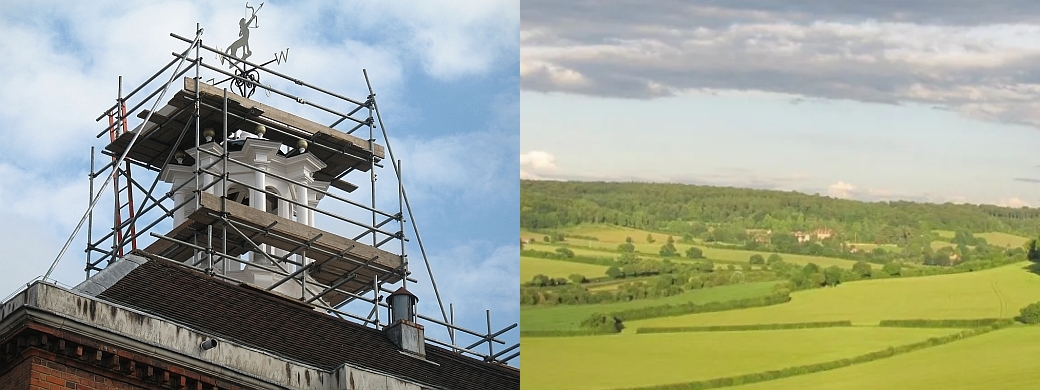
From the age of 6½ till 12, I was at boarding-school*. I’ve just worked out that I may have spent 500 hours in Scripture lessons, plus 500 hours in the village church (illustrated above), for attendance was compulsory: sometimes twice on Sunday, especially when I was in the choir. We went two-by-two into that Ark, “walking in crocodile”, as the English say, to St John the Baptist Parish Church in the village of Sedlescombe, a mile from our school. Apart from the rows of little boys in their Sunday best, all born in the Second World War, most of the congregation was elderly: survivors of both World Wars. Once a year, those cataclysmic events were recalled on Remembrance Sunday. We all wore poppies on that day and sang special hymns:
O valiant hearts, who to your glory came
Through dust of conflict and through battle flame;
Tranquil you lie, your knightly virtue proved,
Your memory hallowed in the land you loved.

But I think for the older villagers, every Sunday was for remembrance of those who had not returned.
My own headmaster had a glass eye and a permanent tremor in his hands, which made his writing jerky. He’d been a telegraphist in the trenches, jerking out Morse code, and suffering shell-shock somewhere along the way. By profession, he’d been a clarinettist. But he encouraged us to learn Morse ourselves and we played a game of talking remotely in the school grounds using police-whistles. He taught us Scripture from The Bible Designed to be Read as Literature. The text was from the King James version, but it was laid out like a normal book rather than in double columns; so it didn’t have verse-numbers dominating the text. And so we read the stories as stories, rather than as Holy Writ; and I wondered if Monty Brummell-Hicks, headmaster, who caned me regularly on bare buttocks to stop me becoming homosexual (it seems to have worked) had this in mind. Was he really a Christian at all, I wondered.
We were a proper English school, fiercely loyal to the Church of England, observing all the rituals, such as the Festival of Nine Lessons and Carols, on the model of King’s College Chapel in Cambridge; starting with the processional “Once in Royal David’s City”, via “Adeste Fideles” and “In Dulci Jubilo” and ending up with the Christmas Day Hymn “Hark! the herald-angels sing” by Charles Wesley to the tune by Mendelssohn. You could say we lived those tunes and stories, as well as the mysterious tales of the Old Testament: Nebuchadnezzar, Belshazzar’s Feast, Shadrach, Meshach, Abednego; the whole story of David, from his slaying of Goliath to the complicated relationships with Jonathan and Saul and beyond. This was the folklore of our tribe, it seemed, but I have not read it since. Later, at grammar school, we studied the New Testament, but more critically.
To be soaked in that Christian upbringing was like being a stone at the bottom of the sea: dredge it up, leave it in the sunshine a few hours, it will be utterly dry. For all the compulsory church attendance and study of Scripture, I didn’t find God.
But I used to wonder about others. What was it like for those who went to Church as volunteers and prayed believing that someone was listening? What was it to believe?
Continued in “What is God?—Continued”
* Merrion House School
 a wayfarer’s notes
“What we need to know is stored within us, inviolate, unconscious, largely inexpressible.” For me, at least for where I am at for the moment (which admittedly can shift and change as I allow myself to be open and accepting and curious, etc.), this is where the God question seems to strike me with the strongest tingle. I don't feel any need to declare myself anything. Labels not only seem sort of meaningless but once people align themselves with this group or that group it seems like they just close themselves off to anything else, as if they have finally arrived at some destination, shutting the door behind them. Atheists are no different from Christians in this regard.
I think your description of early childhood exposure to religion nicely illustrates the process many of us go through, a process that serves to move us even farther away from what it is that is stored within us. We are instead convinced of our unworthiness and evil nature which can only be redeemed by turning oneself over to the mercy of a judgmental God. Over time, the disconnect from the internal becomes even greater, and what has been within us always drifts further and further away, having been convinced there is nothing of value to find inside.
Brilliant writing, Vincent, as you always produce. I look forward to the next installment.
LikeLike
As a young child I was taken to Sunday School. I recall very little of it. It was more of a day care with occasional “art” projects that had us painting or coloring in pictures of religious figures or events.
Most of the time I recall being asked to keep quiet to avoid disturbing the congregation meeting just above us in a large room.
I'm sure there was more to it than that, but this is how I remember it.
There was a time between my very young years and the age of 10 or so where we did not attend church much. Only on holidays.
At around 10, we began attending regularly. I believe it was for me to become an official member of the church.
There were lessons. We were meant to learn something about morality I suppose from the tales that were told. But often I could not clearly see the correlation between the tale that was told and the moral of the story. It was much easier to grasp the moral without the baggage of the biblical tale. Usually the “teacher” would give us examples of how it would relate to us in our lives, this meant more to me than the stories.
Often it was common sense, perhaps this is what you mean by “stored within us”.
At the age of 11 I participated in a weekend retreat that was to mark the end of my Sunday School teachings, and my official membership in the church.
I recall putting itching powder in the girls sleeping bags, playing soccer in the dorm room, talking with friends until late in the evening.
After this I rarely went to church. I stayed home on Sundays and watched football games with my Dad. Or we would take a Sunday drive, something my father always enjoyed. He would take us to several nearby farms to pick fruit or vegetables, or to purchase canned goods.
Religion never came up much after that. In the last 5 years or so, my Sister, Brother and my Mother have all begun acting as if we had always been “Christians” and began attending church again. I have been somewhat taken back by this. It was never that prominent in my days growing up with them as a family unit.
I recall a brief time in college when I felt a need to seek an answer to the God-question, but it was more in the context of “what does it all mean?”. If some sort of God was part of that answer I was open to the idea. I was left with a feeling that there is no preconceived meaning, only what we give it. Again, it was “within me”.
LikeLike
Vincent, I think, in reading this, I am more interested in you personally, (and in the comments, more interested in the people behind the words, as individuals with lives REAL and immediate and vitally important to themselves and the world), than in a finding of God. And of course, this is what you say, in us, and so, only to looked for, in a sense, privately. Tho it is a public expression of it to want friends who are real as one finds themselves to be, yet all sorts are somewhat qualified for the social expression.
To take it out of that context and make it a large group with group aims and intents, that seems alien to me, and even 'bad' in some way, like using it for less than worthy things. Of course when oppressing others becomes the aim of that group, I have to really condemn that as making God mighty worthless and poorly able.
But the quest gets mixed up with practical things, like more money, more stuff, more prestige, and then the good that any group can do seems nullified by individual distortions of selves.
I was not raised religious, yet my family was church oriented, I just didn't take part and was allowed the freedom. I had no use for, even disliked or hated the organized thing and even the bldgs.
I hated the clothes, the facades of the people when they would lapse into their parts as 'godly' and 'knowing', lol. Even my own family.
One day, out of nowhere, came my father who had abandoned us years before and left us desperate, he came and traded me some money for a trip to the church to be baptised, (that is making a long story short, but that is the true gist of it), and who was I, in need of money (my mother and brother and I were dirt poor and needed food), to say no, what did I know about church and baptism, to me it was nonsense, still is. I don't think it means a thing even if one believes it.
My dad disappeared immediately afterward, for good, and I never went to that or any church. But years later, bills reached me for the money I owed, weekly 'gifts' that my baptism included as promised assests, they needed it to spread their word further, and buy new things.
They didn't get a thing from me, never will, how much is a baptism worth?
Some years back, I guess 2003-4, I realized, heartfully and overwhelmingly, that I was a 'Jew' before I was even born, I rejoiced and was immensely relieved, why? Because to me that meant I was a Free Man, didn't belong to anything or anyone in this whole world, now or before, and now could stand my ground better than ever before. Good thing too, no one accepts me, unless I bow to their group natures, which I refuse to do, so I am but I am not, lol, truth is I am.
So the God quest was not that per se for me. The quest was to prove people and especially their groups, world groups, social groups, and their 'claims' to this or that. It ended with the revelation that I was not any of them, not related to them as world groups, but I was this. So there is an apparent contradiction, but not one at all to me.
From there I make my own way. I find it within, like you say.
Great piece, very interesting in both ways, God, and you Vincent.
Maybe more on this later, but I have said my position before, but maybe again some time.
Thanks for the space Vincent, thanks for the inspiration, it is people like you who bring things out for us to discover, out of ourselves, and I thank you for the service….but don't send me no bills, lol.
LikeLike
Thanks Joanne, Charles and Jim! It is heartening to hear your own tales. It's apparent that in our religious education there is an element, in some environments a very strong element, of adult control on children's behaviour. In my own case there was little of that. At boarding-school we were subject to caning on bare flesh and that had no connection with God or Jesus Christ. (I do however recall, lying awake in the dormitory, that I put guilt upon myself for various miseries that I suffered; as if the only way to get God's protection was to follow all the rules. I think I did then, in extremis equate God with the authority-figures placed over me, whose power was infinite: not just to cane but detain, to fill up my free time on Saturday afternoon with punishments, to report to my parents on my behaviour …
LikeLike
Religion was never used aggressively against me in a direct way, as I say, but one finds oneself using it on oneself anyhow; for even as a child, one is told so much about “sin”: much more than one is really able to understand. In fact I don't understand sin even now. I believe it to have a neurotic origin, being pure anxiety. I don't say that I am free of it, but I forgive myself as I go along.
And yes, there may be original sin. But I'm quite clear on that. It's God's fault not mine.
LikeLike