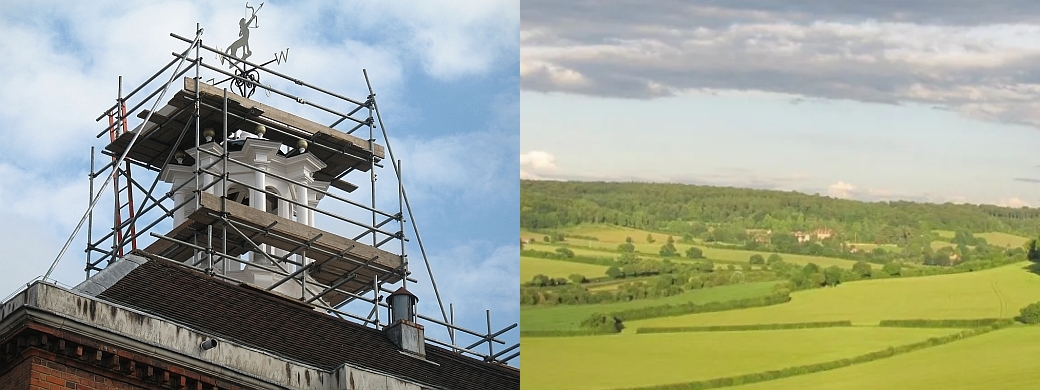

 I might have conveyed the impression in my last that the world has to be put right in order to provide the conditions in which we can live happily. I really think the opposite: that the world has never been better, and never worse, than it is now. We can do our little best to try and improve it. In fact we must. But the only yoke we are to take on our shoulders is, when seen correctly, a light one: to do what we feel impelled to do, as if to let the wind fill our sails, not to think we have to blow into them, which would be unproductive effort.
Of household chores my favourite is to hang out clothes on the line. We have three and they fill the backyard, leaving space for the little birds to feed and flit and flirt. No bourgeois landscaping is needed. Ivy creeps over the fence from next door and that’s enough greenery but we might plant a few herbs. There’s also a bench, which I hope will be kissed by the summer sun.
 My favourite poem is about a clothesline. Lawrence Ferlinghetti wrote it, and reads it here. It begins:

What’s so special about hanging out clothes? It connects us to the wind and clouds and sky, as do those chimney-pots. These are the time-hallowed things, the time-hallowed chores. As a child I had the task of laying fires each winter morning: poking out the ashes from the grate, splitting the kindling, laying it on crumpled newspaper, placing small lumps of coal on top. It was a primitive skill which gave a primitive satisfaction, as John Cowper Powys celebrated in more than one novel:
“The lighting of his fire in the morning, the crackling of the burning sticks, and their fragrant smell, gave Mr Quincunx probably as much pleasure as anything else in the world.” Wood and Stone, page 80.
 I have to stop myself. This is still not what I want to say. I don’t want to imply that the old times were better. Every generation has said that, looking back to the Golden Age of its youth. I may pity my grandchildren for being born into this new century, but they may look back on this time with nostalgia too, and it doesn’t mean that everything is constantly getting worse.
The irredeemable state of the material world has ever been the springboard to the spiritual life; it may act as the bully who pushes you into the pool of Providence, to sink or swim.
I’m not familiar with the Spiritual Exercises of St Ignatius of Loyola. I had a quick Web-glimpse and that was enough. Perhaps the Jesuits still practise them, but they seem out of date. To hang out the washing, to see it billowing to a background of trees and sky, this is the spiritual exercise for which I feel daily gratitude. It makes a connection. It fills with joy.
By some perversion of common sense, the rich countries have all but abolished physical labour. When we bought this house the previous owner urged us to buy his dishwasher, which was fully installed in the kitchen, but we said no. They took it with them, leaving a gap and a tangle of pipes. We could have put an electric clothes drier there but refused that too, preferring the time-hallowed dignity of chores. Why buy labour-saving machines? Then your body has excess energy which you need to spend on the labour-generating exercise machines in gyms, for which you have to work and earn. Is there dignity in work? Yes, if you live in the Third World. Otherwise, I am not so sure.
 As I said, things are no better and no worse than they’ve ever been.
Profit takes dignity from work, esp. if others are used. Profit is acceptable to develop products but this Information Age could inspire service to become a not-for-profit consideration of consultation that could free us from taxation ~ but I have a self-employment idealism that is beyond ME so excuse my reaching.
Your imagery inspires such deep feelings (of maintenance magic of the past) thanks
I've linked you up again, Vincent.
I love this post though I admit to being at a complete loss with domesticity.
I'm once more reminded that I must read Powys when I get back. 🙂
my favorite memories are hanging out clothes on the line as a child.. and watching the horses run and play as i hang out the clothes.
Why do i have a dryer? i need to dump it and put up a clothes line. yeah!
oh dear, housework is not for me! I find plenty of opportunity for labor in gardening, in painting rooms and learning to repair things… and of course, in cooking (from scratch, always!). Cleaning, laundry and such fills me with dread!
Vincent, very impressive writing, the whole thing is a metaphor, you have taken words and strung them out between trees across a backyard of wonderful scenic proportions, and on these clotheslines you have hung your heart and mind in the winds of the Truth and Spirit to restore to us the righteousness and simplicity of being human
Hayden* LOL funny! 🙂
After the ecstasy, the laundry.
–Jack the Stripper
Siegfried*
Jack the who? LOL
Jack the Stripper is Jack Kornfield.
[I recall that V, or “Siegfried”, was Dutch, and it may be relevant to mention that the Dutch Wikipedia article on Jack Kornfield has an explanation for the “stripper” epithet, one which isn’t clear from the automated English translation.—Ed]