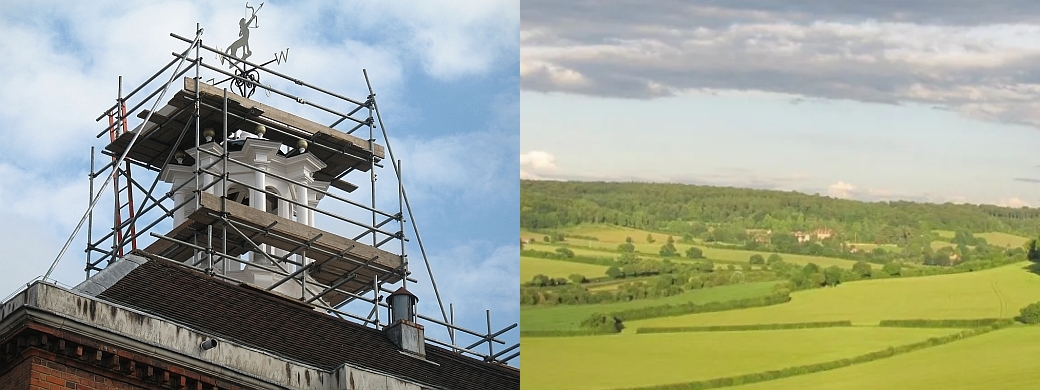


A few miles from here, the Wycliffe Bible Translators nestle in a spot near the woods, in huts that might have once been an Army camp, but have now been landscaped into a cosy village from which the Good News is spread worldwide. Jesus in his time couldn’t speak loud enough to be heard by all the five thousand who followed him into the desert; not unless that was a miracle too, along with the five loaves and two fishes.
Is there actually any good news to tell? Is world-wide communication the answer, and if it is, what is the question? My train of thought was set in motion by Joanne. In her blog she asks “If you had the entire world’s undivided attention for just a minute, what would you say?”
We now have our chance to speak to the world. It’s called blogging, but the more voices, the more the world’s attention is divided.
The Greeks had an art called “rhetoric”: how to get your point across. In its modern form, it’s one of the most studied today, all because of competition: everyone’s selling something, and they all want someone’s undivided attention. When they ask for mine, I seldom give them the full minute.
But, says Joanne*, what would you say? I know this question occupies Jim* a great deal too: not so much what to say, but how to say it. He apprehends life mystically, finding it wondrously intricate, just as scientists do on a parallel path, using different methods. I’m grateful to be in that good company, along with Blake and Wordsworth and a host of others: potentially everyone.
Would God that all the Lord’s people were prophets, and that the Lord would put his spirit upon them
A prophet is “a divinely inspired interpreter, revealer, or teacher of the will or thought of God or of a god; a person who speaks, or is regarded as speaking, for or in the name of God or a god.†” These days it includes pretty much everyone who has something to say. But is there value in their utterance?
Since God was completely unknown and eternally silent, He could be endowed with whatever traits one elected to hang upon Him. (Isaac Bashevis Singer)
If our words are to have any value they must come from a deep place—what Singer calls “private mysticism”.
I was listening on the radio to a discussion on Wordsworth’s The Prelude. He was very free as a child, wand’ring lonely as a cloud amongst the mountains and wild daffodils of the Lake District. He lost his mother at eight and his father at thirteen, becoming the adopted child of Nature which sustained him and flowed through to his poetry. In this blog I have tried to convey how much I have been sustained by trees and clouds and everywhere that the sun illumines, or the rain washes with its tears of joy.


Others get the same thing (as far as I can tell) from holy books. In this post I referred to the Bible’s magical qualities, and I think I explained why that doesn’t make me a Christian. It is obvious that the holy Koran nourishes and protects my neighbours, for many of them have texts on their doors in expressive Arabic calligraphy and you can hear the equally expressive recitations from the Mosque. I don’t know any Arabic, but I perceive the power. And I see that Islamism, as they call the bad side of Islam, is merely the mirror-image of Christian cultural imperialism—and militant Zionism. When one stops threatening, the other will too.
When I turn to the Bible, it’s only when it calls me: the same with Nature.
* PS 28Apr18 re Joanne and Jim: I would have linked, but their blogs have not survived.
† definition from Oxford English Dictionary
 a wayfarer’s notes
The question originally occurred to me because I was thinking about how it seems like those with loud voices speaking mostly about intolerance in the name of their God seem to command so much attention and given a great deal of weight…I wondered if a more “common” messenger were granted just a moment what would he/she say, if anything?
Perhaps it is a moot sort of point, all the words in the world don't change what lives inside the heart. Words are a reflection of what lives inside of us, what we nurture, what we center on. Perhaps it is more important to do an honest looking inward of what it is we are choosing our center to be.
Thank you for thinking this through so thoroughly.
LikeLike
Thanks Joanne for your comment. I have not thought it through thoroughly though. I mean there is plenty more for everyone to think, here.
It occurs to me now – for you have a wonderful ability to pinpoint important anomalies in our common life – that the loud voices and intolerance are symptoms of sickness in the societies in which they occur.
When garden plants don't have optimum conditions – e.g. not enough nutrients or drainage – they become susceptible to diseases. And so it is in human culture.
To those who can hear it, the loud voices are speaking very clearly of that sickness, just the same as a mother can hear very clearly through the cries of her baby that something needs attention. Therefore there is no need to demand of the baby that it do some honest looking inward and then say to its mother in perfect English “I have fouled my diaper, please change it”. That message is already conveyed.
The baby's cry is indeed painful to the mother. It is disturbing and becomes quite intolerable, so as to wake her up from slumber. When she has woken, it will be the stink that guides her to the place where her attention needs to be focused.
For this reason, I see no problem in the loud voices of President Bush, Osama Bin Laden etc: voices which use bombs as exclamation marks.
The problem occurs if and when we believe what they say. They are unconscious messengers. It's their noise that signals the truth, not their words. The baby's cry, if unattended, seems to signal an extreme of suffering, but actually we need to see that it's just to direct attention to the right place.
Unfortunately as I've suggested in comment on your blog, Joanne, those with loud voices are exploiting our built-in quirks. They know where our susceptibility zones are. They know how to press buttons and get the reaction they want.
So yes, you are right, it is we who have to learn to see clearly what is going on. We don't have to choose our centre, but find where it is (I know that is what you mean ) and protect it from being tweaked by words like freedom, democracy, God, evil.
LikeLike
Maybe one could say, rote living, living by habit, even to the extent of words and sounds losing their TENSIVE nature, is dead living, sounds and their words, their messages should be alive, richly and always enterable and clear as crystals, continuums of reality posed, spaces to be investigated, explored appreciated and understood.
This is a great and worthy post (not that your others are less), Vincent, you are always true to your natural appreciation of what life could and should be, an open door, a choice to fulfillment with the choice never narrowed into deceits and harmful intentions.
And I agree that these voices of our leaders are sounds of alarm, even as they themselves lean to noise and confusion, they are no different from us all.
That post of Joanne's was a wonderful opportunity, I have not forgotten the pleasure of that opportunity and the hope it inspired, the livingness of it, the invitation and wonder of it. I thoroughly enjoyed it touching me.
And these very things you speak here, and Joanne in her comment, and you in the reply, and you in the comments to my posts of late, all giving hope, all a breath of fresh air by the opening of the door, however short, however long, the hope living, the contrast seen, the possibilities wonderful.
Very fine work and eloquent, and eloquence invites entry, beauty invites understanding, and the context that becomes apparent supplies the knowing even in its' silence, even in its' quiet.
I would the grasses and trees would speak, the rocks and the hills, the mountains shout to tell the tales and show the way, but for the moment it is us, us who have to cry and speak of days to come, let us hope sooner rather than later, even Daniel cries this in the face of overwhelming odds, and so he still is sounding.
Thanks for all the inspiration and encouragement that I derive from you and also from Joanne.
LikeLike
yes i am:)
LikeLike
i prefer experiencing something rather than anything else. talk is empty without the vessel of experience.
LikeLike
Yes, Vickramthevar, but until you tear yourself free from the cult, you won't know the difference between your experience and your belief.
LikeLike
Vincent, I have those 2 blogs under my links section on the left side…from your comment on my “water bowl” post in my rightorrong blog…
thanks for checking it out
Jon
LikeLike
oh thanks jonbeme. I should have checked more carefully before asking you these lazy questions.
LikeLike
interesting…
LikeLike
I think the experience fact is made more real thru a stronger word/orientation to and with it. To me, the experience should be always highly alive and filled with newness and discovery, and this is available thru a 'real' appreciation of any experience on the verbal level of sensations and explorations.
LikeLike
I'm not sure that speaking has ever had as much influence as example. We believe what we see modeled… there is wisdom in words, but there is embodied wisdom in actions.
By extension, including Jim's comment on dead/rote living – empty living is an empty example. In my recent reflections I've realized that it is those few who have modeled their beliefs in their lives who have most influenced me – and they are the ones that seem to me to be most courageous. Yet they did not 'preach' or tell me how to live, they simply allowed me to see how THEY lived.
LikeLike
Hayden certainly makes sense Vincent, example over mere lipservice is best.
I am talking of speaking with more dimensions, more meaning, more fullness, so as to impregnate the air with life. And I do know the difference between wishful thinking or idealism and real life, I just think real life can be more.
LikeLike
I enjoyed this post. I too liked what Hayden said. yep action speaks louder than words. Buddha said: “Better than a thousand hollow words, is one word that brings peace.”
LikeLike