
My most vivid memories are not of the first days at my new day-school, as you might think, but of coming back home each afternoon. I’d been five years at boarding-school and could not imagine a greater luxury. Let out at 3.45, I’d arrive home from a country-bus ride, ravenous. My mother let me cut “doorsteps” of fresh white bread, butter and golden syrup: perfect.
Then I’d settle to do my homework at the most convenient table. This was a Singer sewing-machine in the bay-window of a large room next to the kitchen. It was the guests’ lounge of our lodging house. They had their dining room and their bedrooms, some of them sharing. We ate in the kitchen. This lounge was a comfortable makeshift, a kind of men’s common room. It wasn’t as extreme as the mess-room that my stepfather Blackett recalled from his sea-voyages. There they had a huge teapot, emptied only at the end of a voyage, if he is to believed. You would keep adding spoonfuls of tea, then boiling water direct from the ship’s steam-pipes. There was a communal teaspoon suspended from the ceiling by elastic.
I liked the Singer table. The machine itself could be swung out of sight leaving a flat surface; and a restless child could work the treadle to a fine speed whilst reading his textbook, for the belt hung disengaged and no one could tell you off for it. It was delicious to manage my own time and not be supervised for my parents were busy enough with their new marriage and the house and adjusting and looking after the boarders. I felt this freedom anew yesterday morning, the first working day since 5th February that I didn’t go to MaxiRam and try to guess what they wanted of me.
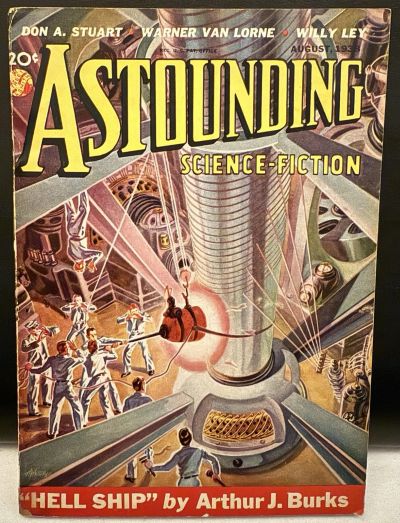
It’s not the homework I remember but the restless distractions I allowed myself. I started by inspecting the little drawers on either side. In addition to the usual sewing-machine attachments, little engineering marvels like the grisly surgical instruments I’d seen in a glass case at the hospital years before, there were loose senna pods, pill-bottles, tarnished coins; not interesting in themselves but conveying a history, this room’s past. Who was the hypochondriac who left these things in the drawers? Perhaps Satterthwaite, the man who’d run off with Blackett’s first wife. The best thing I discovered was a cache of Astounding: American science fiction magazines. One story was “the Man who hated Tuesday”. Another was about a subway train which disappears along with its passengers because its engineers have inadvertently constructed the tunnels like a Möbius strip. Both of these stories (I see from the Web) have been made into movies: worthy homage to a potency which has kept them lodged in my memory for fifty-three years.
 The SF magazines weren’t Blackett’s. His favourite reading was Popular Mechanics, also from the States, which got me interested in crystal sets: radios which required no electricity or loudspeakers. He gave me a crystal and a piece of phosphor-bronze wire to make a “cat’s whisker”. I also cut a whisker from our cat, to test if the real thing might give better reproduction. I’m glad to report that when I acquired a Spanish guitar, with nylon strings, I didn’t eviscerate the poor animal to see if a more authentic sound could be obtained from real catgut. Blackett took me to a friend of his who had a maze of connected sheds in his backyard with a great collection of coils, condensers, valves and other components mostly stripped from aircraft, so that I could get the bits I needed. Ah! Children have endless hours to waste on developing specialised skills. Some kick balls around, some do clever things on bikes and skateboards, a few become prodigies on the piano. And I? From the boarding-school, from my grandfather, I had learned nothing of how things are made, and probably looked down on such learning. I’m grateful to Blackett for the new world I entered. His passion for engineering came from a frustrated career, already declining when I met him, having never amounted to much. He saw himself as an inventor with an encyclopedic mind, but ended up little more than a document controller in an aircraft factory, an unqualified autodidact. Through his influence I devoured the truly encyclopedic Amateur Mechanic in four volumes by Bernard E. Jones. You could build your own house, make your own paints and varnishes, cure and mould rubber stamps, make pumps, dig wells, turn metal on lathes—all with the help of Mr Jones’ detailed narrative and figures. I was a sponge to whatever reading-matter came to hand. Since then, I have believed it possible to make anything, mend anything: and proved it too.
And now I remember a magnificent gift from Blackett: the chronology escapes me but I flew it in Granny’s large garden. How could he have brought it there? It was a scale model with 4-foot wingspan of a Russian MIG-9 fighter in balsa-wood and doped tissue-paper, built by a friend of his. Its hollow fuselage was quite a novelty: a jet’s air intake at the nose, nozzle at the rear. There was space for a little diesel engine and propeller to be concealed inside and keep the illusion that it was a jet. But I flew it as a glider and mended it every time it crashed.
Involving me in mechanics had a hidden agenda for Blackett. Not only was he a failure at work: he had taken huge blows as a husband and father when his whole family ran off to Australia with Satterthwaite. For her part, my mother hardly made any attempt to conceal her superior social class. Who else could Blackett be superior to, but me and the cat? So he belittled my advanced literacy. “The future lies in electronics” he pronounced: and was not wrong. Over the years, we became sullen rivals. He would admonish me to respect his tools and obey my mother. I would silently judge his inadequacies. My mother always craved male attention and had no idea how to be maternal. The best I got from her was to be accepted as her young male companion, a friend when no others were to hand: someone to amuse her and be her source of pride. How could the males in her house eye one another without jealousy?


 I won’t say machines have shaped my life but they’ve sat there as dumb witnesses while I have gained more skills with words than physical materials. That room with its Singer treadle machine and pile of Astounding and Popular Mechanics was an echo of another room from an earlier phase of my life: the one in which my grandmother taught me from Reading Without Tears. It had been built as a bedroom but other floors had been let out to tenants so my grandmother converted it.
  She divided it with folding screens: one-third kitchen, two-thirds dining-sitting room. She had a sink put in with a little high window above. Post-war austerity dictated everything. She had a haybox to minimise use of gas. When your pan of potatoes boiled, you fitted it snugly into a space in this chest and closed the lid. They were cooked soft within the hour. In the other part of the room were the sofa, the dining-table, a china cabinet with a nodding Mandarin and other treasures, such as a bookshelf with her brother Llewellyn’s school prizes bound in calf. One was William James’ The Varieties of Religious Experience into which I dipped when still too young.
But when I sat still learning to read (without tears) she would get out her  sewing machine. You had to turn with one hand whilst guiding the material with the other. She was always bottling fruit and knitting and telling me what fungi and berries were not good to eat and other lore.
In fact my grandmother and Blackett had a lot in common. His metal and Perspex, her food and clothing. Instead of a Merchant Navy teapot, she maintained a perpetual stockpot; at any rate the room reeked of old mutton-fat. She taught me to knit, before I found out it was not a skill for a boy to be proud of. Making and fixing are manly skills which still serve me today.
 a wayfarer’s notes
Vincent,
Your tales of Blackett and mechanics remind me of my neighbor and my Uncle.
My Uncle Homer (my Father's brother), was an electrical engineer. He had many hobbies that involved electronics in one way or another.
He had a large bank of WWII ham radios tuned to listen to chatter from all over the world. You could go down the rack of radios plugging headphones into random devices listening to people speak in foreign languages and occasionally English (many with accents).
I would do this for as long as I could get away with it while visiting their home.
He would also take driftwood, combined with abandoned parts from all kinds of devices and make lamps. My family thought they were hideous, I loved them.
He made binary clocks. They used 10 lights to indicate the numbers of the binary sequence(1, 2, 4, 8, 16, 32) and the values of the lights are added to determine the time. There are two rows of Lights – the top row for the hours and the bottom row for the minutes.
My Neighbor was an artist. I spent many hours with him while he worked. He taught me silk screening, painting and drawing techniques. He also had a passion for airplanes.
He and I built a Navy Hellcat fighter plane that was gas powered and worked on control lines. The control lines exited the plane at the tip of the left wing. You would stand at the end of these lines holding a grip that had the 2 lines attached to it. By raising and lowering your hand you could gain or lose attitude.
Although flying of plane was fun, the real joy was the construction process. We worked on that plane for several months.
I enjoyed the whole process, building the balsa wood structure of the plane, layering the skin on the bones of the plane, assembling all the mechanical parts.
He taught me to use an airbrush to fade the light blue bottom of the plane to the darker blue that was featured on the upper portion.
I painted the pilot with great care as well.
He added a pinup girl to the front of the plane that added some much appreciated character (especially for a teenage boys perspective).
He and I spent many days flying this plane and then repairing it after mishaps.
I too like to believe I can “fix” things. But I tend to be clumsy. So sometimes I make it worse before it gets better.
LikeLike
Ah, Charles, we learned things in those days and we interacted with people and we were like sponges. Now, children play on computer games too much, and when do we hear about any kind of “Popular Mechanics” that a child could take an interest in?
LikeLike
I loved the balsa wood planes, built many, alone and with friends. That was when 6-10 years old perhaps, maybe eleven.
The crystal radio used to go to bed with me, fascinated with that, seems like i use to fasten a wire to the radiator for ground, still fascinated with the thoughts of it, liked it better than the later TV.
Pop Mech, shortwaves, world voices, all very sophisticated and expansive vistas, loved them all.
That sewing machine is also a memory for me, all the way to my teenage years, we had one that wasn't used but, like yours, contained great treasures and made a great drawing table for me.
I tried to sew, I did knit, I did needle point, all skills that signaled art as a thing for me, something challenging for my eyes and hands and mind.
Such things, such content, such times of pleasures seem far away from today. Thanks Vincent, enjoyed it.
LikeLike
Yes, Jim, I came to many of these things later than other boys as my development had been somewhat arrested by circumstances. I've never really caught up, in fact. I tend to find most in common with people ten or sometimes 20 years younger.
Thing is, when I start to think of it, memories flood back of fine detail, e.g. the MIG fighter (it had a 4ft wingspan!) and the sophistication I tried to introduce into my crystal sets. It helped when the germanium diode became available: one less thing to worry about. But largely I floundered as I realise that Blackett didn't actually help me build them and some of my ideas were quite impracticable.
For example I tried to replicate a device from Practical Mechanics for the front of a radio set using brass studs as contacts and a central arm to revolve like a clock hand and touch the one you selected. Instead of plywood or bakelite – both rigid – I used a thick sheet of rubber (you could buy them from Woolworths to cut heels for any size shoe). It was thus impossible to gain a firm contact, but I tended not to give up and thus wasted many hours. With adult guidance my tenacity might have achieved much.
LikeLike
Charles, You've reminded me about short wave radio. We didn't have any special equipment but I used to listen to short wave and even try to unravel the Morse Code, though it was much too fast for my ear.
LikeLike
It just struck me that the dialogue we have in the comments section of blogs is often deeper and more open than in person contact.
Particularly if you consider that we have never met in person.
Is it a more civilized, less inhibited conversation? Or have we simply found people we feel comfortable with, that share our sensitivities?
I'm not sure, but I think it has to do with writing versus the spoken word. I think the same can be said of email, or writing letters versus phone conversation or in person discussion.
One thing that may contribute to the easy nature of our conversations here is that we are learning about one another in an environment where there is no competition, no demands, no expectations.
We are free to express ourselves without concern for our safety, well being or livelihood.
While this may be the case with our friends and our family, we are concerned about our relationships in a different way. This is not to say that I don't treat those I encounter in the web sphere as friends, often I do.
I certainly feel close to you Vincent, as I have come to know you as well as I can through our encounters here. And yet, there is much we don't know about one another. This medium cannot replace personal contact.
Perhaps someday I will meet some of the people I have encountered in this way. I wonder if it will change our impressions or re-enforce them?
In any case I am happy to have had this experience and I have benefited greatly as a result.
I would like to send my thanks to all who have contributed and shared their experiences here. And especially you Vincent for your generous contributions and for allowing us to participate.
LikeLike
clearly, it shows you were enjoying every word that you were typing. it was such a wonderful write-up that i was encouraged to come up from my self-imposed rule of not commenting on your blog with more than two lines.
i must say, i enjoyed every word of it as you enjoyed writing it. and i picked up so many new words!
on your children being sponges, well, i must tell you vincent, it was the same case even twenty years back. when we were kids and the world had not seen the explosion of computer or TV, at least in India. can't make you believe how much experiment i have had with a simple ball-bearing or a simple wooden plank when i was a kid.
vincent, you stirred up so many happy memories with this post! i have many things to learn from you. the most important of all is your zeal for life. sure enough, your love for life is contagious.
i love your blog vincent. please don't stop. God bless.
LikeLike
Ghetu, your comments are like glittering prizes. It is gratifying to know that one is succeeding in the particular direction that one is trying to go.
For some time I have had precisely this objective, to collude with the reader in the way that you describe, making the subject-matter not my life, for those events which I describe are already washed away by the eroding sands of Time: but to draw attention to Life itself in its teeming diversity. Life is what we all share, like a variety of animals gathering to drink from the same lake in some African savannah at dawn or dusk.
LikeLike
It is the reader who takes the words and makes something of them, the reader's life which makes them worthwhile.
LikeLike
And Charles it is not a question of allowing you to participate. Without your participation there would be nothing. You are the co-author.
It is an interesting point that you raise about the difference between this form of correspondence and actually meeting in the flesh, for I have encountered several friends by this method whom I have later got to know face-to-face. It seems the most natural and true method to meet people. It is intimate and without certain distractions. You could say it is soul to soul.
Whether or not we do actually meet in a room, or walk together under the sky, this connection can last a lifetime. We will always remember how magically it started. The Internet allows us to fly across distance!
LikeLike
I have never remembered the morse code on the short wave till now, goodness, how that was!
Great metaphor Vincent, the blogs and comments likes the lake and we all come from our own places to drink and refresh, very good. And it is like that exactly.
Also the explanation of your aim, most exceptional, most excellent, and it truly works, you do achieve it and are all the time at it.
I have heard of people meeting in person after some time of blog acquaintanceship, but never have I heard an evaluation of the experience regarding the comparison of impression. Of course that might just be too personal for the writer to put forward, not so much about the other, but very too revealing about the writer. Don't know.
Lots of good points and realizations being made here, a very good discussion of the act of blogging, maybe best I have read, most real to me and in depth.
I have recently come upon some nearness to the experiences of children in India, Pakistan, and those areas, and I am amazed at the differences and yet the samenesses relative to us in the US and your nation. I enjoyed reading what Ghetufool had to say, and I agree with his remarks about your work. Likewise with the others that comment here.
Thanks all.
LikeLike
Thanks again Jim, your faithful encouragement has been and remains something precious.
At its best, the soul-connection established through Internet correspondence can be followed up without a hiccup or hitch by the actual meeting. There are stories to tell about that!
These runes inscribed on stone or shown as patterns of light on screen are magical as you know Jim from those Kabbalistic studies which are too deep for me to understand. They are spells by which we can tune to one another.
I continue to edit and refine what I post here for a day or two after it first appears. As in Puccini's La Boheme (see my next) there is an impatience that drives creation to manifest without delay!
LikeLike