
Recalling materials for a memoir is like being an archaeologist. Sometimes you have to make do with nothing but a handle, or a spout. From this you deduce and reconstruct the rest of the jug whose fragments have been ground small by Time. Painstaking effort must be aided by guesswork, for you don’t have every piece of the puzzle. So in these notes, the snippets of recall light up the darkness of oblivion.
Fantasy can be stronger than reality. It’s as true for a sleepless child in a boarding-school dormitory as for a monk in his cell visited by a succubus. Sent to bed when it wasn’t yet dark I would see through the window giants fighting, like a Punch and Judy show. It was tall elms bending in the wind, their heads knocking together, their jaws silently shouting.
On nights when the other boys were sleeping I would invent images of gratification. Two of these stick in my mind, from when I was eight or nine. The first was simple enough. The scene was the Green outside my home. It’s an expanse of public grass covering the West Hill, where children play and adults walk their dogs, beneath the mournful cries of wheeling gulls and backed by the glittering sea. There’s a playground there still, with swings and a little roundabout and a bucking “horse” big enough for five children to ride. Best of all the attractions is the cliff of sandstone rocks, carved by Time and the limbs of generations into ledges and galleries and crevasses for children to clamber dangerously.
Lying in my dormitory bed, I’d be riding my own horse, a great Shire such as brewers employed to draw cartloads of barrels. Though I could ride it on the beach or through the woods, I chose to canter and gallop in circles around that playground on the hill, showing off its flying tail and mane. The rough boys of the district scattered beneath my charger’s feet, with the respect due to a knight.
Enough said about that fantasy! But the other one was more curious. A certain toy was popular at the school: the “John Bull Printing Outfit” consisting of wooden blocks with grooves to take type, in the form of letters and punctuation marks made of rubber. With tweezers you could place your letters into the blocks to produce a galley of type to press on an ink-pad and thence to paper. Adults also used it, to produce ad hoc rubber stamps.
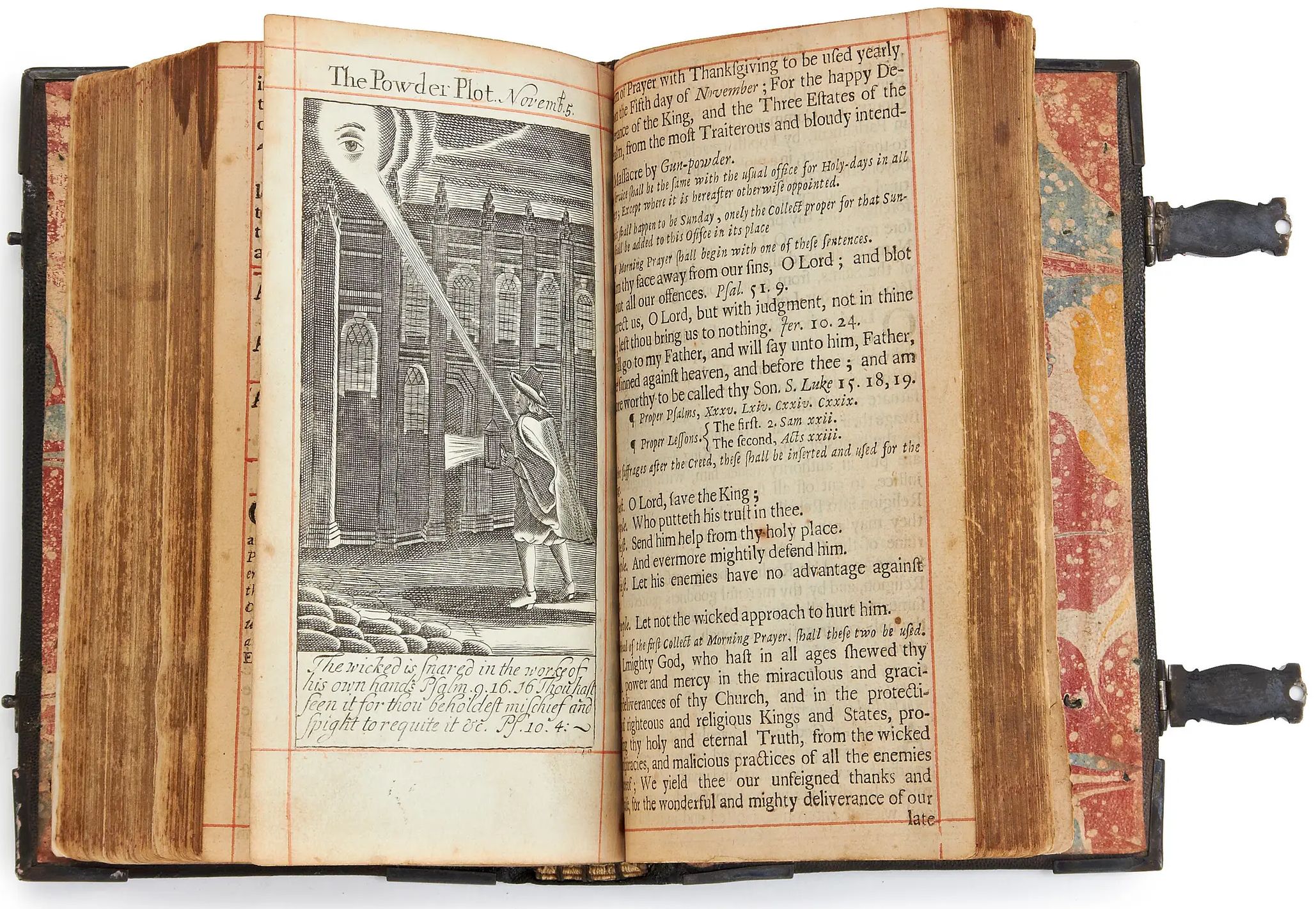
In nocturnal fantasy I used a printing outfit to produce a special edition of the Book of Common Prayer. This with Hymns Ancient and Modern was one of the two books the congregation used at the village church, as in every Church of England service in those days. It goes back to 1550 and it’s famous for graceful language:
Lighten our darkness, we beseech Thee, O Lord; and by Thy great mercy defend us from all perils and dangers of this night; for the love of Thy only Son, our Saviour, Jesus Christ. Amen.
Typically a prayer book was in tiny print, but this did not deter me from selecting it as the first publication of my magical printing press. Later, my mother acquired a small typewriter and touch-typing manual, with the intention to equip herself with secretarial skills. This was after she had left my stepfather and returned to my grandmother’s house, a move which lightened my own darkness greatly. In the holidays I constantly begged to use this machine, just for the sake of printing words on a page and admiring them.
I confess that the fantasy of making a book has never left me. In ’72 when I lived in a hippy commune and made a great Dragon on my wall in charcoal (to be painted with iridescent scales) it was about composing Illuminations, a compendium of my choicest mystical encounters, drug-induced or otherwise. In the early Nineties commuting on the London Underground I scribbled notes for a mighty tome called Seer and System, a humanist-mystical method for designing computer systems.
Nothing much seems to have changed.
 a wayfarer’s notes
I had some kind of printing toy when I was young. I don't remember all the details.
But it was sort of like a type writer. It made impressions on a sheet of rubbery plastic kind of like what those labeling machines use.
You would then stick the sheet onto a roller and insert into a device. Then place a sheet of paper in one end, turn a crank on the side and it made an inked impression from the cylinder onto the paper. In that way you could print many copies of what you typed.
It was all kind of cheaply made and didn't last for very long with the wear and tear a kid can put on it.
But a neat idea.
I tried to start a neighborhood paper with my friends. We went around gathering “news”. I typed it up using my toy printer, printed copies.
We ended the newspaper before my printer wore out. We got in trouble for printing some “gossip” that was not meant for distribution.
LikeLike
More and more I find reading your stories sparking certain memories and thoughts for me, and it occurs to me that I suddenly realize the importance of memoir, not merely a documentation of one individual life, but for how it connects lives to the lives of others.
Case in point as I read the charming comment Charles has left, which has caused a wide grin to break out on my face as well as I recall my ventures into a little newspaper when I was a child as well.
Wonderful work, Vincent.
LikeLike
Yes, yes! To encourage a sense of how similar we are, how we tried to cope with whatever situation we found ourselves in, as if we were brothers and sisters displaced like orphans fostered to different parents, that is the intention of these memoirs. We are joined in the universality of our membership of the human family!
LikeLike
Vincent, fantasy is a means to an end, not an end in itself, at best that is; at worst, fantasy is a hole dug that one can't escape from.
Yours is obviously a means to an end, keep writing, it is your means to your true self, and that is the end of death and the beginning of Life.
Doubt all you want, I will do my best to answer your comment on my blog and so, hopefully, to inform you, not convince you, you will know when you know.
Keep writing, my friend Vincent, we all depend on it.
Thanks for all, see you later.
LikeLike
It's fascinating how you, Charles and you, Serenity, both played with the notion of printing and publishing as children and now do the same in blogs.
Let childhood never end! What is age? I feel so young, so disconnected from the notion of age, actually. I wish children may teach us how to live. I don't mean that in a sentimental way.
And Jim, thanks for your faithful and continuing encouragement. It means a great deal.
LikeLike