
 I was admitted to hospital in January 1949, before my 7th birthday, as covered in a previous post.
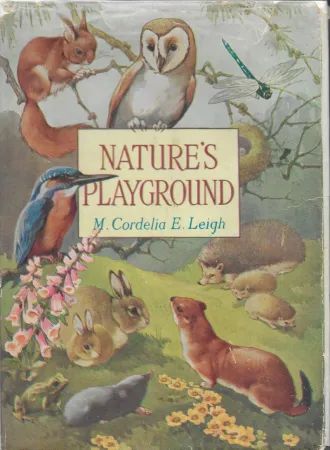
When I reached home from hospital I was pleased to find I had a proper bedroom. Well, it was my baby sister’s room. Her cot had been moved to my parents’ room and I was assigned a mattress on the floor but I luxuriated in its sparse furnishings and relative comfort. I soon found two interesting books on a shelf. One was Nature’s Playground, by M. Cordelia E. Leigh. I recently found a copy in what’s known here as a “car boot sale”, and discovered I almost knew it by heart. 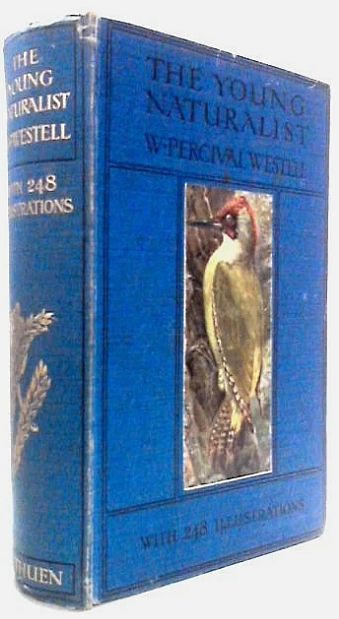 The other was The Young Naturalist, a Victorian volume illustrated with engravings. It showed how to heat minerals using a Bunsen burner making its flame hotter and more focused with a blowpipe. It showed the larva of the caddis fly which encases itself in twigs, sand, little stones and snail-shells. I was fascinated by the terms used for the stages of an insect’s life: larva, pupa and imago, especially the latter. My grandmother had only taught me caterpillar, chrysalis and butterfly.
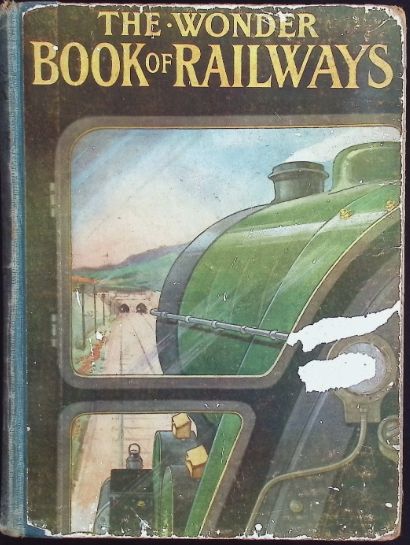
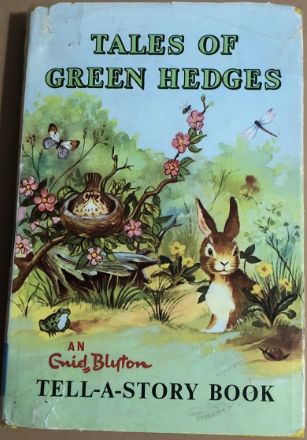 I can remember the books in my life with almost photographic precision, especially around that time when I was seven. I used books to blot out other things. When I recall a book, an image springs up of the place I read it, or vice versa. The rickety camp-bed in the bathroom is associated with Enid Blyton’s “Mr Twiddle” books, and a magazine she published called Green Hedges, named after her house in Beaconsfield, not far from here. There were two other books which I used to peruse for hour after hour in that draughty bathroom: The Wonder Book of Railways and especially The Wonder Book of Ships. It wasn’t a conscious thing but I see now that I was recapturing the feel of that journey to England on the mv Rangitata, and discovering that others, at least the author Harry Golding, found something fascinating about ocean liners. I was in a dream, reliving that fateful journey, escaping the present.
The strange atmosphere of The Young Naturalist was reflected in the rest of this tall narrow house: our part that is—the ground floor was let to tenants. Our mantlepiece was cluttered with statuettes of maidens and swains leaning against tree trunks, objects under glass domes, spotted mirrors in gilt frames, a large round table-top leaning against the wall made of dark marble with a mosaic of Pompeii’s ruins; dusty books lining the stairs. I remember Shakespeare, in a row of separate volumes, and The Waverley Novels, Vol I, Vol II etc. Had they been titled properly, like Ivanhoe by Sir Walter Scott, I would have blown off the dust and taken them down, because I had heard of Ivanhoe. I recall the day, left alone as usual, when I took down Hamlet and started to read. It started with the gate of a castle and Horatio knocking at a door. I was convinced he had said “Who keeps the gate here, ho!” but when I check the Net I discover this was Bardolph in Henry IV Part 2. I must resist this temptation to check memory, which exposes eddies in my space-time continuum, and elements of fiction which creep in against my will.
 My favourite thing in that house was a
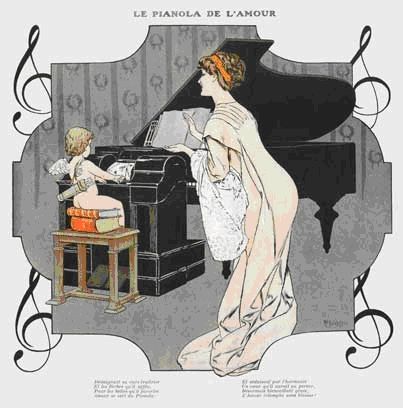
  pianola. It was a dark box with domed top, wheeled in front of the upright piano. When it was in place I would get up early in the morning and play Polonaises by Chopin or Songs without Words by Mendelssohn. All you had to do was insert the roll of paper with holes for the notes, and operate the pedals which powered bellows. Little felt-covered “fingers” would hit the keys and you had music. You could vary the speed and loudness with little brass sliders. It had felt-covered “feet” for the piano’s loud and soft pedals: a kind of Victorian computer in a mahogany cabinet. My parents got fed up with my playing early in the morning and wheeled the pianola back into the kitchen behind a great table on which sat a museum-display of tarnished cutlery and contraptions of a bygone age. According to my mother it was that kitchen which first pushed her in the direction of divorce, on the basis of “Keep it or me, you choose”. My stepfather, naïve at 53, had not imagined that a wife would insist on changing the furniture around, and was profoundly shocked.
She insisted on a full-size gas cooker, plus shelves and cupboards in red and white, and a set of saucepans. He only had one and it sat along with all the other kitchen equipment, on a table in the corner.
At 40 years old she’d never learned to cook. Her mother hadn’t either because they were middle-class and employed a cook. In Singapore they’d had a Chinese cook, and in Australia she was in a lodging housed of women. I remember her showing me how to make Batchelor’s Chicken Noodle soup
 a wayfarer’s notes
Consider please, Vincent, that it might be that, instead of 'escaping the present', you were (and maybe most readers of young ages were/are), recognizing the future, somehow I mean, like metaphorically?
I would love to have one of those around, even to hear it in the morning, especially those named tunes and more like them. I favor stuff like that and it is NOT nostalgia either.
LikeLike
when i was a kid i used to wake up the whole locality with my drumbeats. didn't go well with the non-musical people. they soon found a way to discourage me. they pursued my mother to hide my drum and i was never ever given one.
LikeLike
Early books seem to be remembered with the vividness of early dreams.
LikeLike
Jim your point about recognising the future is very provocative. Perhaps we have a destiny and we recognise it, for we are like seedlings that know what kind of tree we will grow into?
Ghetu did you later learn any musical instrument? You are not too old.
Yes, Paul, those early dreams were remembered partly because their themes seemed to repeat themselves, or I revisited a seemingly familiar dreamscape. It happened the other night: I dreamed my new house (the victorian cottage I'm soon to move to) had an ancient cellar, whose entrance was not within the house but in another street, and it had an archaic atmosphere, like the dungeon of a castle.
LikeLike