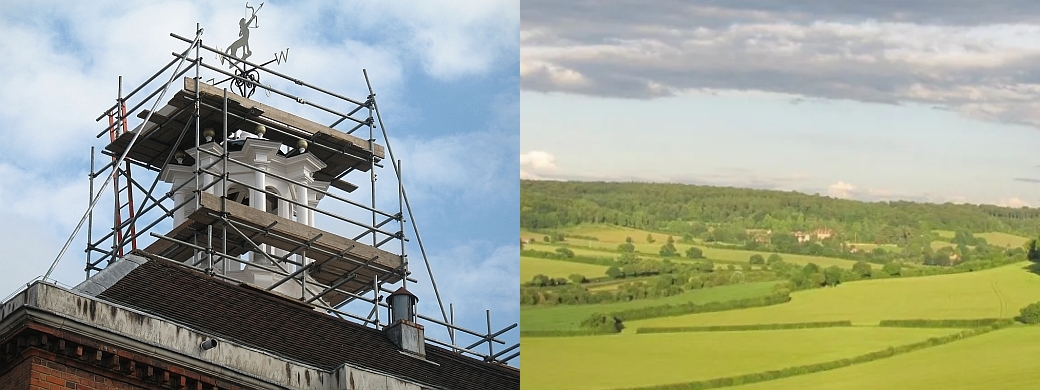


I can see out of my office window to an interesting landscape, though it’s blurred by a film of reflective sunscreen which they’ve stuck on the glass. It’s a view of a new residential development: little houses, roads, flags advertising the Marketing Suite, bulldozers, workers, drainage, dried mud. In the foreground is Peacock Farm, very ancient. They’re taking pains to preserve it. This is England, after all, proud to be ancient. I escape when I can to explore these exciting places. It would take a volume to record the feelings and memories evoked by their sounds, smells and visual impact. Beyond the building-site runs a highway, with a railway line running parallel, which I hardly see now that Spring has put leaves on the trees. The horizon is made of an artificial ski slope, with what looks like two spires behind it, the ensemble like a mythical castle. I must go and see it close up. But as in a fairy tale, there are obstacles to overcome.
A colleague invites me for lunch in the staff restaurant. As soon as I can, I skip out carefree, seeking a path to the fairy castle. I discover a little underpass which tunnels beneath the highway, runs beside the rail track, finally giving access to litter-strewn footpaths, which take you to places grand and squalid. There’s a recreation park for Hewlett Packard, with special jogging routes and tennis courts. It looks exclusive. Signs warn me to stay out, or else the CCTV will see my misdemeanours. I imagine them sending polite security-men in
grey suits and dark glasses. Then there’s a public recycling tip with the unusual sign, “No pedestrians”. I imagine being
accidentally bulldozed into a machine that compresses garbage.
———
 The following day I try again, this time over a rusting iron footbridge, talking to myself via the dictaphone. Francois Rabelais is on my mind. His character Gargantua founded the Abbey of Thelema, whose motto was “Do what you want”. Rabelais wrote in the early 16th century, when religion was in turmoil like today, with a great confusion of ancient authority and manifest corruption. You could see the Reformation gathering force like storm-clouds filling the sky.
I meant to talk about this philosophy of “Fay ce que vouldras” but it’s reluctant to express itself and I’m glad really. It has no need of formulation: just to be felt and lived. My true nature can be trusted to know what to do, so long as I stand on the bedrock of my uniqueness. I remain vulnerable and exposed in this world, but angels protect me. They can be trusted too.