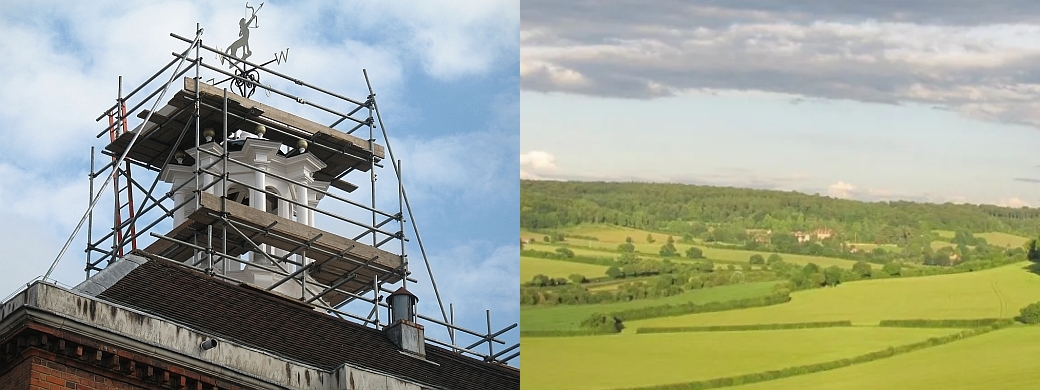

MaxiRam and Babylon Town were my code names respectively for the Fujitsu Corporation and the town of Bracknell, in Berkshire

It is the fate of beautiful English towns to have been raped by mass ownership of the motorcar. You can see the ugly scars: inner-ring roads, underpasses, flyovers, clusters of roundabouts, out-of town retail parks, vast parking lots horizontal and vertical; but you don’t expect them to have engulfed the entire town. Usually there’s an ancient town centre with its Guildhall, Corn Exchange or Parish Church. You might find in those precincts a Royal Charter (a few hundred years old) painted on a board, which permits the driving of cattle down the High Street to market on alternate Tuesdays, and licenses the fairs at Lammas and Whitsuntide where errand boys and milkmaids may be viewed for hiring. To wander the cobbled streets and see these delights, you must consign your car to the hideous Multi-Storey Car Park, or more virtuously to the Park-n-Ride on the outskirts, proceeding onwards by bus.
There is another kind of town, not so much a rape victim but an avid whore. At such a palace of harlotry, I went to meet the MaxiRam Corporation. Babylon Town nestles or sprawls in England’s Silicon Valley. A road sign told me I had reached the centre, otherwise I would not have guessed. It was more like a highway interchange in the centre of an industrial park. Office blocks and great barns housing retail outlets seemed to extend in all directions. “You are in a maze of twisty highways, all alike!”—as if it were the old UNIX text game called ADVENTURE. I could imagine the police regularly trawling the highways in paddy-wagons to impound any pedestrians, to maintain the smooth flow of motor traffic.
I lost my way a little but saw a neon sign MAXI-RAM atop a nine-storey building on the skyline, and snaked back and forth till I reached the megalith. Speaking into a discreet grille, I announced myself at the entrance barrier and was let in. The door to Reception was almost invisible from the outside, like a little hole at the bottom of a beehive. Inside was dim, vast and silent, like a hotel lobby in the closed season. I could not remember who I was supposed to see, so I told the receptionist the only name I could think of, Colin Heffer. Fortunately this was the right person.
The last time I dwelt in an office 9 to 5 was 1997. A colleague used to keep his desk and filing cabinet cluttered with kinetic toys, psychedelic hour-glass paperweights, insect-eating pot plants and a photo of his late-lamented dog. Things seem to have changed in ten years. This office big as a bowling alley was furnished with nothing but oblong tables – not desks – with not a paperclip visible, just a laptop computer on each. Hot-desking, I think they call it. There were no jungle plants, miniature waterfalls or goldfish, just one simple item of decoration: a cardboard logo hanging from the ceiling to remind the team of its client, the Office of Things in Transit, which I shall henceforth refer to as the OTT.
Henceforth? Yes, there’ll be more, as MaxiRam have hired me for several months starting on February 5th.
PS: I left out the most important thing, or perhaps I conveyed it tacitly: that is, the reason I titled the post “Mission to Babylon”.
Besides the expression “whore of Babylon” whose origin I have not even checked, I was invoking the Rastafarian sense of “Babylon” as the forces of worldly power which oppose Spirit, or the human spirit—I'm talking eclectically here and not from any dogmatic position.
Throughout my visit to the town, which I have labelled Babylon so as to frustrate the doggedness of search engines, I experienced a mild but continuous resistance to those forces.
The purpose of the post is not to boast that I can still get a job, though I do celebrate that with pride and relief, but to continue a theme which runs through every post in this blog. I will now express it overtly as well as tacitly.
Out of more than 130 posts, almost all have been inspired whilst walking under the beautiful sky. Unspoilt Nature is a never-ending source of ecstasy to me. But often I've not even explored wild footpaths: just journeyed as a pedestrian to some part of town, perhaps on a banal errand to buy green bananas and salt fish for a Jamaican dish. This too has been a source of ecstasy. Wherever I wander outdoors, the vibes seem good. Sometimes all it takes is to walk out to the backyard with some garbage for the bin: just tasting the outside air and feeling the cosmic rays may be enough. Yesterday evening I was sitting in the car waiting for K to emerge from work, parked in front of a delicate shrub whose leaves rippled in the breeze. There was Eternity in those rippling leaves.
That was a special moment because I acknowledged that the ecstatic feeling of life is in me and not just in the breeze or leaves. Nature to me is what breath meditation is to yogis.
So the sense of Mission in the piece above was to hold on to the ecstatic sense—import it even— whilst in a location which seems to deny the values that I feel so strongly. I cannot say that it denies those values. For example the man I met, who will be my new boss, considers his own normal working hours to extend from 8.30am to 6pm, with the possibility of extended working before or after his core hours. He's only been in his job a week, so I won't draw too many conclusions from that. But his ecstasy may be triggered by working long hours in a place from which the normal untidiness of humanity and Nature have been cleaned out and disinfected.
My challenge will be to earn a crust and still not lose the feeling which I value more than any other.
Hi Vincent, thanks for visiting holtieshouse and your comment on Australia Day.
Hi Vincent – for some reason I never got your kind comments back in December – I have published and replied to them. What good things you're writing here!
Thanks Michael, I did check a couple of times and never saw my comments. One concocts theories as to why . . .
Peter, thanks. I drink to Australia Day with a bottle of Hardy's.
congratulations!
Vincent, I join in congratulating you on your new job. We'll look forward to hearing more about it.
I have my own ideas about where your new town is, but let's just say I worked in a “similar” one a few years back and that's where I started to get interested in the kind of trees and shrubs that are characteristically planted in business parks. There wasn't much else to look at. I also went regularly to the gym and it was the only time I've ever been inspired – or perhaps, I needed – to write beautiful nature poems. So truly numbing surroundings may have tiny compensations. I suppose these days I would also find myself looking at the sky. Still, if you have stayed out of these places for a while the first impact is indeed staggering, I also rediscovered this a couple of weeks back when I had to do a stint among the endless new surburban plain of north Bristol.
I wish you good luck in your new job. I read your comment in here and found your title interesting. The last time I heard anyone use that term “whore of Babylon” was in the Jehovah Witness religion that my parents belong too and raised me in. If you ever stumble across the origin of those words let me know, interesting. Maybe the Bible is the Origin of “Whore of Babylon”…i have to look it up, I'm sure its in the Bible.Interesting post! Thanks Vincent!
I like the new look of your blog! Nice pictures 🙂
Oh I forgot…Robert Thurman! He is a Buddist and a former monk. I found his website interesting:
http://literati.net/Thurman/
He is also the father of actress Uma Thurman.
I wish you fortitude and luck in your job! Since I started working from home last summer I find it increasingly difficult to manage the cities' chaos and hostility that I used to interpret as excitement and expansion.
give me quiet and a bird twitting in the background any day.
Hullo Vincent, congratulations on the new assignment.You've spoken of Babylon. I am leaving tomorrow for Dubai, a city that's a market, a city that revolves around money and the making of money!A propos my last comment, about writing about your Muslim neighbours: yes, Heschel's book on East European Jews was an insider's account. But in today's context, and especially where you are, an empathic account by someone like you also has great significance. Despite being a non-Muslim, or non-religious, you still find admirable and lofty qualities in your neighbours. So I thought you might consider writing about this.
looks similar to the damage done to my old home town of reading, berkshire. all of the warehouses along the kennet and avon canal became reclaimed for yuppies which, i suppose, is an improvement but i can imagine what urban renewal has done to the city center as well.
Yes, I like Reading. It is a good example of carving up a town with roads, though it has rather cleverly kept the town centre as an island surrounded by an inner ring road.
Enjoy Dubai, Rama!
As for your proposal, I have nothing of substance to say about the Muslims other than personal feelings and empathy. Journalists are writing every day about aspects of Islam and relations with the Muslim communities, and they get paid to do their research. I would find it a chore even to go over and meet the local imam or elder in order to discuss such matters.
Of course this may be laziness on my part, but laziness is a virtue that stops us from wasting our energy in practical pursuits fr which we are not fitted!
I could easily imagine that sympathetic views of Pakistanis & Kashmiris in this town could be confused with tacit criticism of their white English or black caribbean compatriots. These are tricky areas!
Glad to see you Kathy, and look forward to your return to blogging. I understand the Whore of Babylon is in the book of Revelations. I found a wonderful woodcut by Albrecht Durer, in which she's riding side-saddle on a monster with seven heads and ten horns.
Thanks to you all for good wishes on my new temp. job.
What I found even more shocking than the brutal impact of the architecture and the unbalanced sense of Mammon-worship, was the speed of old habits resurrecting themselves after ten years. To feel the environment alien and unnatural is something I wish to retain, though it would cause discomfort. To become inured and lose sensitivity to subtler vibes would be a far worse fate.