
I’ve been preoccupied with engineering of late, getting my hands dirty on oily metal, instead of this digital thing, tapping on a keyboard to send digital signals, using digits of the hand, co-ordinated by the eye.
Coincidentally, I’ve been watching The Train (1964), starring Paul Scofield, Burt Lancaster and Jeanne Moreau. The drama of the locomotives almost upstage the actors. They dwarf mere men. They breathe clouds of steam, pant and clank, glint and glower: demanding beasts which need constant pampering and coaxing. We are in France, 1944, under German occupation: jackbooted Nazis are in charge. They need trains to complete and maintain their domination, but only the French railwaymen have the skills to operate them: men deeply infiltrated by the secret organisation of the French Resistance, intent on sabotage. They know how to derail them, or take them along unscheduled routes. This is a man’s world, but Jeanne Moreau as the sulky hotelier, resentful of the aggravation caused by both warring sides, reminds us of the power of women.
I was inspired to try and maintain my own faithful car. Faithful? I’ve always thought of it as reliable, it being a Volvo*. It’s thirteen years old today, bought a workshop manual for its birthday. Last week the BBC radio Book of the Week was Zen and the Art of Motorcycle Maintenance which I’d read long ago. This too pushed me towards the titanic struggle of man versus engine, where the hazards are scraped knuckles, aching backs and crossed threads.
In quest of spark-plugs I passed the “oily yard”, scene of inspiration before now (here and here ) which has acquired a kind of oracular significance in my wanderings. I discovered it now has a Partco depot with a trade counter. This too is a man’s world, not exclusively I’m sure, but one exuding camaraderie and banter. It’s a place of expertise : you can hear timely advice to save hours and pounds. Servers and customers alike are visibly enjoying these interactions. It’s not at all like a supermarket. I wish I were skilled enough to work there.
I went to bed early and in some state, hypnagogic or hypnopompic, heard the whole of Mozart’s Mass in C Minor on BBC Radio 3. I’ve never been a fan of Mozart, preferring the more masculine energy of Haydn, but last night it was more than music.
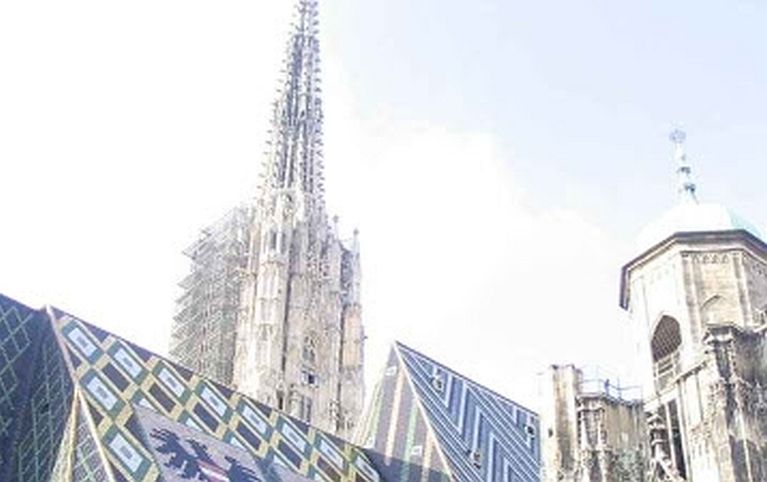
In this borderland between wake and sleep, brain function acts as a distorting-box. The senses shimmer and merge in the phenomenon of synaesthesia. It must have been the climax of interwoven complexities which almost brought me back to waking consciousness. Themes and counterpoint seemed like strands of yarn: woven and knitted into braids and corn-rows which rose into architectural shapes. Imagine the Kremlin domes or cathedral spires constantly renewing themselves, with patterns repeating, replicating, dancing in a way that I could not imagine any human being able to create through musical composition. I’m listening to a replay as I write this: you can get it from the BBC on this link for seven days†, if you are curious. The bits I remember start about half-way through this recording. I can believe it is Mozart’s best work, but in full wakefulness it doesn’t astound me as it did last night, when I saw he was mathematician, engineer, architect, with a throng of helping angels round his head.
* Though I bought it from new it became increasingly unreliable. I’d had an earlier model (340) bought second-hand, which was far worse. Two examples of myths persistent against all evidence.
† The link still gets you to the right page but the replay option has long expired. Try this recording on YouTube instead.
 a wayfarer’s notes
Mozart makes use of the golden section in some of his works.
However the greatest thing about his music (in my opinion) is its rich humanity.
LikeLike
there is no oracle without you my friend………
LikeLike
Oracle? Yes. You are certainly a poet, but even beyond that you weave your posts like an elegant, complex tapestry, with interconnected strands that all fit together in a mosaic of such beauty.
I have found that the twilight time between sleep and wakefulness does lend itself to perception and interpretation that might not otherwise be the case in more wakeful times.
Thank you for your words and your inspiration. Lovely, as always.
LikeLike
thanks, in fact it was Mozart's weaving of threads together which inspired the entire post. Various elements existed in scrappy form before that, and they fitted themselves into place.
A further miracle—apologies to purists for my liberal use of this word—lay in the fact that Mozart's C Minor Mass lay unfinished at the time of his death and for this reason is often short in performance. But Robert Levin has knitted together the various extant detached fragments into the main body, with certain inputs of his own, which experts claim to be able to distinguish from Mozart, and that magnified my sense of a mosaic.
From another point of view, all art is a conjuring trick performed on our sensibilities, but “magic” sounds better, even if it is the same thing.
LikeLike
What beautiful images! You have created a new cathedral spun of words in which Mozart's divine music can soar to new heights.
Mind you, you gave us another vision of all those abandoned bits and pieces of cars, masses of oil and such, but that must wield its own enchantmnt for those who are capable of taming machines.
LikeLike
this one started from a car, than came to bbc, dig deep into mozart and then imagery. but tell me, why i feel those were the limbs of a body. a human body that's this post. great and angelic (with circles above the head and wings). i feel the same listening to ustad amzad ali khan's sarod or ravi shankar's sitar.
LikeLike
[…] Mozart and Angels […]
LikeLike