
Many people supposedly educated don’t understand that the meaning of a word is in its use. Dictionary compilers know this of course, for their task consists in collecting usage as lepidopterists collect butterflies, pinning them to a board and labelling them. Dictionary compilers follow, not lead.
So, as Alice learned, we are free to use words any way we want:
‘. . . and that shows that there are three hundred and sixty-four days when you might get un-birthday presents –’
‘Certainly,’ said Alice.
‘And only one for birthday presents, you know. There’s glory for you!’
‘I don’t know what you mean by “glory”,’ Alice said.
Humpty Dumpty smiled contemptuously. ‘Of course you don’t — till I tell you. I meant “there’s a nice knock-down argument for you!”‘
‘But “glory” doesn’t mean “a nice knock-down argument”,’ Alice objected.
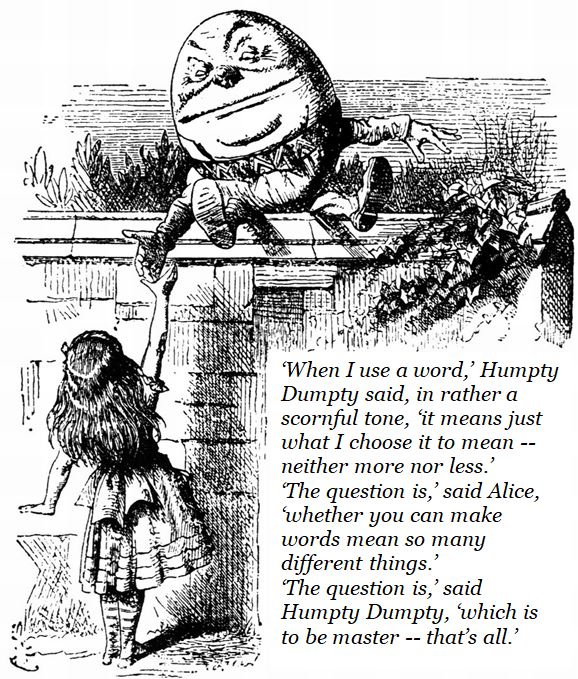
‘When I use a word,’ Humpty Dumpty said, in rather a scornful tone, ‘it means just what I choose it to mean — neither more nor less.’
‘The question is,’ said Alice, ‘whether you can make words mean so many different things.’
‘The question is,’ said Humpty Dumpty, ‘which is to be master — that’s all.’
Alice was too much puzzled to say anything; so after a minute Humpty Dumpty began again. ‘They’ve a temper, some of them — particularly verbs: they’re the proudest — adjectives you can do anything with, but not verbs — however, I can manage the whole lot of them! Impenetrability! That’s what I say!’
‘Would you tell me please,’ said Alice, ‘what that means?’
‘Now you talk like a reasonable child,’ said Humpty Dumpty, looking very much pleased. ‘I meant by “impenetrability” that we’ve had enough of that subject, and it would be just as well if you’d mention what you mean to do next, as I suppose you don’t mean to stop here all the rest of your life.’
‘That’s a great deal to make one word mean,’ Alice said in a thoughtful tone.
But can we afford to use words just as we want? We must have a care to what they evoke in the listener, what place they touch. When I studied Carl Rogers’ Person-Centred psychotherapy, I learned about “unconditional positive regard”. Too many syllables, I thought, and translated it as “love” for my own internal use. Had Rogers called it “love” in the first place, someone somewhere would have translated the word as “sexual predation”.
What is the secret life of the word “ecology”, within your understanding? For me, it has meant “recognising the interdependence of all things”. But now I see it also as “co-existence” and “balance” and “having no enemies, only friends”.
Postscript, twelve years later:
These words were jotted in the simple bubble of euphoria I experienced back then. The joy has not dimmed but I’ve absorbed a broader view, both in reading and living. For example, in Annie Dillard’s Pilgrim at Tinker Creek, I’ve had to acknowledge nature’s capability for cruelty & ugliness.
In Alfred North Whitehead’s Process & Reality, I’m coming face to face with “the order of nature”, as he sets it forth. All living creatures are interdependent. A living society requires food, which consists of other organic entities, themselves organized into “societies”. To eat is to destroy those (usually) simpler societies (of cells, DNA, parasitical bacteria, etc.) As he says plainly,
whether or no it be for the general good, life is robbery. It is at this point that with life morals become acute. The robber requires justification.
He then goes on to speak of God’s purpose, in a line of thought which has come to be known as Process Theology, and whose principal torchbearer has been John B Cobb. One day I hope to present these ideas in an introductory way, as they bring together many of my scattered intuitions into a coherent metaphysics. Indeed I’ve never bothered with the notion of metaphysics till I learned of Whitehead’s. He never bothered with metaphysics himself, until he came to realize that mainstream scientists, who also claimed its irrelevance, carried within them an unquestioned set of assumptions which coloured their picture of facts, reality and the scope of the sciences.
 a wayfarer’s notes
Hullo! Another great post! And timely reminder of the treasures of that wondrous tale (of Alice)!
Best
rama
LikeLike