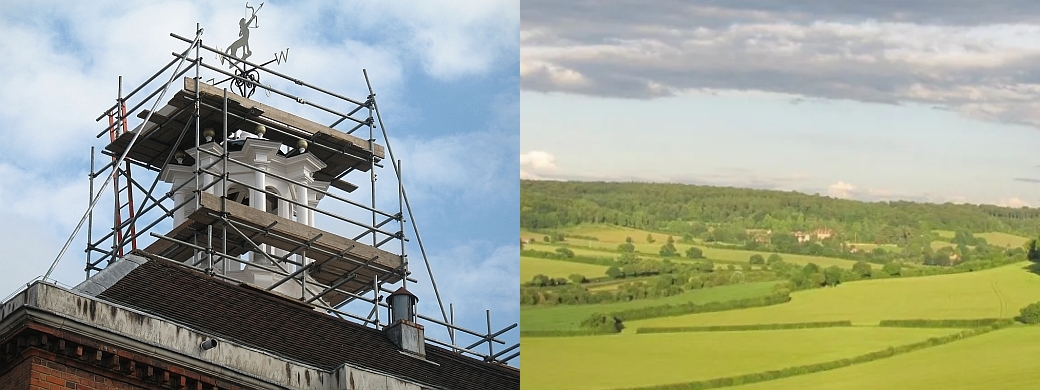

 Karleen succumbed to a flu-like virus yesterday and stayed off work. As her resident physician I prescribed aspirin, white rum, limes and honey. Later, as a booster to these medications, I went to get chocolate. Walking by the scenic route to the supermarket — over the hill instead of round it — I took a path where brambles were weighed down with fruit. I’d been waiting for their ripening and here they were waiting for me! Buying chocolate was a shameful betrayal in the circumstances.
Later, I went to gather some of these humble fruit; “humble” to distinguish them from the pretentious smartphone of the same name. There were plenty of passers-by, but only one man stopped to pick, popping them straight in his mouth. I recall reading about the excited pilgrimages people made in the Twenties to pick beech-mast, a meagre nut that as a child I never managed to find before the squirrels had eaten them.
In the supermarket, there had been signs offering “blackberries” but they were blueberries, imported from elsewhere: a sad indication that people cannot recognise their own wild fruit any more.
How has this happened? The word “peasant” has become a term of abuse, but I aspire to nothing higher. Perhaps it has always been a stigma to pick wild berries, a shameful sign of poverty, though I was taught to pick them by my upper-class grandmother. For she had gone through two world wars.
Noisy polluting trucks passed nearby as I picked, perhaps bringing imported fruit to the supermarket. We’re content to let others plant and harvest our necessities, whilst we trade abstractions and suffer obesity and depression. We are pathetically enslaved to our supermarkets, which push down prices on our behalf to enslave those we have never seen. Then our charitable organisations send aid to the countries we have robbed.
In my adopted land, England, there was much poverty in the later eighteenth century. Those who stole to eat were transported to my birthplace, Australia. The rest flocked to dark Satanic mills to staff the Industrial Revolution. At the start of the twentieth century, Taylorism completed the project of depriving the working man of pride in his skills and handiwork.
If you organised them into gangs and paid them, people would certainly pick blackberries. If you produced television documentaries to tell them what’s in front of their own eyes, they might open them and see. But I’m in danger of distinguishing myself from “people”, and getting sad about humanity. I’ll go and make some blackberry jam.
Later:
My jam-making has been indirectly sabotaged by international terrorism.
News broke of the attempt to blow up planes flying from London to America, and my town was mentioned as one of three places where the suspects have been arrested. They’ve closed off part of a road near my son’s former school. Who knows, I may have exchanged looks with a perpetrator in the street, without knowing it. The TV news was absorbing for once. Since this is not Lebanon, I don’t suppose the town will be bombed for giving succour to terrorists.
From the Guardian: According to the BBC, the find was made by officers searching King’s Wood in High Wycombe, Buckinghamshire. A police source told the BBC that the suitcase contained “everything you would need to make an improvised device
Till now, the news has had little impact on my life. Except that in watching it on TV, I forgot the blackberries boiling on the stove. They’ve turned into toffee and stuck to the pan.
18th August:
The trouble caused by these terrorist plots goes on and on. While hand-cream is still used in this household without triggering major incident*, something nasty nearly happened to me this morning.
I was returning from the petrol station with a copy of the local paper. I learned that suspects have been arrested in every street where I once considered renting a flat, but not the street where I live now.
Without waiting to get home, I opened the paper and read as I walked. Fascinating! Mounted police (on horseback!) were patrolling King’s Wood, where parts had been cordoned off to dig for explosives. I remembered the suspicions I’d had once, recounted in “A grave mystery unearthed”.
All of a sudden, a hand grabbed my sleeve, accompanied by a loud cry. An earnest grey-haired lady was at my side. She’d been walking behind me, but speeded up when she saw that I was about to step in a pool of vomit.
I thanked her for this prompt rescue. It was nearly the second time I’d been hit: first the ruined jam, now this. I cannot say this was a win for the terrorist strategy: they’d intended to sow fear in our hearts, but for me it was curiosity. “Curiosity killed the cat”, as my Granny used to day. With this in mind, I thanked the lady and quipped “It’s all because of the terrorists, they put such chaos in our lives.”
This went over her head, perhaps because she was Polish with poor command of English. “Terrorists? Terrorists!” She rolled her eyes and pointed a finger to her temple, international sign for “bees in their bonnet”: “It’s money! All money!” Neither of us knew what the other meant.
*The discovered bomb plot, linked to our town, involved smuggling explosive liquids on to airlines. As a precaution, international passengers were no longer allowed to take on board bottles and jars of cosmetics.
That was a great Carline Thistle photo, and I was glad to learn about Taylorism too. Thanks for your comment. How do you rate the jam? I usually only make a blackberry & apple pie.
Thanks, Michael. As I wrote in later post, the jam was ruined by international terrorism. That's a poor excuse, actually, for if it wasn't one distraction it would have been another.
Alas, ruined jam is a minor tragedy in itself. I have no trouble connecting it with terrorism – the emotional distance people travel from their food prepares one to emotionally distance oneself from humanity that is distant.
I love the simple rituals of cooking; although these days I don’t garden, I still think of Saturday morning at the Farmers Market as a high point of my week. Quiet conversation about crops and weather, families and animals is as rich a part of the ritual as is the buying of wholesome food.
I am glad she got to you in time, ugh. Sorry about the jam thing.Just goes to show something behind you working in your choice of streets to live on. You would have been okay anyway, I believe.Thanks Vincent
Yes, I would have been OK anyway. What I have been trying to convey is that media hype is not the same as life on the ground. Even the local media and local member of parliament here have been stirring things up unintentionally. They have their own agendas of course, the one to sell newspapers etc and the other to justify his existence and his party’s point of view.
What I see is that there are forces in the world so powerful that they infiltrate into stable local communities to a certain extent, so that in this peaceful town there are some young men who don’t want peace at all, they want to fight, so they look for some perceived injustice and then they get seduced by what we used to call the “recruiting sergeants” into joining up.
I see that it is not enough to be a peaceful community. Young men want more than peace. They want a cause to dedicate their life to. As wise old men we need to ensure that we don’t set them up with the excuse of any government-sponsored injustices. Mistakes like failing to feed the Irish peasants during the Potato Famine, or more recently, invading Iraq, keep on feeding the young men’s rage for centuries. There are more controversial examples but I will leave them to the imagination. Then there are the cunning old men who exploit these feuds for their own devious ends.
That is the way I see it: not evil but something natural which needs to be dealt with wisely and dispassionately.
It has been that way for a long time Vincent, a long time, the young and the old, the causes and the lack of peace, maybe out of all this more and better peace will come. I think so, for everyone.
We have different views in details, we have to deal with those, each in our own peaceful ways, being as effective as we can for our point of view, always realizing the other side as much as possible, the main thing is maintaining the environment for that, a peaceful place to change things that need changing.
Thanks Vincent.