
I glory in my sure-footedness, and the comfort of a buttoned cardigan†, on a chilly August day, walking through a stubble-field in a slow insistent drizzle. My path takes me behind a row of sturdy houses. Their backyards look untidy from the rear, with canvas chairs left outside to get wet, children’s toys left strewn for another day.
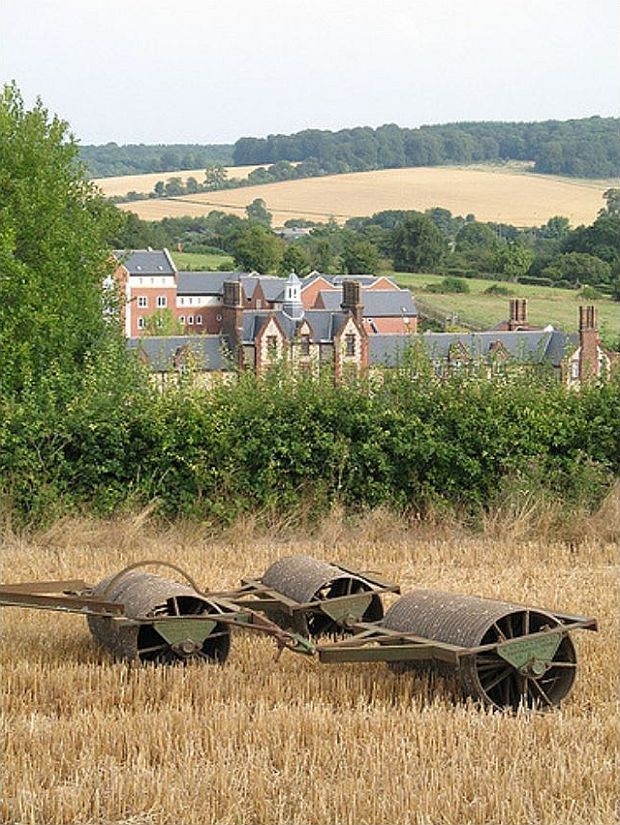
Fresh-cut stubble is more golden than the dull ochre of uncut barley. It gleams metallic, even on a damp overcast day. O, my legs feel so sturdy! I am in my prime, without any dog as companion, just this tape recorder, to share immediate impressions. In stubble I need no longer keep to the footpath but can wander unimpeded, so I go to the top of the ridge for a long-range view on all sides. For this privilege I willingly endure the sharp wind. Amongst other detritus, I find here an unopened bag of potato crisps. I open and eat. Is it angel-sent, Manna from heaven? Ugh! I think not, but I finish it anyway, so that I can screw up the empty bag and put in my pocket, rather than drop litter in a sacred place, though it was already litter when I found it. How lucky I am to have the benefit of home-cooked food each day, that makes such factory-fare seem as ashes in my mouth.
From the ridge, I gaze down on roof-tops and survey the world of work. Over there is a hospital car park, whose attendant, in a yellow high-vis vest, checks the authorisations of each arrival. Ah yes, but as a pedestrian, I could go there without being stopped! I shall “wander, lonely as a cloud”, not through daffodils but through concrete mazes of the built world. O glory! O wonder! This is so great. I am cleansed by this wind. This is my home. Here my spirit expands. What more could one ask? Glory! All the sweeter because an ailment prevented me for years from walking thus, except in imagination. Anxiety that I would run out of energy, and be stranded on a hill such as this, would even pervade my dreams. And before that, in the athletic days of youth? Ailments of the mind were effective shackles that kept me enslaved.
Now is the time of glory. Now is the time of thanking God, even a God that I invent, in order to have someone to thank. Now I go down Whielden Street, under the Cornes Bridge where the bypass goes overhead. Dried guano is crunchy underfoot, output of families of pigeons who roost here. Turn left and I’m at the Hospital, passing first the Haleacre Unit, where brisk nurses guard the insane. I look down a slope to their exercise yard, protected by a high wire fence, like a POW camp. A man stands, reading his newspaper and smoking. Two other patients are engaged in deep conversation. I certainly look madder than they, my cardigan bedewed in drizzle, and a floppy canvas hat low over my eyes.
I reach the car park attendant and greet him politely in passing. He’s startled as if caught out, but stammers a reply: “Good morning, Sir.” It’s the senior staff car park, where pecking order rules. Medicine, like the armed forces and most organizations, maintains hierarchies of decision & privilege. Perhaps he thinks I am an off-duty Professor of Psychiatry whose face he has unaccountably forgotten, poor man.
I stride towards the interesting building I’d spotted from the hill. Its plate says “Day Nursery”. I discover that it’s a dead-end, even for pedestrians. A couple of women eye me suspiciously, as if I were an ogre seeking infant flesh for breakfast. Now I have sunk to the lowest level. Here I may be reviled, with a look of virtuous contempt. I gaze back at the golden hill of barley stubble, where I stood just a few minutes before.
Which is better? To gaze from the heights, letting our visionary eye replace the detail we can’t see? Or to journey like a pilgrim to the actual spot, watch the fabled landscape harden into mundane detail? I’ve seen both, I don’t know.
* The building in front was originally the Workhouse built in 1838 following an amendment to the Poor Law, & designed by Sir George Gilbert Scott.
It was still a workhouse in 1930, when it was converted to a hospital. More recently it has been reconverted to flats.
† Cardigan: I bought it in 1991 at a pavement stall near the Vatican. It went ragged at the elbows and is slowly disintegrating around the leather patches I sewed on at some point. I don’t display it outdoors any more except in the front or backyard. I’ve given up trying to find a replacement with those loose sleeves & sloppy fit.
PS thrown away in 2018, after falling apart.
 a wayfarer’s notes
“From the ridge, I gaze down on roof-tops and survey the world of work. Over there is a car park, whose attendant, in a yellow high-vis vest, checks the authorisations of each arrival. Ah yes, but as a pedestrian, I can go there, without being stopped! I shall “wander, lonely as a cloud”, not through daffodils but through the constructed world. O glory! O wonder! This is so great. I am cleansed by this wind. This is my home. Here my spirit expands. What more could one possibly ask? The glory of it!” Thank you. I was reminded of AE (George William Russell)'s “The Candle of Vision”. Also, something the Scottish biologist and town planner (1854-1932) wrote:
“The child in sunshine sees the violet shadows upon the dusty road just as the impressionist paints them : it is only the mis-educated grown up, who has been trained from old pictures, or perhaps still more from printed descriptions of them, who persuades himself that the same shadow is brown. To escape from common literary epithets and to be encouraged to observe how often earth is purple, grass gold, and the sea all possible colours is a training which most of the older generation have missed and which the younger are not by any means sufficiently receiving.”
Thanks for your ear / eyeball! Best, rama
LikeLike
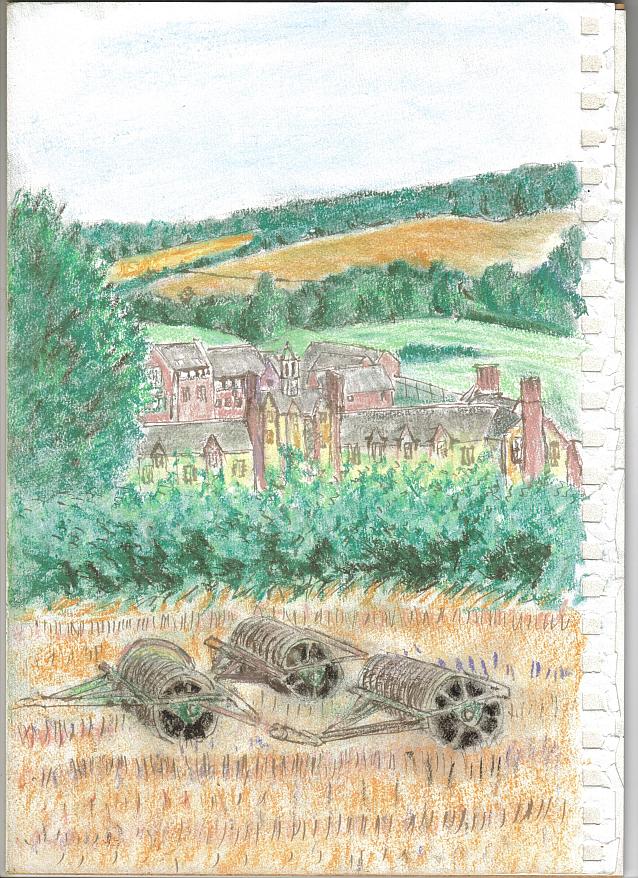
And your quote reminds me of how I should avoid, in my sketches, using photographs as reference. We know that a photo is nothing like our direct vision of reality, but in lazy and unthinking homage to technology, we act as if a photo is a faithful copy.
In myriad ways we cheat ourselves of experience!
LikeLike
You are extremely fortunate – and fortunate enough to know it.
LikeLike
oh, god how i miss england.
thank you for your descriptions.
of course shadows are purple, brown, grey, blackest black and even blue.
when you decide.
LikeLike
Beautiful!
LikeLike
Thanks for the comments which inspire one to keep at it!
LikeLike
[…] earlier years . . . ” Perhaps I would start with a piece from the 6th of August, 2006, called “Outsider”. It’s the archetype of various pieces I’ve written on the topic of wayfaring: wandering […]
LikeLike
[…] “Over there is a car park, whose attendant, in a yellow reflective vest, checks the authorisations of each arrival. […]
LikeLike