
 On a warm but overcast day, we went up Lodge Hill. With my box of pastels and a sketch pad, I felt like Vincent van Gogh going out to do a day’s work. Before I knew its real name, we (kids and I) used to call it Butterfly Hill, because in August particularly it was full of lepidoptera. The Chilterns are a range of chalk hills, but Lodge Hill is different, a carbuncle on the general flow of the undulations. Don’t think of a tall windswept place, but a miniature nature reserve. Its trees and shrubs give it shelter without destroying the views which stretch off to the Vale of Aylesbury in the misty distance. Such vistas you never see in Wye Vale: here, when you stand on a hillside, you see across to the rest of the town on all the other hillsides. It’s a community poured into a series of valleys. Are we therefore “inward-looking”?
We found a spot in a little meadow spongy with mosses, bumpy with tussocks of ancient rabbit-warrens, enclosed with thorn-bushes. The butterflies were pursuing one another romantically, sometimes at risk of inter-species relations. Do they dare, or is it taboo? The wildflowers were exquisite and often tiny. They put me in mind of some alpine meadow, which I’ve never seen in real life. There was wild thyme in flower, some mint that smells like lavender when crushed, yellow loose-strife, viper’s bugloss, stonecrop, ragwort and many I’ve never seen before. Elders and brambles were in flower, promising rich black fruit with purple juice later; and sloes swelling green like olives. Later they’ll turn glossy black under an indigo bloom.

It must take a lifetime of study to know the flora and fauna by name and family, and all the details of how they propagate and why they are the way they are. Most of what I know is from Mr Warriner, a master at prep school who took us on country walks and taught us names of plants which have pretty much stayed with me since.
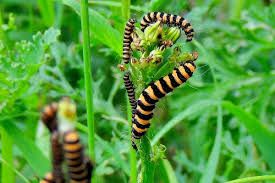
We sprawled on a rug, K with her crossword, till she lay down and snoozed, whilst I wondered what if anything I could capture with my box of cheap colours. I stuck to the first thing I had noticed: a striped caterpillar which appeared to be reclining lazily on ragwort. Closer examination showed that it was munching furiously on bud after bud. I was able to draw the caterpillar easily enough but ragwort is not easy with chunky crayons. The cinnabar caterpillar is striped like this, it seems, to warn predators that it is full of the ragwort poison, which is so strong that they have to make sure there is no ragwort in a field where animals graze.
 The colourful wall records some initiative years ago to express a no-drugs message with professional graffiti—text and panorama—sponsored by local companies. Other messages have long been superimposed.
But then, “official” graffiti are on the increase in Wye Vale (my code name for this town). The University puts out cool messages in this form. And even at the Hospital, near where K works, they have screwed some large graffiti-like paintings (prepared elsewhere) to certain drab outside walls. Why, we cannot imagine,
Are we culturally advanced or retarded? I can’t decide.
 a wayfarer’s notes
okay! looking forward to reading that. I'm catching up in all my blog readings.
when you have time i would love to know what that big white ball is in your photo blog? i can only guess but im not sure? just curious.
LikeLike
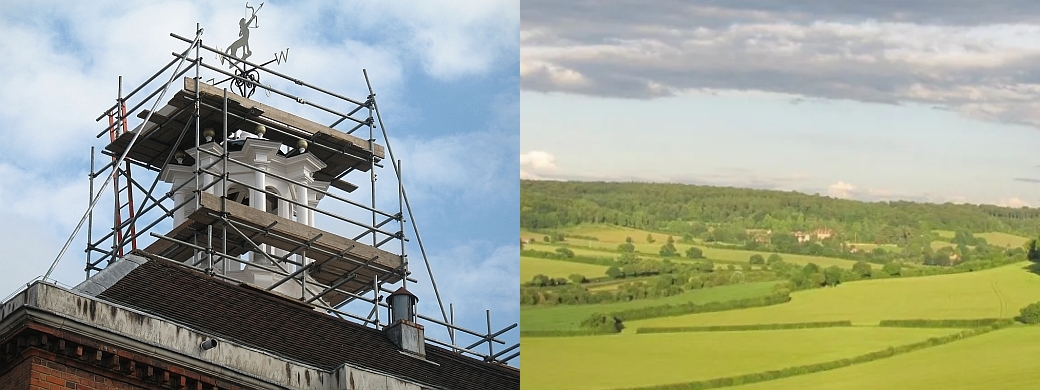
It is the famous “Golden Ball” which sits on top of St Lawrence's Church in West Wycombe. In the hill on which the church stands, you will find the Hell Fire Caves in which Sir Francis Dashwood, his guests and sometimes some company hired from a brothel would pass a merry hour. One of the visitors to this club, legend has it, was Benjamin Franklin. The Golden Ball glints gold in the sunshine. Perhaps it is covered in gold leaf, but I have made it pale in the picture. We can see it in the distance from our flat. I have never been up the tower but they say that the Ball is big enough for four people to sit around a dining table. So perhaps Sir Francis entertained Benjamin there too. Erica Jong, famous for her novel, Fear of Flying, has also written a feminist novel entirely in eighteenth century English, in which Fanny Hill, the main character in well-known old erotic novel, tells her own hilarious story, which includes being hired to dress as a nun for the above-mentioned festivities.
LikeLike
WOW, that is a good story you just told kathy, Vincent, that could be a post itself.
LikeLike
*sigh* TEASE!
LikeLike
my comment just disappeared. I'll try again. I never heard of The Golden Ball! interesting info, so much i don't know, and thank you for that.
love your caterpillar, sounds like you had a lovely time.
LikeLike
I think that ragwort is the plant that spread from the Botanic Gardens in Oxford along the railway lines to many other places.
I may be wrong but I think that is the one.
Sounds like you had a nice day.
(Incidentally I was impressed with David Cameron -I think he will be a major voice for many years to come.)
LikeLike
“Oxford Ragwort escaped from the Oxford Botanic Garden in 1794 and has been spreading outwards ever since. A yellow daisy-like flower similar to other Ragworts, but first appearing much earlier in the year than all the rest.” Ah, but it may not have been the Oxford variety. Oxford has no monopoly on bright yet poisonous plants and I am not referring to David Cameron, who I am sure is a sweetie as you imply.
LikeLike
marvelous picture, and a description worth waiting for! thank you!!
LikeLike
You make me envious Vincent, so much knowledge and, to boot, a box of colors, energy, and time to go outside with it all. Oh but for the fates…, well, I hope you had a great time, you can do some more sketching and coloring, you'll get more and more proficient, figuring out what it is you want to make the media do, then you'll be having some serious fun.Great picture, great descriptions, thanks much.
LikeLike