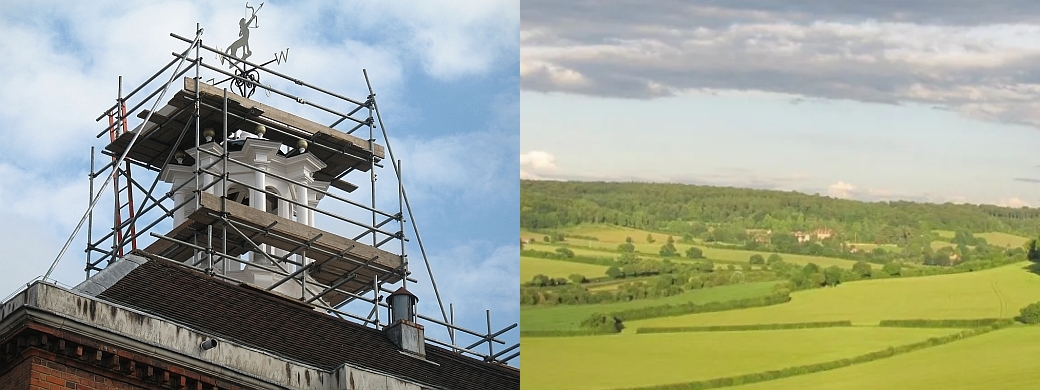

This was written on September 1st, 2006. My beloved was working in Amersham Old Town. Being unemployed, I would to drive her there and take advantage of any suitable weather to tramp around the countryside. To be so entwined with Nature was an uplifting experience. I felt at one with the creatures I encountered and… Continue reading I am an animal
Category: history
The Story of Tools
I got this little volume of 44 pages from a book sale in West Wycombe Village Hall, many years ago. It's plain to see that it was specifically designed to help educate members of the Young Communist League appreciate the advantages of collectivism—as against the deadly enemy, Capitalism. Good for them, I say. This may… Continue reading The Story of Tools
A Feather on the Breath of God
I like opening extraordinary and special books at random, such as The Book of Disquiet (Pessoa), Centuries (Traherne) and Anam Ċara (O'Donohue). This is what came up when I did the same with our current book. It's the section titled CAUSES AND CURES, pp 108-11. The four elements That there are only four elements: There… Continue reading A Feather on the Breath of God
Pilgrimage to St Cuthbert’s . . .
. . . Spiritual Homes, December 2024 I had been quite apprehensive about this trip as I was worried about my own personal excitability and spontaneous way of being — a concern/question as to how I could both be myself as well as act in an appropriate way in respect of my fellow pilgrim travellers,… Continue reading Pilgrimage to St Cuthbert’s . . .
Greenhayes Across the Years
Mark at 13; a language student. my half-sister Mary at 7 — Is it legal to take stones from the massive deposits lying around the mountains? If it is illegal then who should I contact to collect said stones? — No, it would technically be theft—you'd need to ask the landowner for permission Originally Snowdon… Continue reading Greenhayes Across the Years
Happy Birthday Mary
Some pictures of Hastings that you and I will recognize from childhood. Much has changed since, I'm sure. Welcome to Memory Lane! . . .and there's a cave, long abandoned but didn't smell nice when I looked in as a child
Touched by the Printed Word
First published on Feb. 25th, 2009 I learned to read at my grandmother’s knee, at four years old. We used a Victorian primer, Reading without Tears: it proved itself worthy of the name and I worked through it in a few days, mostly on my own. I remember being frustrated with the word “parlour” near… Continue reading Touched by the Printed Word
A Brief History of Politics?
inspired by a new blog: A Platform for Politics and Culture Speech evolved from homo erectus's point and grunt for catching game in a team. It's presented as a series of steps explained in a talk by Wittgenstein, transcribed in The Brown Book, appended here. Thus creatures and things could be given names. Then speech… Continue reading A Brief History of Politics?
Thomas Traherne: his outlook on life
An essay by Frances Towers in 1920, a few years after the first publication of manuscripts by Thomas Traherne from the 17th century. BETWEEN the covers of the Centuries of Meditation lies a spiritual kingdom. It has a close affinity with certain other kingdoms of the spirit, and the wanderer who crosses that threshold is conscious of… Continue reading Thomas Traherne: his outlook on life
The Coffee House: a brief history . . .
. . . from De Quincey to Starbucks Coleridge had published Kubla Khan in 1816. The first English translations of the Arabian Nights in the early 18th century had provided an aura of magic and violent intrigue. And The Travels of Marco Polo had been widely available since the Middle Ages. As a result, the… Continue reading The Coffee House: a brief history . . .
Remembrance
We just got back from the Remembrance Day Parade in town. There was a biting wind. In previous years we've attended the church service, but today it was enough to watch the march-past, the saluting of and by the senior officers; to see the Mayor, aldermen, bigwigs, old soldiers and uniformed youth. We were dressed… Continue reading Remembrance
While I Can…Because I Can
It’s the second day of March, with a bit of blue sky but a biting damp wind. I walk along Desborough Road to the bus station, destination and agenda undecided. Why? Because I can. Whatever I can now do, one day I won’t be able to. No one knows the day, or the hour. Thanks,… Continue reading While I Can…Because I Can
The Gordian Knot
The sword is not just a symbol of killing. In the days before stainless steel, a sharp bright sword was a symbol of value and power. Famous or magical swords had names. Excalibur is raised out of the Lake by the Lady who dwells therein so that it may pass directly to its intended holder… Continue reading The Gordian Knot
At the Moot spot
moot, adj.:Originally in Law, of a case, issue, etc.: proposed for discussion at a moot. Later also gen.: open to argument, debatable; uncertain, doubtful; unable to be firmly resolved. (OED) It’s a long time since I went wayfaring, so long that I became a malade imaginaire and my soul went into hibernation. The vicious circle… Continue reading At the Moot spot
The Call to Service
updates to this post pending, e.g. correction of links - Oct 7th, '25 (being the third of a trilogy on “Religion and Violence”, a theme covered in Karen Armstrong’s latest book, Fields of Blood) Background What I learned about religion in childhood came almost entirely from school. The single exception was a phase when my… Continue reading The Call to Service
“They hold life cheap”
The subtitle of Karen Armstrong’s latest book Fields of Blood is “Religion and the History of Violence”. At the end of my last I said she was arguing the wrong case, and promised to write a follow-up post nominating the right case. This is the best I can do. As to whether religion is involved,… Continue reading “They hold life cheap”
How I came to inhabit this body
Most days, I walk down the Desborough Road, to observe in passing the extraordinary variety of human life-forms on display. Suddenly the “brotherhood of all mankind” comes into my head. As usual, I’m glad to be me, thankful indeed. But then I reflect that my birth was no more of my choosing than theirs was… Continue reading How I came to inhabit this body
Wayfaring Again
This is the day I become clear about the purpose of my purposeless journey. Now the task is to express clearly what I see clearly. My path leads more to the past than the future, for “the past is my treasure” as an archaeologist might say. I heard the scraping shovel from behind a hoarding… Continue reading Wayfaring Again
The Abyss
Scattered amongst these pages is a series of sketches which, extracted and sorted in chronological order, constitute a personal memoir; more of a collage than a coherent portrait. But I’ve never yet managed to cover the era between the ages of sixteen and sixty-four. Until this moment of writing—in which dawn has not yet broken,… Continue reading The Abyss
Scraps for a Future History of Now
I had intended to take my well-trodden valley path, a fruitful place for broodings which I’ve several times captured and preserved in essays on this site. But a different plan revealed itself as I progressed. The first leg was walking with Karleen to her work at the hospital, about a mile away. After we said… Continue reading Scraps for a Future History of Now
What the Alpine Club had to say
REVIEWS AND NOTICES. Dolomite Strongholds. B y the Rev. J. Sanger Davies. Illustrated. (London : Bell and Sons. 1894.) WE are informed on the title page of this book that it contains an account of ascents of the last untrodden Alpine peaks—namely, the Creda da Lago, the Little and Great Zinnen, the Cinque Torri, the… Continue reading What the Alpine Club had to say
Then and Now
Days pass. Not much wayfaring and not much writing. The two are connected. I had promised to dedicate a post to Lady in Red, who writes “I love it when you describe the places you walk through, bringing it alive for those of us who can only imagine both the countryside and the industrial areas… Continue reading Then and Now
Diogenes and Alexander
For Scot & Ghetufool A dear friend asks some questions in comments on my previous post. I numbered them for convenience, intending to answer them one by one. (So much for intentions.) (1) Do you think this kind of serenity is possible in daily life? or (2) that I have to be retired like you… Continue reading Diogenes and Alexander
News of the fight soon reached the Queen
"One day in 1852, young Freddie Attrill was gathering shell-fish on Osborne beach when another boy came along, told him to clear off and kicked his bucket flying. Indignant, Freddie gave him a thump—only to be told by shocked attendants that he had just hit Albert Edward, Queen Victoria’s eldest son and heir to the… Continue reading News of the fight soon reached the Queen
Fog on the Solent (Norfolk House 5)
The Solent may have been the busiest sea-lane in the world and the most varied in its traffic. There were ferries between the mainland and our Island; the Royal Navy base at Portsmouth; the transatlantic liner port at Southampton; the Sawley Oil Refinery where tankers plied from the Gulf; and innumerable sailing craft. The Royal… Continue reading Fog on the Solent (Norfolk House 5)
Bible-reading martyrs
In the Middle Ages (I used to study Medieval History, so I know) the religious and secular realms---Church and State---would either be at war with one another or in some kind of alliance, as in “The Holy Roman Empire”, which was neither holy nor Roman. In matters secular, foreign policy and internal laws were backed… Continue reading Bible-reading martyrs
Young, heroic and lethal
Almost everyone is baffled by the strangeness of the world today. Not children, of course. They take as they find for adaptation is what they do. On the way to adulthood we choose either to swim with the tide, taking advantage of the way things are, or finding some token way to set ourselves against… Continue reading Young, heroic and lethal
Back streets, oily hands
There is a conversation going on here and here, perhaps everywhere, about goodness. I’m aware that the discourse in the US is frequently about good and evil. Bush refers to evil terrorists not just as individuals but as an Axis of Evil. Meanwhile, America is considered evil, as Irish humorist Dylan Moran puts it, by “the… Continue reading Back streets, oily hands
 a wayfarer’s notes